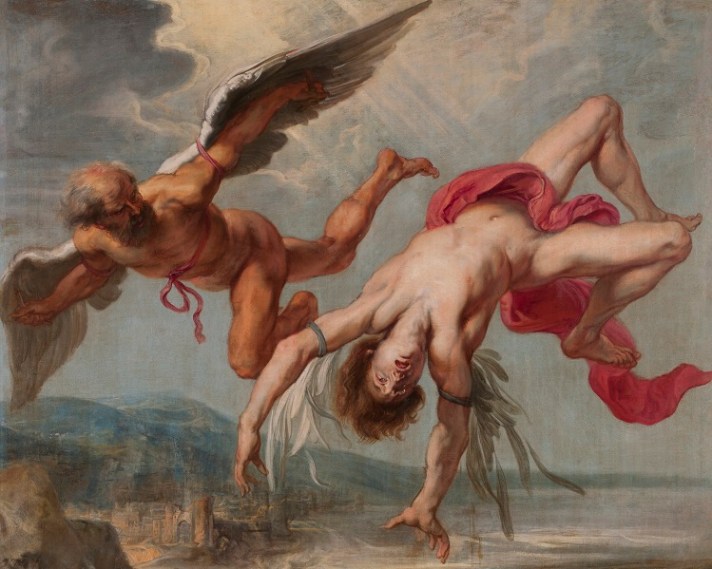
Icarus flew too close to the sun, the wax holding his artificial wings together melted, and he fell to his doom. The boy’s father, Daedalus, warned against flying either too low or too high, for the wetness of the seawater and the heat of the sun would undermine the integrity of the artificial wings. Nevertheless, Icarus full of hubris defied the instructions, went his own way, and fell to his own destruction.
The Icarus myth quite often gets replayed in real life as hubristic men cast off all restraints and become a law unto themselves. Sometime ago Hank Hanegraaff read a chilling quote from Algeny by economic and social theorist Jeremy Rifkin:
We no longer feel ourselves to be guests in someone else’s home and therefore obliged to make our behavior conform with a set of pre-existing cosmic rules. It is our creation now. We make the rules. We establish the parameters of reality. We create the world, and because we do, we no longer feel beholden to outside forces. We no longer have to justify our behavior, for we are now the architects of the universe. We are responsible to nothing outside ourselves, for we are the kingdom, the power, and the glory for ever and ever.1
Rifkin back in the early 1980s was forewarning of the challenging implications of the emerging age of biotechnology and how it will shape the way humans perceive life and the meaning of life. Christianity needs well informed ethicists to grapple well with the way the essential doctrine of humanity bearing the imago Dei informs bioengineering questions on what can be done and whether or not it should be done For further related reading, see “On Chimeras and What It Means to Be Human” by Jay Watts.
Beyond the mystifying subject of bioengineering, life eastward of Eden has a way of bringing out the hubris in us all. We want to pretend that God is out of the picture, the world is ours to have and mode according to our whims. We can even deny our own biology and humanity. We tout a misguided sense of freedom in declaring, “I can do whatever I want to do without any restraint.” Sure, we might add the qualifier, “So, long as nobody gets hurt.” Even so, it never takes long to find examples of the way some can rationalize feticide, gendercide, infanticide, slavery, licentiousness, self-mutilation, sodomy, classism, eugenics and the likes as something they need to be able to do in order to be “free.”
Hubris may very well lead to a loss sense of being human and self-destruction.
I can remember back in the day reading My Heart God’s Home, which is a short allegory some guy let Jesus into his home (i.e. life). The main character had to rearrange all the rooms in his house to accommodate his guest, i.e. the library, the dining room, the living room, the workroom, the rec room, and the hall closet. Here the rooms represent different aspects of one’s life: doctrine (library), appetite for temporal or heavenly things (dining room), communion with the Lord (living room), ministry and vocation (workroom), satisfaction in life (rec room), and hidden sins (hall closet). The guy eventually hands over the deed to Jesus.
I always appreciated the story, and found it very helpful, but never in a day should that allegory be taken in the most wooden literalistic way. Hubris can even make some suppose Jesus is on the outside trying to invade their universe and occupy their territory. But, David rightly declared: “The earth is the Lord’s, and all it contains, | The world, and those who dwell in it” (Psa. 24:1).
In God’s Crime Scene: A Cold-Case Detective Examines the Evidence for a Divinely Created, J. Warner Wallace writes,
The Divine Intruder we’ve described as the source for all the cosmological, biological, mental, and moral evidence in the universe is the Creator of our home. It’s His house and He’s still the primary owner and inhabitant. In our limited, self-focused view of reality, we’ve imagined this to be our universe, when in fact, it is His. We are His guest. We are the ones living in the universe God created, resisting the existence of our Creator (and landlord) and viewing Him as the intruder of our lives…
…We are God’s invited guest, and although it is His house, He created it with us in mind.2
Imagine that! We are the one’s God has allowed to stay in His home, even to put our junk into His library, dining room, living room, workroom, rec room, and hall closet, but it is our hubris that makes us think we owned the place or believe this world is better off with Him gone.
God created us as free agents so that we have a relationship with Him based upon love. No person is an automaton preprogramed to do God’s bidding; rather, each person has the capacity to give and receive love. Moreover, God made this universe for us to have a place to commune together. Father, Son, Holy Spirit and us together for eternity. It is our sin which breaks up the relationship. But, it is God who through Jesus Christ initiates the way for the relationship to be restored. The Fall will kill us all, but Christ can raise the dead, reverse the effects of the Fall, and set all things to right.
“Pride goes before destruction, And a haughty spirit before stumbling” (Prov. 16:18).
— WGN
Notes:
- Jeremy Rifkin, Algeny: A New World — A New World (New York: Viking, 1983), 244.
- Warner Wallace, God’s Crime Scene: A Cold-Case Detective Examines the Evidence for a Divinely Created Universe (Colorado Springs, CO: David C. Cook, 2015), 201, 202.

 Love Truth Blog