So to keep me from becoming conceited because of the surpassing greatness of the revelations, a thorn was given me in the flesh, a messenger of Satan to harass me, to keep me from becoming conceited. Three times I pleaded with the Lord about this, that it should leave me. But he said to me, “My grace is sufficient for you, for my power is made perfect in weakness.” Therefore I will boast all the more gladly of my weaknesses, so that the power of Christ may rest upon me. For the sake of Christ, then, I am content with weaknesses, insults, hardships, persecutions, and calamities. For when I am weak, then I am strong (2 Corinthians 12:7-10, ESV).
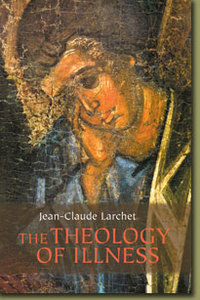
I have of late been reading though The Theology of Illness by Jean-Claude Larchet, which is a most enjoyable read on the subject of sickness, suffering, and death.
 Much of what I come across in the Christian bookstore on illness over promise and underperform. So, I’ll get sort of a faith formula to apply, which practically guarantees perfect health and fitness. I can then live a long and healthy life without any sick days. There are even so-called modern-day apostles and prophets who can make cosmic journeys into heaven, enter into rooms filled with arms, legs, eyes, ears, and other body parts, take a part, and return to earth for healing the sick. So, if somebody has a broken leg, they can simply go to heaven, get a leg from the room, bring it back, and voilà the leg is restored. But, I find these sorts of teachings on sickness and healing never square with the Bible, life, and reality. Don’t believe the hype.
One key element to a robust theology of illness, which Larchet points out, is that prior to the fall Adam and Eve knew nothing of illness. Sickness, suffering, and death was never part of their experience prior to the Fall. The Fall ultimately brings into their experience sickness, suffering, and death. The same evils of sickness, suffering, and death has been a perennial problem for all of Adam and Eve’s progeny.
Larchet observes that “perfect health never exists in absolute form; health is always a matter of partial and temporary equilibrium. We can even say that health in this present age is simply a matter of lesser illness.”1 Somedays are better than others, yet we will definitely experience some sort of malady at some point, and we all have an expiration date.
Who wants to be sick? We all want our bodies to be aesthetically pleasing with optimal functionality. We want health, or the absence of sickness, suffering, and death. Is there any problem with that? Larchet thinks it is possible for heath to be stumbling block or something evil. He writes,
Health is worthless to the human person — it does not constitute a true goodness but is only good in appearance — if it is not used well, that is, if it is not used with an aim toward the Good: to fulfill the commandments of Christ and to glorify God. This is why St Basil declares: “Insofar as it does not render good those who possess it, health cannot be counted among those things that are good by nature.” In fact it is evil if it contributes to making a person indifferent to his salvation, keeps him away from God by giving him the false impression that he is self-sufficient, and bestows on hum that strength of the flesh which actually weaken, rather than giving him that weakness in which God reveals himself, which constitutes true strength (2 Cor 12:9-10). Health is an even greater evil if it is used to give free rein to the passions, thereby becoming an instrument of iniquity (Rom 6:13).2
The body prone to illness serves as a daily reminder that we can never trust in physical strength and beauty to solve problems, neither is perfect health to be the ultimate goal of existence. This never means we cease eating well, sleeping enough, and getting some exercise. On the other hand, if being strong and looking good is the end itself, then something is missing. God created us to be in relationship with Him.
Christianity ultimately yearns for the resurrection to eternal life. When Jesus Christ appears again, the dead shall be raised from the graves. The saints shall be resurrected to eternal life in a new heaven and new hearth and the sinners to eternal condemnation in the lake of fire (John 5:28-29; 1 Cor. 15:1-58; 2 Cor. 5:9-10; Heb. 9:27-28; Rev. 20:11-12; cf. Dan. 12:2). God’s people will be raised imperishable, incorruptible, immortal.
— WGN
- Jean-Claude Larchet, The Theology of Illness (Crestwood, NY: St. Vladimir’s Seminary Press, 2002), 53.
- Ibid. 55-56.

 Love Truth Blog