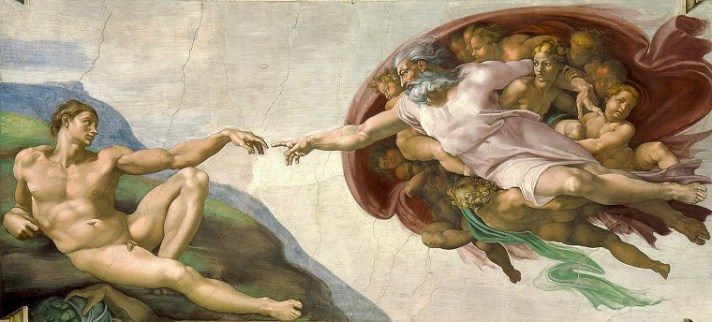
Does God exist? An idea of there being a god has been with me since childhood. When I was a wee lad, I would pray:
Now I lay me down to sleep
I pray the Lord my soul to keep
If I die before I wake
I pray the Lord my soul to take
Namu Amida Butsu
The end portion — Namu Amida Butsu — is a nembutsu (meditation or chant) from the Jodo Shinshu Buddhism sect (a major Buddhist tradition from Japan), albeit I was clueless about any of the dharma from that religious tradition. The beginning portion is a popular Christian children’s prayer that goes back to eighteenth century America. Growing up in a Japanese American home, I guess that was a way of covering the bases for the god taking notice.
I was raised to think that religion whatever form it took was something good and useful, since it would instill positive values in me and make me a better person overall. I even occasionally attended Sunday school at a Baptist church in the neighborhood. Prosperity and good tidings were the stuff associated with a happy god or Buddha. My childhood religious beliefs were neither Buddhist nor Christian in any sense of the two major world religions. If it could be called anything, it would be a moralistic therapeutic religious pluralism. Nevertheless, I have since moved away from that childhood version of god.
Christianity came to me as a teen. I got involved in youth group in the Baptist church that I attended since childhood. I attended Sunday school, Sunday evening fellowships, mid-week gatherings, retreats, concerts, and other church related activities. One experience that grabbed me in those days was the praise music. Whether it was just stripped down to just a singer with an acoustic guitar or a full-on band experience, I experienced moments of God’s presence. The presence of God felt so real it was as if something like the burning bush or Transfiguration were happening right there and then. There was something deeply uplifting about the songs from Maranatha, Vineyard, and even original inventions from within Asian American Christian circles such as the music of Wes Terasaki.
Another experience that played a significant part in my teen faith was responding to the altar call. I recall attending an evangelistic movie night featuring a film entitled A Distant Thunder (a sort of precursor to the ever-popular Left Behind movie), it scared the heebie-jeebies out of me, there was an altar call, I went up, and prayed the “sinner’s prayer” to receive Jesus Christ as Lord and Savior. Soon after, I was baptized.
During my teens and young adult years, I connected with a number of different Christian friends open to talking about the Bible, theology, and the Christian life. A few who attended the Master’s College and Seminary supplied me with a healthy cache of John MacArthur commentaries, study notes, and sermon audios. The Gospel According to Jesus really contributed to the shape of my understanding of what it means for a Christian to follow the Lord over and against “easy-believism” and the value of the verse-by-verse exposition of the Scriptures. Other reads which shaped my faith were The Pursuit of Holiness by Jerry Bridges and The Normal Christian Life by Watchman Nee.
There still came about many winds and waves that made my own earthly sojourn difficult. For me it has always been a struggle to be a Christian in an ever-increasing post-Christian world. Skeptics were there every step of the way to pass on their reasons why I would be better off just dropping Christianity altogether. I was bombarded with questions like:
- How can you rationally believe in an omniscient and omnipotent God in a world where evil persists?
- Do we need to appeal to God to explain the existence of the universe? How can you believe in something immeasurable, without height, width, depth, color, scent, texture, or mass?
- Why even believe in the God of the Bible who goes against His own moral principles in giving marching orders to His people to commit morally reprehensible acts against other people, such as slavery and genocide? Are not even the teachings and practices of Christians bad for your mental and social well-being?
- How do you know the Jesus of Christianity — the fully divine and fully human being that died and rose again on the third day — really existed?
- Are there not myriads of myths about dying and rising gods, so why is the Christian message about Jesus, i.e. the Gospel, something other than another ancient myth?
- What makes Jesus the exclusive way? Will not god accept all people of different ways?
These skeptical objections came up again and again. Those who presented them were very articulate, knowledgeable, and passionate about their views. A number of them I am even naturally inclined to pay the highest honor and respect, like college professors, scientists, and even Bible scholars. The arguments against Christianity are really like a highly corrosive acid that erodes away the substance of faith.
Skeptics did raise doubts and caused me to really question my faith. Did I really buy into a lie? Was I actually brainwashed?
Rather than raising the white flag of surrender upon a canon shot across the bow of the ship, I was spurred on to critically examine the objections to my faith. While many of them appeared to be internally consistent, I found them to be either logically inconsistent, built upon a faulty method of biblical interpretation or even contrary to the best available evidence. I also found there were good reasons to believe.
Why do I still believe? In forthcoming posts, I plan to offer some reasons for my faith.
— WGN

 Love Truth Blog
You aren’t able to banish from your mind your moral and intellectual prejudices i.e. your religious faith.
LikeLike
Reblogged this on Truth2Freedom's Blog.
LikeLike
I’m curious about how you justify your belief. Most Christians make the same claims as other theists who worship other gods. None has evidence so I’m curious why you think your version is true?
LikeLike
I’ll get into that in subsequent posts. For now, keep in mind A and Not-A or two contradictory ideas can never both be true simultaneously. Either one is true and the other false or both false. I am convinced that Christian theism is true against claimed to the contrary.
LikeLike
Which version of Christianity do you claim is true?
LikeLike
I deal with that question here: https://wordpress.com/page/lovetruth1.wordpress.com/442 Belief in God’s existence (i.e. theism) is something that Christians of all stripes can agree. But, if I can be pigeon holed into category, I am an evangelical Christian. I may from time to time blog on something related to evangelicalism, but this and the forthcoming posts on God’s existence will be something Christians of all stripes can stand shoulder-to-shoulder upon.
LikeLike
Ok, thanks. I was a Presbyterian. Are they Christians per your opinion?
LikeLike
Presbyterians are in general authentic expressions of historic Christianity.
LikeLike
I see the wiggle words “in general”. What do you disapprove of?
LikeLike
That might be the topic for a blog on another day. The maxim applies- in essentials unity, in non-essentials liberty, and in all things charity.
LikeLike
How one is saved is pretty much an essential. Is it predestination or not?
LikeLike
I deal with that issue in this article… Warren Nozaki, “Reformed Theology Resurgence: New Calvinists and the Future of Evangelicalism,” Christian Research Journal, 32, 3 (2009)
LikeLike