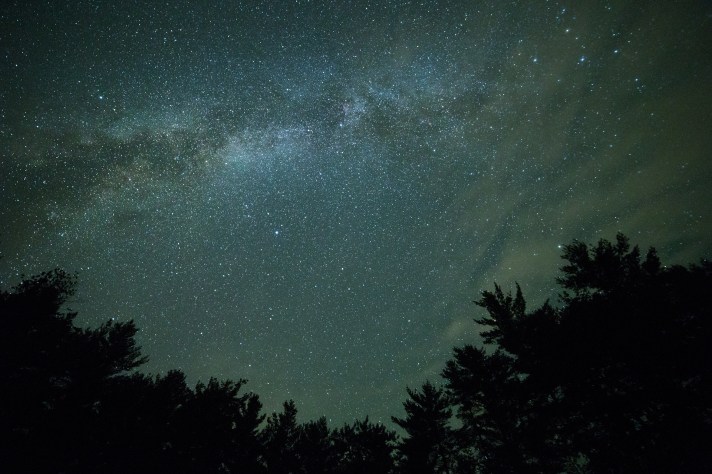
Why do I believe in God? One reason is the very existence of the cosmos points to a divine creator. Let me explain.1
We live in a universe imbued with the principle of causality — cause and effect. This means if something can be established as being an effect, then out of necessity there must have been a cause.2 There are myriads of examples of causality in this universe. For example, if I apply enough heat to wood (cause), then combustion will happen (effect), in other words, the wood catches on fire. If I press my foot down upon damp soil (cause), the mud retains my footprint (effect). Every person on this planet is ultimately an effect of a cause, which hardly needs any explanation. This universe is filled with people, places, and things that are contingent. These people, places, and things are contingent because they owe their very existence to a prior cause.
We can even say that the universe itself is an effect of a cause. In other words, all matter and time-space within this universe is contingent upon a prior cause.
One of the more widely accepted cosmological models on the origin of the universe within modern science is the Big Bang. The Big Bang proposes that the universe began to rapidly expanded from a singularity of infinite density, This expansion began about 13.8 billion years ago, expansion is still occurring, and the rate of expansion is accelerating.3 Spectrograph readings will show a blue shift in the color spectrum of objects moving towards the earth and a red shift of objects moving away the earth. The red shift in the spectrograph of observable nebulae and galaxies indicated they were moving away from our galaxy, which is consistent with an expanding universe model. The formation of helium in the universe comports with the Big Bang, as the initial heat from the early stages of expansion (practically minutes after expansion began) was the optimal condition for producing the element. The detection of the cosmic microwave background in our universe is the residual radiation expected from the initial heat and expansion resulting from the Big Bang. It then stands to reason that the universe had a beginning.
Alternative cosmological models of the universe have been proposed, like the universe has been eternally expanding, or the universe eternally cycles through expansion and contraction, but none have the sufficient counter evidence to replace all the support for the Big Bang model of the universe.4
The universe is the effect of a prior cause, and the Big Bang is the prior cause. Could not the Big Bang itself have prior cause, and even that prior cause to the Big Bang have a prior cause, so forth ad infinitum? Do we need to consider a first cause or does there even need to be one?
Here is the trick. When it comes to the principal of causation, it is possible to have a contingent universe as part of a series of causes and effects with a beginning and an end, something finite, like a “line segment” defined by two points. It is even possible to have a contingent universe as part of a series of causes and effects that start at one point but never end, a potential infinite, like a “ray” extending from one point onward forever. However, it is impossible to have a contingent universe as part of a series of causes and effects with neither beginning nor end, an actual infinite, like a line extending in both directions forever.5
Existence of an actual infinite is impossible in our universe. The reason is thatn an actual infinite would generate logic defying paradoxes and unresolvable contradictions. For example, let us say there is a business called Zeno’s Electric Guitar Emporium. The store has an actual infinite number of electric guitars in stock. If this were the case, Zeno would have an extremely peculiar inventory. If he sold a hundred Fender Stratocasters, the total number of electric guitars in stock still stays the same (infinity – 100 = infinity). If he received a hundred Gibson Les Paul Standards into the stockroom, the total numbers of electric guitars in stock still remains the same (infinity + 100 = infinity). Even if Zeno sold an electric guitar to each of the 7.7 billion men, women and children on Earth, there would still be an infinite number of electric guitars in the shop.
Actual infinite series of events can never really exist within this world of time and space. It is, therefore, impossible to have contingent universe to be part of an endless series of causes and effects with neither beginning nor end.6
What initiated that first cause which bought about our universe? It is difficult to imagine the cause of the universe was a spontaneous event. In other words, the cause of the universe was impersonal and there was never really any person with foresight, purpose, and goal in mind to set things in motion. A universe spontaneously emerging from nothing is untenable. Something never comes from nothing. Nothing produces nothing. A stationary object remains stationary until it is moved by an external force. A better option is to conceive our universe being set in motion by a non-contingent causal agent. This a non-contingent causal agent would be an absolute being that volitionally initiated the first cause. Hence, the best explanation for the existence of our universe is that it came about by the free action of an absolute being.
The very idea of this contingent universe being initiated by the free action of a non-contingent causal agent comports well with Christian doctrine of divine creation ex nihilo (out of nothing). The prologue to the Book of Genesis declares: “In the beginning, God created the heavens and the earth” (Gen. 1:1, ESV). Elsewhere, Moses declared, “Before the mountains were born | Or You gave birth to the earth and the world, | Even from everlasting to everlasting, You are God” (Psalm 90:2, ESV). In the New Testament, John the Apostle echoes the same idea with respect to Jesus Christ: “In the beginning was the Word, and the Word was with God, and the Word was God. He was in the beginning with God. All things were made through him, and without him was not any thing made that was made… And the Word became flesh, and dwelt among us, and we saw His glory, glory as of the only begotten from the Father, full of grace and truth” (Jn. 1:1-2, 14, ESV). Likewise, the Apostle Paul writes, “For by [Christ] all things were created, in heaven and on earth, visible and invisible, whether thrones or dominions or rulers or authorities—all things were created through him and for him. And he is before all things, and in him all things hold together” (Col. 1:16-17, ESV).
One of the reasons I believe in God is because God is the best explanation for very existence of the universe where I live.
— WGN
See Part 1
Notes:
- My argument is the universe is evidence for God’s existence, which is the cosmological argument for the existence of God. The case for God’s existence presented in this blog is informed by a number of different resources, which includes: James N. Anderson, Why Should I Believe Christianity? (Scotland: Christian Focus, 2016), 102-106, David Beck, “The Cosmological Argument,” in Evidence for God: 50 Arguments for Faith from the Bible, History, Philosophy, and Science, ed. William A. Dembski and Michael R. Licona (Grand Rapids, MI: Baker, 2010), 15-19, William Lane Craig, Reasonable Faith: Christian Truth and Apologetics (Wheaton, IL Crossway, 1984), 79-83, 90-122 J.P. Moreland, Scaling the Secular City: A Defense of Christianity (Grand Rapids, MI: Baker, 1987), 15-42, and J. Warner Wallace, God’s Crime Scene: A Cold-Case Detective Examines the Evidence for a Divinely Created Universe (Colorado Springs, CO: David C. Cook, 2015), 27-46, 205-213.
- R.C. Sproul, Defending Your Faith: An Introduction to Apologetics (Wheaton, IL: Crossway, 2003), 51-53.
- For the sake of discussion, I am going with the well accepted estimates of the universe being 13.8 billion years old, which goes along with Earth being 4.6 billion years old. Many fine Christians who are old Earth creationists can accept these estimates. However, I recognize that there are young earth creationists purporting this planet along with the rest of the universe is around 6,000-10,000 years old. The questions on the age of the universe and the age of the earth are intramural issues Christians can debate but not divide. I find the best treatments on the subject to be: David G. Hagopian, The Genesis Debate: Three Views on the Days of Creation (Mission Viejo, CA: Crux Press, 2001), William Dembski, The End of Christianity: Finding A Good God in an Evil World (Nashville, TN: B&H Publishing Group, 2009), and Hank Hanegraaff, The Creation Answer Book (Nashville, TN: Thomas Nelson, 2012). See also Charles Lee Irons, “Adam and Evolution.”
- For further study on the Big Bang model of the universe, a helpful treatment can be found in J. Warner Wallace, God’s Crime Scene, 27-46, 205-213. A more technical treatment on the Big Bang and critique of alternative cosmological models of the universe, see Paul Copan and William Lane Craig, Creation Out of Nothing: A Biblical Philosophical and Scientific Exploration (Grand Rapids, MI: Baker Academic, 2004), 219-248.
- The “line segment,” “ray,” and “line” are terms from Euclidian Geometry.
- Additional discussion on the impossibility of the actual infinite, see Copan and Craig, Creation out of Nothing, 197-217; Moreland, Scaling the Secular City, 28-33

 Love Truth Blog
2 thoughts on “Does God exist? Part 2: The Universe Presupposes the Existence of God.”