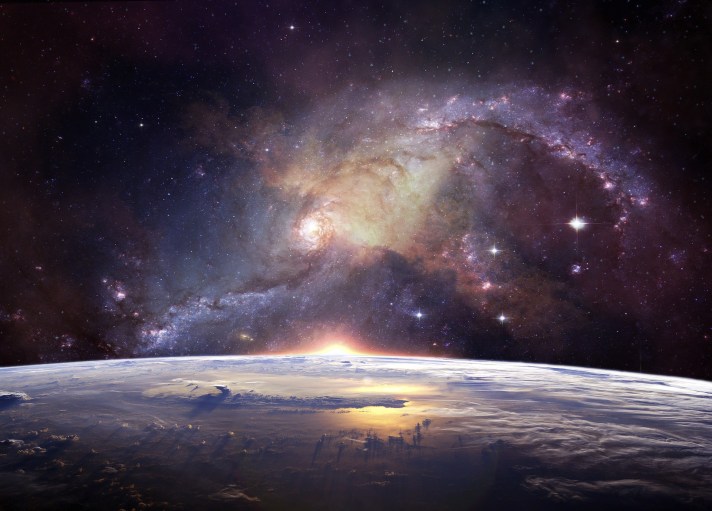
Earth is an exceptional planet. It is well suited to sustain a diversity of biological lifeforms and situated at an optimal vantage point within the Milky Way galaxy for intelligent life to explore the cosmos. The fact that Earth is exceptional with respect to supporting life and exploring the cosmos infers an intelligent designer. To explain this, I would like to share a bit about my younger days.
I have always enjoyed sci-fi. Even as a lad I especially was captivated by stories about extraterrestrial intelligent life. Star Wars1 came out when I was eleven-years-old the result was instant fandom. Strange other worldly beings, droids, spaceships, lightsabers, and epic battles with the triumph of good over evil — what was not to like? There were in fact many sci-fi stories about life on other planets back in those days that I greatly enjoyed watching such as the original Battlestar Galactica, Buck Rodgers: In the Twenty-Fifth Century and syndications of Star Trek. Episodes of Mork and Mindy were always great for laughs. Even the Six-Million Dollar Man had an episode about the “Bigfoot” Sasquatch being a cyborg built by extraterrestrials. C.S. Lewis in the Space Trilogy wrote fantastic tales about voyages to Mars (Out of the Silent Planet) and Venus (Perelandra). It was tantalizing to imagine intelligent life existing on all the planets of our solar system and beyond.
The actual search for extraterrestrial intelligence (SETI) has turned out far different than what anyone imagined. SETI has revealed that while life thrives on Earth, it has yet to be found elsewhere. Whether by astronauts or unmanned probes the places in the final frontier we have landed — Earth’s moon, Venus, Mars, Eros, Jupiter, Saturn’s moon Titan, Comet 9P/Temple 1, Comet 67P/Churyumov Gerasimenko, Asteroid Eros, Asteroid Itokawa, Asteroid Ryugu — as far as we can tell, they are sterile places. SETI is hardly finished, most of the universe remains unexplored, but so far biological life — particularly intelligent life — can only be found on Earth.
Earth is well-suited to support a diversity of biological lifeforms because it possesses a matrix of all the right ingredients in just the right proportions. There are likely myriads of Earth-like planets orbiting Sun-like stars; however, if they lack all the right ingredients in just the right proportions, they will all be sterile. This makes the task of finding extraterrestrial life exponentially more difficult.
A few essential ingredients for life include elements like carbon, hydrogen, and oxygen.2 Both carbon and water (i.e. two hydrogen atoms bonded to one oxygen atom) are necessary conditions for life to exist they are hardly sufficient. But there is more to it than just that and a host of other ingredients are needed. Another ingredient is a magnetic field or “magnetosphere,” which shields the planet’s atmosphere from interacting with solar wind particles, such as protons and electrons, but should solar winds interact with Earth’s upper atmosphere, the result will be “sputtering” or the stripping away of elements, like hydrogen and oxygen atoms, and that loss of water will be bad for life.3
Right distance from the Sun is another ingredient that makes Earth well-suited for life. Closer to the Sun, the Earth would be “a hothouse with a thick atmosphere like that of Venus,” but further from the Sun, the Earth would require “a much thicker…atmosphere with a great deal more carbon dioxide, to keep water flowing on its surface,” albeit, “such an atmosphere, even with surface water, would still be hostile to animal life.”4 The list of ingredients is still incomplete. Jay Richards, Senior Fellow and Co-Founder of the Discovery Institute and Dr. Guillermo Gonzalez, an astrophysicist expound further on the ingredients for planetary life:
If you were a cosmic chef, your recipe for cooking up a habitable planet would have many ingredients. You would need a rocky planet large enough to hold on to a substantial atmosphere and oceans of water and to retain internal heat for billions of years. You would need the right kind of atmosphere. You would need a large moon to stabilize the tilt of the planet’s rotation on its axis. You would need the planet to have a nearly circular orbit around a main sequence star similar to our sun. You would need to give that planet the right kind of planetary neighbors within its star system. And you would need to put that system far from the center, edges, and spiral arm of a galaxy like the Milky Way. You would need to cook it during a narrow window of time in the history of the universe. And so on. This is a partial list.5
Complex biological life can be found from both frigged poles to the tropics at the equator. Lifeforms can even be found in the deepest darkest region of the oceans. However, the more we find about what it takes for a planet to be habitable to support diverse biological lifeforms, particularly intelligent ones, the harder it comes to actually finding a planet that can be counted as an exact twin sibling to the Earth. A number of Earth-like planets have been found but extraterrestrial life has yet to be confirmed. We are still searching for strange new life in the final frontier.
Here is another amazing truth: Earth is situated at a prime location within the Milky Way galaxy to be a base for space exploration. Richards and Gonzalez explain,
The same narrow conditions that make a planet habitable for complex life also make it the best place overall for making a wide range of scientific discoveries. In other words, if we compare our local environment with others, less hospitable environments, we find a striking coincidence: observers find themselves in the best place overall for observing. For instance, the atmosphere that complex life needs is also an atmosphere that is transparent to most scientifically useful “light.” The geology and planetary system that life needs is also the best, overall, for allowing that life to reconstruct events form the past. And the most habitable region of the galaxy, and the most habitable time in cosmic history, are also the best place and time, overall, for doing astronomy and cosmology. If the universe is merely a blind concatenation of atoms colliding with atoms, and nothing else, you wouldn’t expect this pattern. You would expect it, on the other hand, if the universe is designed for discovery.6
Earth’s exceptionality in being both well suited for the habitation of complex biological life and optimally positioned for the exploration of the universe and scientific discovery infers an intelligent designer. Not just a maker of things alone, but one that determines to fill the universe with intelligent creatures with a curiosity to how things work in the world they live, and places them in just the right place to do just that. The intelligent creatures’ quest for knowing about the universe from studying the book of nature ultimately gives them a glimpse into the heart and mind of their maker.
For further reading on Earth’s exceptionality, see Guillermo Gonzalez and Jay W. Richards, The Privileged Planet: How Our Place in the Cosmos is Designed for Discovery (Washington DC: Regnery Publishing, Inc., 2004).
What if SETI discovers extraterrestrial life? Will that undermine the Earth’s exceptionality? Not a chance. Guillermo Gonzalez indicates “this would not mean…that life is easy to get started by natural means. An intelligent designer would still be the best explanation for the origin of life on Mars, as it is for life on Earth. The same goes for life discovered on a distant exoplanet.”7
It is sublime to suppose that an intelligent mind put intelligent creatures on this planet so that one day they would look to the stars and explore the final frontier. The more things they discovered about their universe actually reveals to them something about the wisdom and mind of their maker. All this comports with the proclamation of the Scriptures. From them we read: “By the word of the Lord the heavens were made, and by the breath of his mouth all their host” (Psalm 33:6, ESV).8 All of creation gives praise to their God and Maker.
— WGN
Notes:
- Later retitled Star Wars: Episode IV — A New Hope.
- There are imaginative stories about silicon-based lifeforms, but so far, they are just stories. Cf. Guillermo Gonzalez and Jay W. Richards, The Privileged Planet: How Our Place in the Cosmos is Designed for Discovery (Washington DC: Regnery Publishing, Inc., 2004), 32-33; 356 n.40; 411 n.38.
- Guillermo Gonzalez and Jay W. Richards, The Privileged Planet: How Our Place in the Cosmos is Designed for Discovery (Washington DC: Regnery Publishing, Inc., 2004), 58.
- , 140.
- Guillermo Gonzalez and Jay Richards, “Designed for Discovery,” in 50 Evidence for God: Arguments for Faith from the Bible, History, Philosophy and Science William A. Dembski and Michael R. Licona (Grand Rapids, MI: Baker Books, 2010), 102
- Gonzalez and Richards, “Designed for Discovery,” 103.
- Guillermo Gonzalez, “Will Extraterrestrial Life Spell Doom for Christianity?” Christian Research Journal, 35, 1 [2012]: 48.

 Love Truth Blog
Reblogged this on Truth2Freedom's Blog.
LikeLike