God exists and He is not silent. What the Lord said has been preserved for us on the pages of the Scriptures. If all this is true, then we can expect the Bible to be infallible. All that the Bible asserts is “truthful and worth of entire confidence” and “Scripture does not mislead because it is God’s own self-testimony.”1 When we read the Bible, if we are correct about the message being communicated,2 then the message received can be trusted. We can even say the Bible is inerrant. In other words, “If the Bible has been supervised down to its very words by the God of truth, we can be confident that it will be free from error,” and “whenever the Bible prescribes the content of our belief (doctrine) or the pattern of our living (ethics) or records of actual events (history), it speaks the truth.”3
Now, the matter of the inerrancy of the Scriptures does generate quite a few objections, particularly the mention of alleged Bible contradictions. Some of the blowback is just gaslighting — the critic has neither intention nor expectation to receive a reply — thus it is unnecessary to respond to the verbal slam. It is best to navigate away from debating a human chatbot.4 Worst off is we might just start trading off quips and memes without ever having meaningful human interaction. “Answer not a fool according to his folly, lest you be like him yourself” (Prov. 26:4).5 On the other hand, there are occasions where the one positing the conundrum is looking for a reasonable response either out of curiosity or some existential crisis, which is an occasion to give a well-reasoned answer. “Answer a fool according to his folly, lest he be wise in his own eyes” (Prov. 26:5).
Various lists of apparent Bible contradictions have been circulating through the years, and while all of them are quite lengthy, the objections typically have to do with either the Bible being internally inconsistent or the God of the Scriptures being morally flawed. If the Bible is factually incorrect on a matter, and if the God of Scripture is in any way morally flawed, then there is hardly any a good reason to accept the ideas that biblical writers produced their works under the inspiration of the Holy Spirit. The Bible’s own claim to be the Word of God must be rejected. The stakes are high!
Let us look at the assertions about the Bible being internally inconsistent. One example of this concerns the instances of people seeing God (Gen. 32:30; Exod. 30:12-23; Judges 13:22) and the declaration that nobody has seen God (Jn. 1:18; 1 Jn. 4:12). We never really have an actual contradiction in what the Scriptures communicate. There are those who have seen visual manifestations of God (i.e. theophanies) but ultimately human eyes have never actually seen the invisible essence of God.6 God can cause Himself to appear as a burning bush, a cloud, a male human figure, etc. Nevertheless, God’s essence remains invisible to the naked eye (1 Kings 19:11-12).
Nuances between the way different biblical writers narrated common events are also posited as errors of internal consistency. A typical example of this is the discovery of the empty tomb on the third day (cf. Matt. 28:1-10, Mk. 16:1-8, Lk. 23:1-12, Jn. 20:1-10). For example, Bible critics say the four accounts are contradictory since they tell of different numbers of women who came to the empty tomb. John only mentions Mary Magdalene discovering the empty tomb (John 20:1). Matthew indicates Mary Magdalene was accompanied by another woman named Mary (Matt. 28:1). Mark mentions three women: Mary Magdalene, Mary the mother of James and Salome (Mark 16:1). Luke tells us several women witnessed the empty tomb: Mary Magdalene, Mary the mother of James, Joanna and “other women” (Luke 24:10).
There is no contradiction with respect to the number of women witnessing the empty tomb. Mary Magdalene is the key witness, whereas the other women serve as additional witnesses. These reports of women discovering the empty tomb are significant and for the Gospel writers to report such a thing would have been “unusual for the culture and shows that this detail was not one constructed by the church, because a woman’s testimony would not be respected in that culture.”7
Other nuances exist, but they are hardly contradictions. John indicates it was still dark (John 20:1) whereas Mark indicates the sun had arisen (Mark 16:2). The situation is the women began their walk to the tomb early in the morning while it was still dark and upon arriving at the tomb dawn had just broken on the horizon.
What we actually have are four independent accounts from witnesses to the same event, each one of them contributing information about the event allowing us to form a composite picture of what took place. These nuances between the Gospel writers actually serve as a testimonial to their authenticity! “Ironically,” writes Lee Strobel, “if the gospels had been identical to each other, word for word, this would have raised charges that the authors had conspired among themselves to coordinate their stories in advance, and that would have cast doubt on them”8 Four identical narrations from the Gospel writers actually suggests collusion and the distortion of the facts.9
Now, lets look at some of the assertions about the God of the Scriptures being morally flawed. One example of this Jesus’ teaching: “If your right eye causes you to sin, tear it out and throw it away. For it is better that you lose one of your members than that your whole body be thrown into hell. And if your right hand causes you to sin, cut it off and throw it away. For it is better that you lose one of your members than that your whole body go into hell” (Matt. 5:29-30). A ridged fundamentalist interpreter would take this to mean that bodily mutilation is needed for spiritual purity. The same shallow minded sort might even suppose the passage allows tribunals to sentence the guilty to bodily mutilation in accordance to crimes committed, like amputating the hand of a convicted shoplifter. This misinterpretation is the result of a flawed wooden literal method of biblical interpretation.
Jesus is never really condoning bodily mutilation in Matthew 5:29-30; rather, this He is employing the use of hyperbole. Hyperbole is the application of an extravagant exaggeration to make a point. It is like saying, “I’m so hungry, I could eat a cow.” Here one is describing the intensity of the stomach pangs as opposed to declaring any intent to consume an entire beast. The Lord’s statement about the eye and hand has to do with having a life totally committed to following God, as opposed to removing body parts like the eye, hand, and heart.10[x]
Another example of a morally flawed God is the duplicity of the Mosaic prohibitions against human sacrifice and the sacrifice of Jephthah’s daughter (Lev. 18:21 vs. Judg. 11:29-40). Jephthah made a rash vow and some Bible scholars concede a human sacrifice occurred but consider the ordeal to be an example of something acknowledge but never approved in the Scriptures.11 However, I think the better understanding is that Jephthah dedicated his daughter to be a perpetual virgin, and she willingly commits herself as a living sacrifice to the Lord.12 This explains why the daughter would mourn her virginity (Judg. 11:39a), why Israelite women would find the event honorific enough to commemorate in an annual tradition (Judg. 11:39b-40), and the place of Jephthah alongside the community of people who had faith in the promises of God (Heb. 11:1-40 cf. v. 35).
A third example of the biblical God being morally flawed is the purported instance of divinely sanctioned genocide in the Old Testament. Genocide is a term coined after the twentieth century Holocaust, referring to “the deliberate and systematic destruction of a racial, political, or cultural group.”13 To be certain there are likely many instances of genocide occurring throughout the entire span of world history; however, there is nothing in the Scriptures to suggest a divinely sanctioned genocide.
God informed the Israelites that He would give them “the Hittites, the Girgashites, the Amorites, the Canaanites, the Perizzites, the Hivites, and the Jebusites,” and the Israelites were to “devote them to complete destruction” (Deut. 7:1-2). Specific persons devoted to the Lord for destruction were under a ban and they were put to death (Lev. 27:29).
What we never find is any edict from the God of the Old Testament for the complete annihilation of every non-Israelite man, woman, and child dwelling in the promise land. There are several reasons for this. First, Rahab, a Canaanite prostitute working at Jericho, feared the Lord. Although Jericho was devoted to the Lord for destruction, Rahab and her family were saved. They were even assimilated into the Israelite society (Josh. 2:1-24; 6:1-26). Rahab was even included in the lineage of Israel’s Great Redeemer — Jesus the Messiah or Christ (Matt. 1:5).
Second, the Lord even informed the Israelites that they would be living side by side with non-Israelites. God drove out the pagans “little by little” but not all at once (Exod. 23:27-30; Deut. 7:22). The Israelites were even supposed to have one law for them and the aliens (Lev. 24:22; Num. 15:14-16). The Israelites were to live alongside the non-Israelites, and non-Israelites were never to be completely annihilated by the Israelites. There were even Canaanites living in the time of Christ (Matt. 15:21-28).
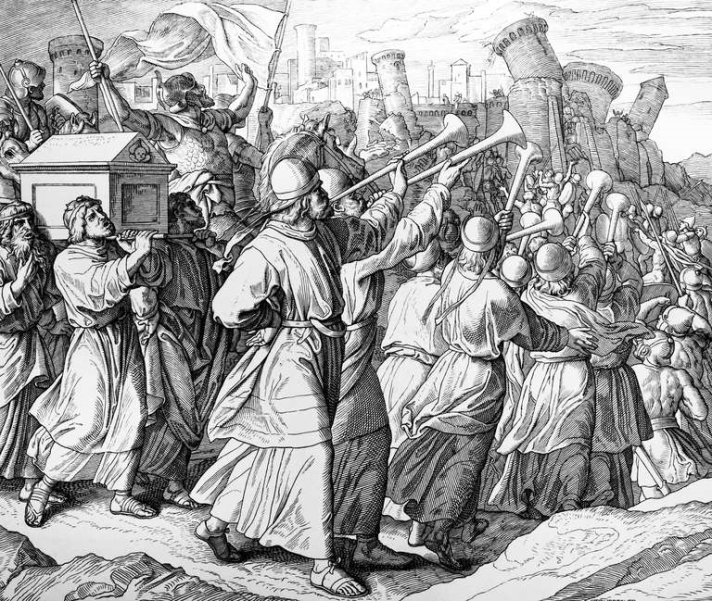
Third, the cities devoted to destruction, like Jericho and Ai, were “military forts or garrisons” as opposed to the places full of noncombatants (i.e. women, children, so forth).14 Joshua’s battles were against military installations that housed the kings, troops, and priests of the corrupt regimes. These were not typical places noncombatants dwelt.
Fourth, God set the ban upon the pagan people, places, and things in the promise land as the last resort to keep wickedness from spreading — particularly to the Israelites (Deut. 7:3-5). The Lord informed Abram that it would be around four centuries before his descendants could take possession of the promise land since “the iniquity of the Amorites is not yet complete” (Gen. 15:15). In other words, they would remain until the necessary time of judgment.
The sword cut both ways too! If the Israelites began to do the same kind of wickedness as the pagans, then God Almighty would oppose them too (Lev. 20:22-26; cf. Lev. 18:1-30 and Deut. 18:9-14). In fact, the descendants of Abraham went into Assyrian and Babylonian exile because they forsook the ways of the Lord and took on ways that were identical to the pagans God opposed (2 Kings 17:17-23). God’s goal was to erase the wickedness but never to erase the people.
Finally, God wanted people from all nations to be included in Israel’s society and worship. A stipulation of God’s covenant with Abraham was for his descendants to become a nation that blesses all nations (Gen. 12:1-3; 17:1-8). The Mosaic Law called the people to love the aliens and strangers in the land (Lev. 19:33-34). The Law even allowed for foreigners to join in the Passover, which was an essential component of Yahweh worship (Exod. 12:43-49; Num. 9:14). All this pointed forward to the redemptive work of Jesus Christ that servers God’s ultimate plan of saving that which was lost (John 3:16; Gal. 3:23-29; Rom. 1:16-17).
Rampant corruption was occurring in the promise land during in days Joshua that persisted for hundreds of years. It became necessary for God to use a nation to end the reign of corruption in that place to keep it from spreading elsewhere. This was never a total annihilation of non-Israelites, but the elimination of specific structures that maintained the culture of corruption. God’s call for sinners to repent was always available.15
Affirming the inerrancy of the Scriptures typically generates replies about apparent contradictions. The apparent contradictions mainly concern purported internal consistency between the biblical writers and the God of Scriptures being morally flawed. However, these apparent contradictions are really the result of a faulty method of interpretation as opposed to any sort of flaw conveyed through the texts of the Scriptures.
God has spoken to us. God’s Word is preserved in the Scriptures. The Scriptures can be trusted, i.e. they are infallible. The Scriptures convey a flawless message, i.e. they are inerrant.
In the next post, I will blog about the ultimate revelation of God in the person of Jesus Christ.
– WGN
- Bruce Milne, Know the Truth: A Handbook of Christian Belief (Downers Grove, IL: Inter-Varsity Press, 1982, 1998), 55
- The operative word is “if,” as I have to admit to instances of being wrong about the meaning passage, and I need of learning and correction too.
- Milne, 56-57. There is debate among those who affirm inerrancy over the extent of the external information that can be used in interpreting the Scriptures. Cf. James Patrick Holding, “The Debate over Defining Inerrancy,” Christian Research Journal, 38, 3 [2015]: https://www.equip.org/article/debate-defining-inerrancy/
- Cf. Graham Veale, “Contemporary Atheism and Sneer,” Christian Research Journal, 38, 5 [2015]: https://www.equip.org/article/contemporary-atheists-sneer/
- All Scripture cited from The Holy Bible: English Standard Version (Wheaton, IL: Crossway Bibles, 2016), unless noted.
- See Charles Lee Irons, “Is it Possible for Humans to See God?” Christian Research Journal, 39, 5 [2016]: https://www.equip.org/article/is-it-possible-for-humans-to-see-god/
- Darrell Bock, Jesus According to Scripture, (Grand Rapids, MI: Baker Academic, 2002), 394
- Lee Strobel, The Case for Christ (Grand Rapids, MI: Zondervan, 1998), 45
- For additional reading on alleged Bible inconsistencies, see H. Wayne House, “Presumed Innocent until Proven Guilty,” Christian Research Journal, 29, 5 [2006]: https://www.equip.org/articles/presumed-innocent-until-proven-guilty/ and Rachel D. Ramer, “Taming Bible ‘Discrepancies,’ ” Christian Research Journal, 24, 2 [2001]: https://www.equip.org/articles/taming-bible-discrepancies-/. Other helpful resources include: Hank Hanegraaff, The Complete Bible Answer Book: Collector’s Edition Revised and Updated (Nashville, TN: Thomas Nelson, 2016), Gleason L. Archer, New International Encyclopedia of Bible Difficulties (Grand Rapids, MI: Zondervan Publishing House, 1982), and Walter C. Kaiser Jr. et al., Hard Sayings of the Bible (Downers Grove, IL: InterVarsity, 1996).
- Cf. Christy Gambrell, “Does Jesus Condone Self-Mutilation in Matthew 5:29-30,” Christian Research Journal, 41, 1 [2018]: https://www.equip.org/article/does-jesus-condone-self-mutilation-in-matthew-5-29-30/
- Walter C. Kaiser Jr. et al., Hard Sayings of the Bible (Downers Grove, IL: InterVarsity, 1996), 193–195.
- James Patrick Holding, “Jephthah’s Bloodless Sacrifice,” Christian Research Journal, 39, 4 [2016]: https://www.equip.org/article/jephthahs-bloodless-sacrifice/. Cf. also Gleason L. Archer, New International Encyclopedia of Bible Difficulties (Grand Rapids, MI: Zondervan Publishing House, 1982), 164–165.
- Inc Merriam-Webster, Merriam-Webster’s Collegiate Dictionary. (Springfield, MA: Merriam-Webster, Inc., 2003).
- Paul Copan, Is God a Moral Monster? Making Sense of the Old Testament God (Grand Rapids, MI: Baker Books, 2011), 175-177
- For a more in-depth look at the objection to the inerrancy of the Scripture on the basis of a morally flawed God of the Old Testament who commands genocide, please see Hank Hanegraaff, “How Can Christians Legitimize a God who Orders the Genocide of Entire Nations?” in The Complete Bible Answer Book: Collector’s Edition Revised and Updated (Nashville, TN: Thomas Nelson, 2008, 2016), 178-179, Clay Jones, “Killing the Canaanites: A Response to the New Atheism’s ‘Divine Genocide’ Claims,” Christian Research Journal, 33, 4 [2010]: https://www.equip.org/articles/killing-the-canaanites/, Paul Copan and Matthew Flannagan, “Was Israel Commanded to Commit Genocide,” Christian Research Journal, 34, 5 [2011]: https://www.equip.org/article/israel-commanded-commit-genocide/, and Matthew Flannagan, “Is the God of the Old Testament a Proponent of Total War against Noncombatants?” Christian Research Journal, 38, 6 [2015]: https://www.equip.org/article/god-old-testament-proponent-total-war-noncombatants/ For lengthier treatments on the subject, please consult Paul Copan, Is God a Moral Monster? Making Sense of the Old Testament God (Grand Rapids: Baker Books, 2011), and Paul Copan and Matthew Flannagan, Did God Really Command Genocide? Coming to Terms with the Justice of God (Grand Rapids: Baker Books, 2014).

 Love Truth Blog
3 thoughts on “Does God Exist? Part 9: Addressing the Apparent Contradictions in the Word of God”