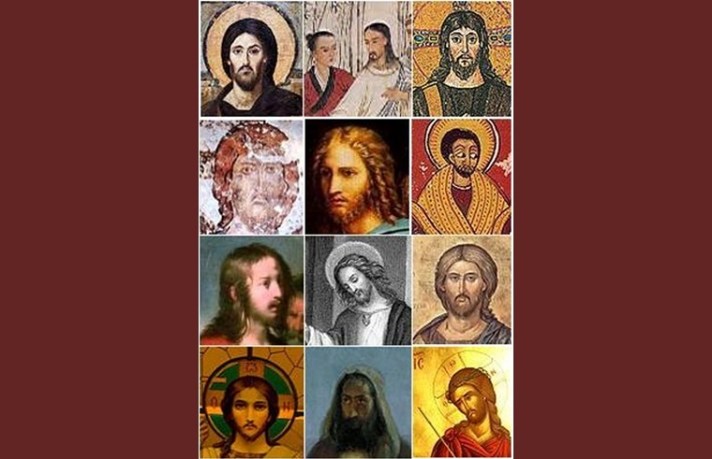
Jesus posed the question: “Who do people say that I am?” The disciples answered by offering the response they were hearing in conversations. “John the Baptist,” “Elijah” or another prophet (Mk. 8:27-28).1 Everyone has got a mental picture of their own sort of personal Jesus. Today there are probably more conceptions (or misconceptions) of Jesus circulating in the universe as there are Elvis Presley impersonators. Which version of Jesus is the genuine article? Is there really a genuine article? Does it matter?
Back in the 1990s an acquaintance of mine would occasionally bring up the topic of religion. He professed atheism and kept a signed statement renouncing Roman Catholicism, while fully acknowledging accepting eternal perdition. He contended that the best answer for how Jesus could perform miracles and even come back to life from the dead is because the guy was an extraterrestrial. The access to advanced alien technology explained the extraordinary feats, while benighted ancient humans mistook extraterrestrials for gods.
My old acquaintance, of course, failed to see the inherent circular reasoning of the extraterrestrial named Jesus story. Ancient alien theory goes like this: the teachings of Christianity along with other world religions proves the existence of extraterrestrials and close encounters with extraterrestrials explain the origin of Christianity along with other world religions — this is begging the question. The guy was really suffering from worldview confusion in his interpretation of the Bible. Instead of understanding Scriptures from its inherent historical and cultural framework, he was reading his own predilections about panspermia into the biblical text. Moreover, the guy’s belief in the extraterrestrial named Jesus story was really based upon blind faith without the support of any evidence.2
Through the years, I repeatedly came across in pop-culture references to the Jesus of Christianity being a man-made myth based upon other man-made myths. It is purported that there were many pagan gods that were born of virgins on December 25, who were called “Savior” and “Lord,” and who died and rose again. Jesus Christ is said to be a slightly modified copy of pagan gods like Osirus, Attis, Mithra, Krishna, and Dionysus.3
A closer look at the pagan myths reveals very little resemblance to the life of Jesus Christ. Take, for example, Osiris. The Egyptian deity is “supposedly murdered by his brother and buried in the Nile. The goddess Isis recovers the cadaver, only to lose it once again to her brother-in-law who cuts the body into fourteen pieces and scatters them around the world. After finding the parts, Isis ‘baptizes’ each piece in the Nile River and Osiris is ‘resurrected.’ The alleged similarities as well as the terminology used to communicate them are greatly exaggerated. Parallels between the ‘resurrection’ of Osiris and the resurrection of Christ are an obvious stretch.”4
The other problem is the pagan myths of dying and rising gods more likely came after the emergence of Christianity. A good example of this is Mithra. Historian Dr. Edwin Yamauchi says, “Mithraism was a late Roman mystery religion that was popular among soldiers and merchants, and which became a chief rival to Christianity in the second century and later.”5 Mithraism emerged after the New Testament era.
Outside of Christianity I found stories about Jesus being an avatar, an enlightened human, the spirit brother of Lucifer (i.e. Satan or the Devil), a god but not the God, a way shower, and so forth.
I even found other portraits of a non-divine-ordinary-human Jesus published in academia. New Testament scholar Craig Evans indicates, “Over the last century or so Jesus has been presented as a Pharisee (of one stripe or another), an Essene, a prophet or a great moral teacher. In more recent times Jesus has been interpreted as a philosopher, a rabbi, a sage, a charismatic holy man and a magician. Indeed, some of these portraits combine tow or more of these categories.”6 The “strangest” proposal comes from John Dominic Crossan, who thinks “Jesus was a ‘peasant Jesus Cynic’ and that Jesus and his followers were ‘hippies in a world of Augustan yuppies.’”7 Cynics were known for being “ragged” and “unkempt.”8 Instead of “materialism and vanity,” they wanted to live with “simplicity and integrity before God,” albeit they were “known for flouting social custom and etiquette, such as urinating, defecating and engaging in sexual intercourse in public,” and they “could be coarse and rude.”9 Here is the problem: “There was no Cynic presence in Galilee in the early first century A.D.”10
The various portraits of Jesus purported in academia presuppose a dichotomy between a historical Jesus and a mythical Christ. The former represents the person who actually lived whereas the latter the person bolstered and embellished with legends and myths. It is further presumed that the New Testament presents to us the mythical Christ. In other words, Christians made up stories and sayings about Jesus, which Jesus neither said nor did, and these legends got incorporated into the New Testament. The memories of the post-Easter Christian community purportedly got “edited, deleted, augmented, and combined many times over many years.”11 The information about the historical Jesus got more and more corrupted through the passing on of the oral tradition from one generation to the next, which happened prior to the composition of the New Testament. Hence, readers are to strip away the legends and myths to know the historical Jesus.
Did the early Christian church invent stories about Jesus? Presupposing a historical Jesus and mythical Christ divide is simply a faulty method of biblical interpretation. It lacks any basis in reality. The New Testament writers likely received information about Jesus through oral tradition; however, there is nary any good reason to suppose their writings distorted the facts. Modern people in the West live in a written culture, which means we tend to retain less information from hearing a message, and writing down the information helps us to recall things. The New Testament peoples lived in an oral culture, where information was passed on verbally. Concerning the preservation of information in an oral culture, Timothy Paul Jones indicates, “teachers used rhythm, rhyme, telling and retelling truths until the vital content could be recalled at a moment’s notice” and “when especially significant events occurred, communities rapidly preserved the essential content in pithy oral histories.”12 One ancient rabbi named Perida repeated his teachings from four-hundred to eight-hundred times in order for students to recall what was essentially being passed on. As a Jewish teacher, Jesus was “expected to train His followers to preserve His teachings.”13 Fabricated stories about the Lord could never really emerge “while people who knew Him were still alive” since “the eyewitnesses of His life could have protested.”14
The New Testament writers preserved the testimonials of eyewitnesses to the teachings and works of Jesus of Nazareth. Richard Bauckham puts it this way: “[The Gospel texts] embody the testimony of the eyewitnesses, not of course without editing and interpretation, but in a way that is substantially faithful to how the eyewitnesses themselves told it, since the Evangelists were in more or less direct contact with eyewitnesses, not removed from them by a long process of anonymous transmission of the traditions.”15
1 Corinthians 15:3-8 preserves a creed that the Apostle Paul received which was likely composed between “three to eight years after Jesus’ crucifixion,”16 or perhaps even earlier, like within months of the first Easter.17 The good news of Christ death and resurrection is an early Christian tradition, and one unlikely to have gone through mythological embellishment.
A pre-AD 70 date of composition can be assigned to the Gospel of Luke and the Acts of the Apostles. It is generally understood that the composition of Luke preceded Acts (cf. Luke 1:1-4 and Acts 1:1-2). The abrupt ending in Acts with Paul being under house arrest in Rome suggest an early date of composition around AD 60-62. It also can be pointed out that “Acts makes no mention of several key events from the period 65–70 that we might have expected it to mention: the Neronian persecution, the deaths of Peter and Paul, and the destruction of Jerusalem at the hands of the Romans,”18 and “Especially important is the lack of mention in either Luke or Acts of the fall of Jerusalem. So cataclysmic an event in the history of the Jewish people is unlikely to have gone completely unmentioned in books that focus so much on the nature and theological continuity of Israel and the people of God.”19 The composition of Acts can be dated around AD 62 and Luke prior to that. The Gospel of Mark is also believed to have been composed before Luke-Acts. It is even plausible that the entirety of the New Testament was completed before AD 70.20 This makes it less likely that for one to expect elements of the New Testament to have come from the result of mythologizing.
Absence of Jesus sayings on major first century church controversies such as speaking in tongues (1 Cor. 12; 14), divorcing on the grounds of the desertion of an unbelieving spouse (1 Cor. 7:15), eating meat sacrificed to idols (1 Cor. 8) and circumcision (Acts 15) is conspicuous. According to Paul Copan, “If Jesus-material was being invented to address community concerns (as Crossan says), why are these so shockingly absent in Jesus’ teaching? We actually discover these controversies within the epistles and Acts, not in the Gospels.”21 One would think that the early Christian leaders — if they were really inventing stories about Jesus —could have created a story or a saying of Jesus specifically taking on these hot button issues to settle the debate.
Inclusion of embarrassing material in the Gospels is likewise conspicuous. The New Testament writers had an integrity and honesty that cannot be accounted for by a fabrication hypothesis, as one would be inclined to leave out potentially embarrassing or difficult information in an invented story. A few examples of the embarrassing material include: Jesus submitting to John’s baptism (Mark 1:4-11), Jesus not knowing the time of the return (Mark 13:32), or Jesus’ family believing he was out of his mind (Mark 3:21). Gospel writers would unlikely have included embarrassing material unless it was factually accurate.22
Versions of Jesus out there are almost innumerable and none are exactly the same. It is impossible for them all to be true. They can all be false. Nevertheless, the genuine article can really be out there. I believe there is good reason to say the Jesus Christ presented in the Scriptures and affirmed by the historic Christian faith is rooted in indisputable historical evidence. It is this Jesus who reveals, redeems, and reconciles humanity with God of the universe. He is the genuine article. Whoever believes in Him should not perish but have eternal life (Jn. 3:16).
Jesus asked the disciples, “Who do you say that I am?” Simon Peter responded “You are the Christ” (Mk. 8:29). The ex-fisherman even adds “the Son of the living God” (Matt. 16:16). The Lord replied, “Blessed are you, Simon Barjona, because flesh and blood did not reveal this to you, but My Father who is in heaven” (Matt, 16:17).
God is decisively revealed in the person of Jesus Christ. This belief is tethered to evidence from philosophy, science, history and archaeology. Is doubt possible? I want to address doubt in the next blog.
— WGN
For further related reading, please see the following articles:
Craig A. Evans, “Why the Followers of Jesus Recognized Him as Divine,” Christian Research Journal, volume 37, number 3 (2014).
Craig Hazen, “Gabriel’s Revelation: A Challenge to Our View of the Resurrection?”, Christian Research Journal, volume 32, number 2 (2009)
James Patrick Holding, “Confronting the Spirit of the Age” from the Christian Research Journal, volume 32, number 5 (2009).
James Patrick Holding, “The Da Vinci Code: Revisiting a Cracked Conspiracy,” Christian Research Journal, volume 24, number 1 (2004)
Dennis Ingolfsland, “Jesus and the ‘Earliest’ Sources: An Answer to John Dominic Crossan” from the Christian Research Journal, volume 25, number 3 (2003).
Ronald Nash “Was the New Testament Influenced by Pagan Religions?” from the Christian Research Journal, Winter (1994).
Ronald Nash, “Was the New Testament Influenced By Pagan Philosophy?” from the Christian Research Journal, Fall (1993).
Lee Strobel, “Defending the New Testament Jesus” from the Christian Research Journal, volume 30, number 5 (2007)
Notes:
- All Scriptures cited from The Holy Bible: English Standard Version (Wheaton, IL: Crossway Bibles, 2016), unless noted.
- For further related reading, cf. Robert Velarde, “Did Ancient Extraterrestrials Visit Earth?” Christian Research Journal, 37, 6 [2014]: https://www.equip.org/article/did-ancient-extraterrestrials-visit-earth/
- This assertion is made in Zeitgeist The Movie (2007) written and directed by Peter Joseph and Religulous (2008) written by Bill Maher and directed by Larry Charles. The same assertion is made in the popular novel The Da Vinci Code (New York: Doubleday, 2003) by Dan Brown.
- Hank Hanegraaff, The Complete Bible Answer Book: Collector’s Edition Revised and Updated (Nashville, TN: Thomas Nelson, 2016) 258.
- Lee Strobel, The Case for the Real Jesus: A Journalist Investigates Current Attacks on the Identity of Christ (Grand Rapids, MI: Zondervan, 2007), 168.
- Craig A. Evans, Fabricating Jesus: How Modern Scholars Distort the Gospels (Downers Grove, IL: IVP Books, 2006), 103
- Ibid., 105.
- Ibid. 106.
- Ibid., 109, 110.
- Ibid., 122.
- Timothy Paul Jones, Conspiracies and the Cross (Lake Mary: FL: Front Line, 2008), 94
- Ibid., 95.
- Ibid., 95
- Ibid, 99.
- Richard Bauckham, Jesus and the Eyewitnesses: The Gospels as Eyewitness Testimony (Grand Rapids, MI: William B. Eerdmans Publishing Company, 2006), 6
- Gary R. Habermas, The Historical Jesus: Ancient Evidence for the Life of Christ (Joplin, MO: College Press Publishing Company, 1996), 124.
- Michael R. Licona, The Resurrection of Jesus: A New Historiographical Approach (Downers Grove, InterVaristy Press, 2010), 234.
- D. A. Carson and Douglas J. Moo, An Introduction to the New Testament, Second Edition (Grand Rapids, MI: Zondervan, 2005), 207.
- Ibid., 208.
- Hank Hanegraaff, The Complete Bible Answer Book: Collector’s Edition Revised and Expanded (Nashville, TN: Thomas Nelson, 2016), 528-532; cf. John A.T. Robinson, Redating the New Testament (Eugene, OR: Wipf and Stock Publishers, 1976).
- Paul Copan, True For You But Not For Me: Overcoming Objections to Christian Faith (Minneapolis, MN: Bethany House , 1998, 2009), 156.
- Ibid., 159.

 Love Truth Blog
One thought on “Does God exist? Part 13: Debunking the Claim that Christianity Made Up Stories About Their Divine Messiah.”