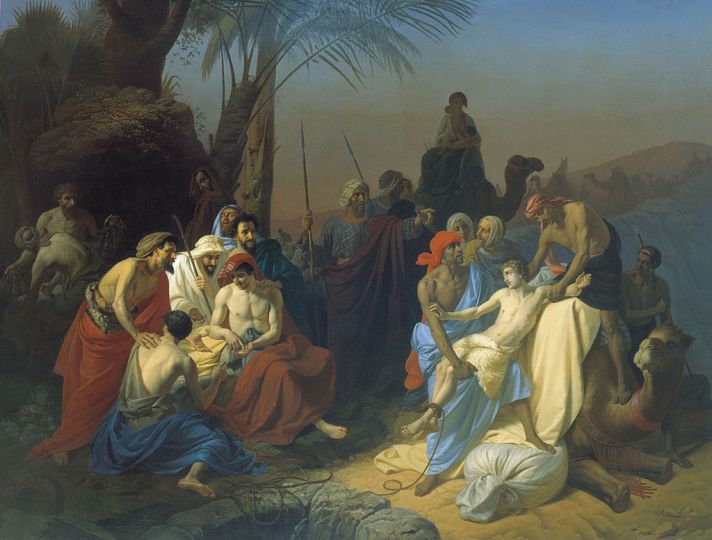
Slavery has existed for eons. In fact, it was well-established in the ancient Near East society1 even in days prior the patriarch Abraham (BC 2166-1991).2 Slaves are mentioned throughout the Scriptures. Does God approve of slavery? No. God never condones slavery; instead, the Lord calls people out of this life to a better life without slavery. In the rest of this post, my goal is to demonstrate why this is the case.
What is slavery? Slavery is a system of servitude wherein a person or slave is retained as the chattel or property of another person, institution, or sovereign.3 Slaves can be bought and sold as commodities. Some fall into slavery because of the inability to pay off an extreme debt. Others become slaves because they are abducted or kidnapped and sold into slavery. There are even those who are born slaves on account of the enslavement of their parents or ancestors. When a child is forced without consent into a marriage can be counted as a type of slavery. Captives of war are subjected to forced labor is still another type of slavery. Slaves are put to work doing various sorts of jobs (housework, farming, manufacturing, militia, prostitution etc.). Both adults and children can become slaves. Slavery is illegal throughout the modern world; however, the practice still continues. There is an estimated 40 million people who are entrapped in modern slavery, i.e. human trafficking.
Notable distinctions can be made between modern human trafficking around the world along with the antebellum (prewar) slavery in the United States from the slavery practiced in biblical times. K.A. Kitchen indicates that in the ancient Near East “slaves could and did acquire various rights before the law or by custom, and these included ownership (even of other slaves) and the power to conduct business while they were yet under their masters’ control.”4 Joseph (Gen. 39-41) and Daniel (Dan. 1-2; 5-6) were slaves whom rose to prominence under their respected masters. There were even prominent Old Testament figures who kept servants, as in the cases of Abraham, Isaac, Jacob, David and Solomon. Moses assigned slaves to serve the priest in the tabernacle (Num. 31:25-31) and Joshua subjugated the Gibeonites (Josh. 9:3-27).
Arthur A. Rupprecht notes that 85-90% of the inhabitants of Roman and the Italian peninsula were slaves or slave origins in the first and second centuries AD, Greco-Roman slaves were permitted to worship as an extend member of their master’s family, they could marry (though their children would be the property of their respective master), they were allowed to accumulate their own money, and they could purchase their own freedom.5
Nevertheless, one is still hard-pressed to find in the Scriptures an instance where the Word of the Lord spoken through a prophet condones even the relatively milder forms of slavery in the ancient Near East and the Greco-Roman world.
What we find in the Scripture is God calling people out of the world and leading them to a better world, a new heaven and new earth wherein sin does not dwell — a place without slavery. Paul Copan points out that “God ‘works with’ Israel as he finds her, He meets his people where they are while seeking to show them a higher ideal in the context of ancient Near Eastern life,” but “God didn’t impose legislation that Israel wasn’t ready for. He moved incrementally.”6 God meets people where they are at, then sets His redeemed on a different trajectory towards something better. Along the way, God introduces incremental changes into the lives of His people, which prepares them for life where they were destined. God took them out of a life immersed in a slave driven economy and gradually guided them to a new and better life without slavery.
Old Testament laws called the Israelites to recognize the dignity and worth of the person including slaves. For example, if a master beat a slave to death, he would be held liable (Exod. 21:20). If a master physically injured a slave, such as blinding an eye or knocking out a tooth, the slave was to be set free (Exod. 21:26-27).
Israelites were to establish ways for slaves to be set free. Slaves could only serve a maximum of six years, and when the seventh year came, the masters were to send them off with wine, animals, and grain (Deut. 15:12-13; Lev. 25:2-7). On the other hand, God’s people were to do whatever they could to keep fellow Israelites from entering into debt-slavery (Deut. 15:7-11; Lev. 25:35-46). The Mosaic Law even encouraged Israelites in the land to negotiate payments based upon the year of jubilee for purchasing their countrymen out of debt slavery (Lev.25:47-55). Permanent servitude was to be upon the consent of the slave (Exod. 21:4-6; Deut. 15:16-17). Fugitive slaves from pagan nations were never to be extradited; rather, they were to be given a place of refuge in Israel (Deut. 23:15-16). Kidnapping persons to be sold as slaves was prohibited and punishable by death according to Mosaic Law (Exod. 21:16; Deut. 24:7).7 God forged ways for His people to give up the practice of slavery. All this was a step in the right direction but hardly the final destination.
The New Testament opens with Jesus connected His ministry with the fulfillment of Isaiah’s yearning for Israel’s the year of jubilee as commanded by Moses, which involved the release of captives and the oppressed (Luke 4:16-21; cf. Isa. 61:1-2, 58:6; Lev. 25). Paul wrote, “There is neither slave nor free…for you are all one in Christ Jesus” (Gal. 3:28),8 and “For in one Spirit we were all baptized into one body—Jews or Greeks, slaves or free—and all were made to drink of one Spirit” (1 Cor. 12:13). In other words, the Apostle declared slaves and masters to be equal. 1 Timothy 1:10 mentions various groups of law offenders with one of them being “enslavers.”9 Craig Keener observes, “Paul’s remark directly assaults the vicious slave trade of his day. Many kidnappers sought children to make them male and female slave prostitutes.”10
Onesimus was a valuable assistant to Paul (Philem. 11). Since Onesimus was a runaway slave, Paul sent Onesimus back to his master Philemon. The Apostle included a letter with an appeal for Philemon to receive back Onesimus, albeit “no longer as a bondservant but more than a bondservant, as a beloved brother” (Philem. 16). Whatever Onesimus owed Philemon, i.e. the debt which brought them into a master and slave relationship, Paul offers to repay (Philem. 18). Paul also mentions the debt Philemon owed to him, which was the good news about the new life received in Jesus Christ (Philem. 19). Both Philemon and Onesimus came to faith through Paul’s ministry. What better thing could Philemon do but redeem his Christian brother, Onesimus, out of debt slavery, since it would open a door of opportunity for Onesimus to continue being a useful assistant to Paul? The natural progression of the new life in Christ is then the manumission of slaves.
Jesus Christ then brings God’s people even closer the “ultimate ideal.” This ultimate ideal “includes the genuine realization of creation ideals in Genesis 1:26-27, in which God’s image-bearers live and work together and are fairly, graciously treated; they are viewed as full persons and equals; and genuine humanness is restored in Christ, the second Adam/the new man.”11 It is the abolishment of slavery that brings humanity closer to the kind of world God intended humans to dwell in from the very beginning.
Early Christians demanded “good treatment of slaves” but “seldom denounced the institution as a whole.” However, starting around the 300s, “the moral pressure to fully emancipate slaves continually mounted.” Early church fathers such as Gregory of Nyssa “condemned the whole institution,” and both Augustine of Hippo along with John Chrysostom “preached that slavery was a sin.” Once we get to the 700s “there were few slaves in Europe.”12
Unfortunately, the resurgence of the slave trade in 1400s marked an unspeakable dark spot in the history of Western Civilization. Professing Christians gave sanction and support to the practice. They even twisted Scriptures to justify enslavement. However, there were dissenters. “In 1537,” for example, “Pope Paul III memorably declared that no Indian should be ‘given into servitude,’ and in the seventeenth century, Pope innocent XI ruled that it was not permitted to buy or sell Africans who had been seized against their will. The papacy condemned slaver or the slave trade in 1462, 1741, 1815 and 1839. Needless to say, slaveholders in the New World paid little attention to any of these pronouncements, except occasionally to issue ringing protest.”13
One can also point out that “the first African slaves arrived in British American colonies in 1619, on a Dutch ship docking at Jamestown, Virginia. They were first treated much like indentured servants, but the expansion of tobacco and cotton made field labor necessary to landowners, and slaves became personal property like a horse or a chair.”14 Slaves were a basic feature of the newly formed United States of America in 1776, and it would be another four score and seven years until the Emancipation Proclamation.15
Critics that equate antebellum slavery with Israel’s servant laws are “seriously misguided.” Copan contends, “if the three clear laws of the Old Testament had been followed in the South — that is, the anti-kidnapping, anti-harm, and anti-slave-return regulations in Exodus 21:16, 20, 26-27 and Deuteronomy 23:15-16 and 24:7 — then slavery wouldn’t have arisen in America.”16 Moreover, Hank Hanegraaff believes “it was the application of biblical principles that ultimately led to the overthrow of slavery” and that “Israel’s liberation from slavery in Egypt became the model for the liberation of slaves in general.”17
Slavery has been illegalized throughout to world; however, throughout the world slavery is illegally practiced. Nevertheless, God is still at work in redeeming fallen humanity. He has been leading people from a place of darkness to a better a place, a place without slavery. The amazing grace of God can even transform a wretched slave trader like John Newton into a Christian abolitionist. We have yet to arrive at that better world where slavery is completely eradicated but God’s people can still walk in step with their Lord through helping others out of their bondages. Christians also look for the second appearance of Jesus Christ when all things will be set to right. This is the blessed hope.
— WGN
- Cf. E. H. Merrill, Dictionary of the Old Testament: Pentateuch, ed. T. Desmond Alexander and David W. Baker (Downers Grove, IL: InterVarsity Press, 2003), 121.
- Around the same time Abraham lived, legislation was already established in ancient Mesopotamia concerning treatments of slaves. Examples include the Laws of Ur-Nammu or Shulgi (approximately 2112-2004 BC), the Laws of Lipit-Ishtar (1934-1924 BC), Laws of Dadusha of Eshnunna (18th century BC), and Laws of Hammurapi (circa 18th century BC) (cf. Bill T. Arnold and Bryan E. Beyer, Readings from the Ancient Near East [Grand Rapids, MI: Baker Academic, 2002], 104-114).
- Information on slavery is gleaned from: Guy Ryder, Andrew Forrest, and William Lacy Swing, “Modern Slavery is Real and 40 Million People are Trapped in it,” Time, https://time.com/4989574/modern-slavery-forced-labor-marriage/; Kate Hodal, “One in 200 People is a Slave. Why?” Guardian, https://www.theguardian.com/news/2019/feb/25/modern-slavery-trafficking-persons-one-in-200; U.S. Department of State, “What is Modern Slavery?” https://www.state.gov/what-is-modern-slavery/
- K. A. Kitchen, New Bible Dictionary, ed. D. R. W. Wood et al. (Downers Grove, IL: InterVarsity Press, 1996), 1110.
- Arthur A. Rupprecht, Dictionary of Paul and His Letters, ed. Gerald F. Hawthorne, Ralph P. Martin, and Daniel G. Reid (Downers Grove, IL: InterVarsity Press, 1993), 881.
- Paul Copan, Is God a Moral Monster? Making Sense of the Old Testament God (Grand Rapids, MI: Baker Books, 2011), 61.
- Gleason Archer explains, “The death penalty was prescribed for this offense as well: ‘Whoever steals a man, whether he sells him or is found in possession of him, shall be put to death’ (Exod. 21:16). Deuteronomy 24:7 expands this a little to include among the victims ‘one of his brethren, the people of Israel.’ The motive for kidnapping was not the extortion of ransom, as it is in modern times, but rather for selling into slavery, presumably to an alien and heathen master” (Gleason Archer, The Zondervan Pictorial Encyclopedia of the Bible, vol. 1, ed. Merrill C. Tenney [Grand Rapids: Zondervan, 1976], 1034).
- All Scripture cited from The Holy Bible: English Standard Version (Wheaton, IL: Crossway Bibles, 2016), unless noted.
- The term “enslavers” from the ESV is used to translate the Greek word andrapodisteis. The same Greek word is also translated “kidnappers” (NASB; NKJV), “menstealers” (KJV), or “slave traders” (NIV; NLT; NRSV). Each is essentially synonymous with abductors who hold others against their will.
- Craig Keener, The IVP Bible Background Commentary: New Testament (Downers Grove, IL: Inter-Varsity Press, 1993), 609.
- Paul Copan, Is God a Moral Monster? Making Sense of the Old Testament God (Grand Rapids, MI: Baker Books, 2011), 63. Elsewhere Copan writes, “God’s ultimate intention wasn’t for humans to ‘keep slaves.’ In fact, the Genesis ideal is that all humans are equal and that they do not work for another; rather, each person under God’s care is to be his own ‘master,’ sitting under his own vine and fig tree (1 Kings 4:25; Micah 4:4; Zech. 3:10)” (Ibid., 134).
- Jeffrey Burton Russell, Exposing Myths About Christianity (Downers Grove, IL: InterVarsity Press, 2012), 62. Russell further adds, “Serfs, resembling sharecroppers more than slaves, usually had their personal rights guaranteed by law though even they were not allowed to leave the large manorial estates without permission” (Ibid.) For more discussion on the abolition of medieval slavery, cf. Rodney Stark, The Victory of Reason: How Christianity Led to Freedom, Capitalism, and Western Success (New York: Random House, 2005), 26-32.
- Vicent Carroll and David Shiflett, Christianity on Trial: Arguments Against Anti-Religious Bigotry (San Francisco, CA: Encounter Books, 2002), 29.
- Russell, Exposing Myths About Christianity, 63.
- For further reading, see Jeffrey B. Russell, “Christianity and Black Slavery,” Christian Research Journal, 36, 1 [2013]: https://www.equip.org/article/christianity-black-slavery/
- Copan, 132.
- Hank Hanegraaff, The Complete Bible Answer Book: Collector’s Edition Revised and Updated (Nashville, TN: Thomas Nelson, 2008, 2016), 170.

 Love Truth Blog
One thought on “Does God Approve of Slavery?”