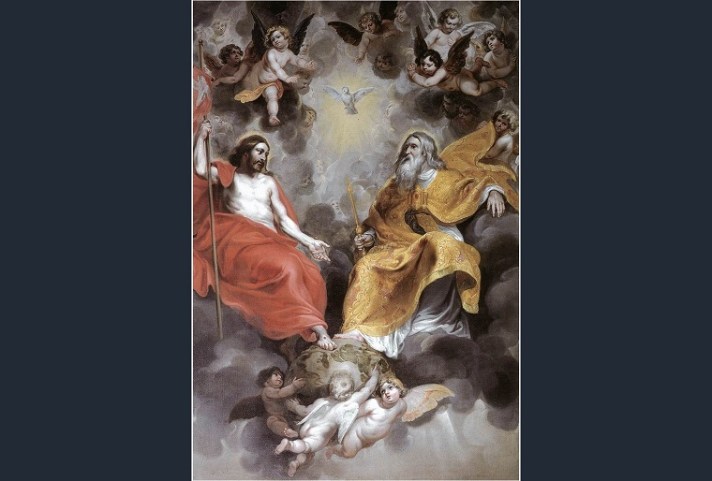
My last post addressed the question on why Jesus is called the only begotten (monogeneis) Son of God. I addressed the problem of mistaking only begotten for being created or made. Rather, only begotten refers to Jesus’ unique status as the Word become flesh — the incarnate deity. But I thought it best to offer some additional comments on the Scriptures identifying Jesus being begotten of God, particularly the way the biblical writers connected begotten with enthronement.
A primary reason for giving additional attention to this matter is the typical confounding of the biblical teaching on Jesus being begotten of God with physical procreation or sexual reproduction. For example, Brigham Young, the second president of The Church of Jesus Christ of Latter-day Saints, said, “the birth of the Saviour was as natural as are the births of our children; it was the result of natural action. He partook of flesh and blood—was begotten of his Father, as were of our Fathers.”1 Muhammad, likewise, mistook begotten for procreation, and this resulted in the greater error of rejecting the biblical teaching on Jesus being incarnate deity. Thus, the Qur’an says, “[Allah] begets not, nor is He begotten (Qur’an 112:3)2 and “Wonderful Originator of the heavens and the earth! How could He have a son when He has no consort” (Qur’an 6:101). Thus, Muhammad’s rejection of the incarnation begins with confounding being begotten with physical procreation.
Let’s look now at the biblical teaching on Jesus being begotten. In the Old Testament, the David and the successors to his throne were identified as the “begotten” of God. Psalm 2 declares, “As for me, I have set my King on Zion, my holy hill. I will tell of the decree: The Lord said to me, ‘You are my Son; today I have begotten you’” (vv. 6-7).3 Here the word “begotten”4 being used figuratively as opposed to literally. The psalmist’s declaration has to do with God establishing the rule of a king, specifically those reigning upon the throne of David, despite the uproar of all the opposing nations. Derek Kinder also notes “The words here may have been spoken as an oracle by a prophet or read out by a king…in the coronation rite, as the word today suggests, to mark the moment when the new sovereign formally took up his inheritance and his titles.”5
Similar familial terminology to describe the relationship between God and the divinely appointed king is also employed in Psalm 89: “I have found David, my servant; with my holy oil I have anointed him, so that my hand shall be established with him; my arm also shall strengthen him…He shall cry to me, ‘You are my Father, my God, and the Rock of my salvation.’ And I will make him the firstborn, the highest of the kings of the earth” (Psa. 89:20-21, 26-27). Daniel Mann notes, “God making King David His “firstborn” had nothing to do with giving birth to him, but it had everything to do with exalting him as “the highest of the kings of the earth.”6 David is then begotten of God in the sense of being enthroned as the ruler of a nation.
Paul believed all of Israel’s history came to a climax with the Savior Jesus Christ, the offspring of David, who died and rose again (Acts 13:16-31). What God promised to the fathers was fulfilled to their children (Acts 13:32-33a). The Apostle then applies to the exalted Christ: “You are my Son, today I have begotten you” (Acts 13:33b; cf. Psa. 2:7).
The Epistle to the Hebrews tells us that Jesus is the one divinely appointed to be heir of all things, He is the creator of the world, He shines with God’s glory, His essence is divine, He sustains all things by His word, He purifies sinners, and He is seated at the right hand of God (Heb. 1:2-3). Moreover, God declares to Jesus alone: “You are my Son, today I have begotten you.” On the other hand, God never makes the same declaration to the angels (Heb. 1:5, cf. Psa. 2:7).7 Jesus is then a superior revealer of God than all other prophets and angelic messengers.
Jesus being the begotten of God has nothing to do with physical birth or sexual reproduction; rather, it has to do with enthronement. Nicene Creed thus affirms Christ is “begotten, not made.”
All the good kings have disappeared. In their place are contemptible usurpers of the throne. They reign over a kingdom of darkness. Not that the evil overlords over the masses, but all too often the masses flock to enlist in their service. The darkness entices and lures us into joining into all sorts of corrupt revelries. Yet, the darkness that reigns never really offers a good life; rather, it disregards all life. It uses, abuses, and destroys the creation.
“Enemy-occupied territory,” says C.S. Lewis, “that is what this world is. Christianity is the story of how the rightful king has landed, you might say landed in disguise, and is calling us all to take part in a great campaign of sabotage.”8 God the Son has entered into this world in the person of Jesus Christ, and God the Father has declared, “You are my Son, today I have begotten you.” The Maker and rightful King is taking back His throne. Christ gives His life as a sacrifice so that we can be united with God forever. He is Lord. He is the Light of the World.
This world was never meant to be ruled by darkness, but the Light has come to start a new day. Many see the darkness for what it is and they defect to the Light. Shine on you sons and daughters of Light.
— WGN
- Brigham Young, Journal of Discourses 8:115, https://contentdm.lib.byu.edu/digital/collection/JournalOfDiscourses3/id/3413
- All passages from the Qur’an cited from M. H. Shakir, ed., The Quran (Medford, MA: Perseus Digital Library, n.d.).
- All Scripture cited from The Holy Bible: English Standard Version (Wheaton, IL: Crossway Bibles, 2016), unless noted.
- The word “begotten” is used to translate the Hebrew verb yalad. which has to do with “formally installing king into theocratic rights” (Francis Brown, Samuel Rolles Driver, and Charles Augustus Briggs, Enhanced Brown-Driver-Briggs Hebrew and English Lexicon [Oxford: Clarendon Press, 1977], 408.) The Greek verb gennao is used to translate the Hebrew verb yalad of Psalm 2 in the Septuagint, which is the Greek translation of the Old Testament, and the Greek New Testament.
- Derek Kinder, Tyndale Old Testament Commentaries: Psalms 1-72, ed. D.J. Wiseman (Downers Grove, IL: Inter-Varsity Press, 1973), 51.
- Daniel Mann, “Jesus: The ‘Begotten’ of the Father,” Christian Research Journal, 34, 2 [2011]: https://www.equip.org/article/jesus-the-begotten-of-the-father/
- Elsewhere in the same epistle, it is observed that the God who said to Jesus, “You are my Son, today I have begotten you,” likewise pronounced, “You are a priest forever, after the order of Melchizedek” (Heb. 5:5-6). Christ is then appointed to be a high priest in the order of Melchizedek. This is part of a larger discussion extending from 4:14-10:18 on the superiority of Christ’s priesthood to the Aaronic priesthood.
- C.S. Lewis, Mere Christianity (New York: Harper Collins, 1952), 46.

 Love Truth Blog