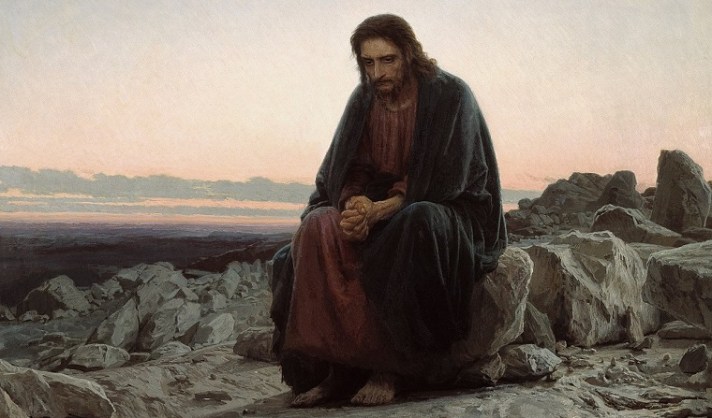
Staying home and social distancing from other people has become a sort of new but less-than-welcomed norm for us. The Triune God of the universe is a relational deity, and the human beings made in the image of God are relational creatures. We are really made for embodied social interactions. But all this extra alone time is hardly a waste. Times of solitude can even be spiritually beneficial.
Mark recalls on one occasion after “rising very early in the morning, while it was still dark,” that Jesus Christ “departed and went out to a desolate place, and there he prayed” (Mark 1:35; cf. Lk. 4:42).1 It was the Lord’s habit to pray in solitude (Mark 1:35; 6:45-46; 14:32-42; Matt. 14:23; 26:36-43; Lk. 5:16; 9:18; 22:39-46). The Lord used times of solitude to commune in prayer with the Heavenly Father. The same habit of prayer in solitude is something the Lord wants us to do too. He says, “When you pray, go into your room and shut the door and pray to your Father who is in secret” (Matt. 6:6a).2
Solitude puts us in a position to cease any performances. All guards and gimmicks are set aside since nobody is really around to take notice. Puritan minister George Swinnock pointed out that “exercising yourself to godliness in solitude will be a probable evidence of your uprightness. Men are withheld in company from doing evil by the iron curb of fear or shame, and provoked to do good by the golden spurs of praise or profit; but in solitariness there are not such rubs in the way of lust to hinder our passage, nor such baits in the way of holiness to encourage our progress.”3 Rarely do people share their most intimate thoughts and feelings out in public. If any sharing of such things goes on, it is to a trusted confidant. When we are alone with God, there is nothing to hide, for nothing is hidden from Him, and He is deeply acquainted with our lives (Psa. 139:1-6).
Our alone time can also be an opportunity to develop Christ-like character. “There are whole tracts of stubbornness and ignorance to be revealed by the Holy Spirit in each one of us, and it can only be done when Jesus gets us alone” writes Oswald Chambers.4 God can then use our times of solitude to move us one step closer to glory.
Donald Whitley tells us that “scriptural solitude is the biblical practice of temporarily withdrawing to privacy for spiritual purposes” and “it is sought in order to engage in other spiritual disciplines without some of the distractions typically experienced by the presence of people.”5 [v] Solitude provides an opportunity for one to worship through prayer and meditation upon the Scriptures. “Withdrawing from the presence of all but God,” says Whitley, “affords an excellent occasion for focused thinking about gospel truths and realities, to freshly apply the gospel to our souls again, and to reflect on the blessings and hopes that are ours through the gospel.”6
Solitude prepares the Christian for spiritual warfare. Consider, for example, the temptation in the wilderness that Jesus experienced after baptism (Matt.41-11). “The Spirit,” writes Dallas Willard, “led him into the wilderness to be tempted by the devil,” but “the place of solitude and deprivation, was actually the place of strength and strengthening for our Lord and that the Spirit led him there —as he would lead us there — to ensure that Christ was in the best possible condition for the trial.”7 Willard goes on to say, “In that desert solitude, Jesus fasted for more than a month. Then, and not before, Satan was allowed to approach him with his glittering proposals of bread, notoriety, and power. Only then was Jesus at the height of his strength. The desert was his fortress, his place of power.”8
All this solitude can be a good thing, as it provides us an opportunity to practice spiritual disciplines for the cultivation of Christ-like virtues. Loneliness can break a person; however, thing never have to always be that way. Christianity offers a way for us to use solitude as a spiritual discipline to produce in us godly virtues.
— WGN
- All Scripture cited from The Holy Bible: English Standard Version (Wheaton, IL: Crossway Bibles, 2016), unless noted.
- Solitary prayer is set in contradistinction to ostentatiously praying in public for the sake of public recognition. Jesus says, “When you pray, you must not be like the hypocrites. For they love to stand and pray in the synagogues and at the street corners, that they may be seen by others. Truly, I say to you, they have received their reward…And your Father who sees in secret will reward you” (Matt. 6:5, 6b).
- Elliot Ritzema and Elizabeth Vince, eds., 300 Quotations for Preachers from the Puritans, Pastorum Series (Bellingham, WA: Lexham Press, 2013).
- Oswald Chambers, My Utmost for His Highest: Selections for the Year (Grand Rapids, MI: Oswald Chambers Publications; Marshall Pickering, 1986).
- Donald Whitney, “The Gospel and Solitude,” https://www.ligonier.org/learn/articles/the-gospel-and-solitude/
- Ibid.
- Dallas Willard, The Spirit of the Disciplines: Understanding How God Changes Lives (New York: HarperSanFrancisco, 1988), 101-102.
- Ibid., 102.

 Love Truth Blog