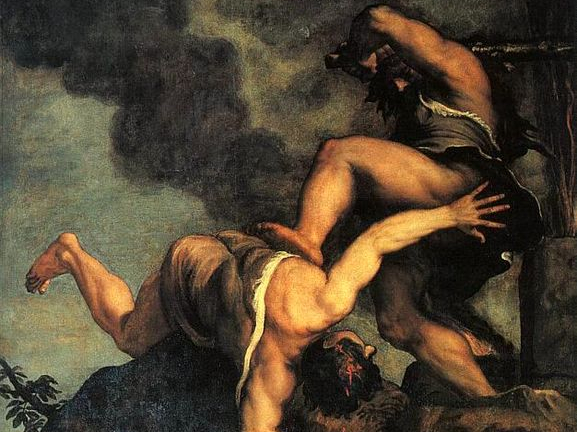
Adam and Eve had two sons, the elder was Cain and Abel was the younger. The younger became a herdsman and the elder a farmer. No sibling rivalries are mentioned but one day Cain murders Abel. Unjustified primeval fratricide! The tipping point that led to the younger brother’s demise actually happens at the altar of God. We are told, “Cain brought to the Lord an offering of the fruit of the ground, and Abel also brought of the firstborn of his flock and of their fat portions. And the Lord had regard for Abel and his offering, but for Cain and his offering he had no regard” (Gen. 4:3-5a).1 Why did God reject Cain’s sacrifice?
Both brothers present gifts according to their respective vocations. Abel makes an offering from the firstborn. Cain makes an offering of fruit. Was it because the fruits offered were grown in cursed soil (Gen. 3:17) the reason Cain’s offering was rejected? Was the pouring out of blood the reason Abel’s offering was accepted? Neither of these explanations are clear from the immediate context. Offerings from both the firstborn of the flocks and firstfruits of the fields were received by the Lord.2 Interestingly, Abel offers the “firstborn” of the flock (Deut. 15:19-23) and Cain offers fruit from the field but it is unknown whether or not the sacrifice came from the first fruits (cf. Exod. 23:19a; Lev. 2; Deut. 26:2).
What really made one offering acceptable over the other comes down to a matter of the heart. C. John Collins points out that “at no stage in Israel’s life was the operation of a sacrifice automatic: the sacrifice is effectual only for those who will offer it with a believing and contrite heart, as the prophets had to point out all too frequently.”3 Abel sought to connect with God through the sacrifice whereas Cain had a sinful disposition. The Epistle to the Hebrews informs us that “by faith Abel offered to God a more acceptable sacrifice than Cain, through which he was commended as righteous, God commending him by accepting his gifts. And through his faith, though he died, he still speaks” (Heb. 11:4). If pure worship of the Lord exists, Cain is first to bring about its corruption.
Cain became angered over the rejection of his sacrifice. He even went about with an angry countenance. Taking notice, the Lord warns: “Why are you angry, and why has your face fallen? If you do well, will you not be accepted? And if you do not do well, sin is crouching at the door. Its desire is contrary to you, but you must rule over it” (Gen. 4:6-7). Cain is really becoming unglued. Something is off about his sacrifice, God rejects it, but rather than admitting wrong, he becomes enraged. He is losing an inner battle against the temptation to do something utterly nefarious. Meredith Klein notes, “God’s warning pictures Cain’s murderous purpose like an entrance-demon (an allusion to serpent-Satan) coiled at the door of his heart, desiring to master him.”4
Sadly, the elder brother gives into temptation and slays his younger brother (Gen. 4:8). All humans are created in the image of God or imago Dei (Gen. 1:27). It is because each person bears the imago Dei that they possess an intrinsic worth, which makes each life sacred. Abel and Cain are both bearers of the imago Dei; however, the latter destroys the former. Cain is the first to commit the unjustified killing of Abel, both his brother and another human made in God’s image. This is quintessential desecration of the imago Dei.
When the Lord asks the whereabouts of Abel, the murderer answers, “I do not know” (Gen. 4:9a). This is a lie. The man obviously knows the place of his brother’s corpse. The reply, “Am I my brother’s keeper?” (Gen. 4:9b) implies a lack of guilt and responsibility over the killing. Cain is without any inclination to be the keeper over his younger brother’s well-being. Yes! We are to be our brother’s keeper. Right? Here familial love or community is corrupted.
Cain never expresses guilt over the murder of Abel but only grief over the penalties imposed upon him for the crime. The murderer says, “My punishment is greater than I can bear. Behold, you have driven me today away from the ground, and from your face I shall be hidden. I shall be a fugitive and a wanderer on the earth, and whoever finds me will kill me” (Gen. 4:13-14). H.L. Ellison notes that “Cain’s answer to God’s question (9) shows that he had lost Adam’s consciousness of nakedness before God (3:10)” and “that Cain felt no remorse is seen in his suggestion that God was being unfair to him (13).”5
Cain only worries about somebody seeking retribution for Abel — perhaps Adam, Eve, or somebody else. However, the Lord extends mercy towards the sinner. He says, “If anyone kills Cain, vengeance shall be taken on him sevenfold” (Gen. 4:15). The postdiluvian survivors were instructed: “Whoever sheds the blood of man, by man shall his blood be shed, for God made man in his own image” (Gen. 9:6). Nevertheless, Cain is allowed to move on. He flees from the presence of the Lord, settle in Nod east of Eden, take a wife and bear children (Gen. 9:16-17). The irony is that the farmer Cain winds up dwelling in Nod, which is “the land of wandering, of nomads.”6 Farming calls for settling in a place and cultivating the land, but Cain wanders about and takes up the city life. One typically finds farms in rural areas upon the outskirts of cities but only a few gardens inside, but now Adam’s eldest son becomes detached from his vocation.
All of Cain’s descendants perish in the flood; however, his name has become associated with evil, murder and identification with the Devil. John warns his flock, “We should not be like Cain, who was of the evil one and murdered his brother. And why did he murder him? Because his own deeds were evil and his brother’s righteous” (1 Jn. 3:12). Cain is the very name which “remains indelibly associated with images of anger, murder and a waywardness unchecked by wisdom, a cursed wanderer whose sage informs all who might be tempted to leave the fertile fields of faith to scavenge for existence in the barren land east of Eden.”7 These are the thorns and thistles that spout forth in a life trying to wandering away from God.
We see something far different in Abel. Having a lifetime of experiences outside of the Garden in Eden, Abel knows very well what things are like within a sinful and fallen world, but something draws him seek for a connection with Yahweh, the Creator of the all things. He makes a sacrifice from the firstborn of his flock to be an offering for the Lord. The Lord receives his offering for it had been given in faith. Abel has authentic faith; however, it never really guarantees him a long life of peace and prosperity. He is murdered. Yet, despite this tragic death, his life is far from over. Abel “still speaks” (Heb. 11:4). Murder never really ends his life. Even in the earliest chapters of human history there is a faint glimmer of a coming morning piercing through the darkest night which fell upon the Earth as the result of the fall.
Abel is among those who “died in faith, not having received the things promised, but having seen them and greeted them from afar, and having acknowledged that they were strangers and exiles on the earth. For people who speak thus make it clear that they are seeking a homeland. If they had been thinking of that land from which they had gone out, they would have had opportunity to return. But as it is, they desire a better country, that is, a heavenly one. Therefore God is not ashamed to be called their God, for he has prepared for them a city” (Heb. 11:13-16). What Abel anticipated through the sacrifice, Christians find fully realized in Jesus Christ, who “gave himself for us to redeem us from all lawlessness and to purify for himself a people for his own possession who are zealous for good works” (Titus 2:14).
Life is a moment at a crossroads. Like Abel, we can seek a better world, which is a life reconnected to God. We participate in a way of worship passed to us from Christ — the preaching of the Word, baptism, the Lord Supper, the proclamation of the Good News for the extension of God’s kingdom, the singing of psalms, hymns and spiritual songs, so forth. More than just fulfilling a check list or religious duties, our participation in worship is to be united to God the Father through faith in the Son by the power of the Holy Spirit. At the crossroads, we fall upon our knees, and ask the Lord for mercy, praying “take me if you please.”
The way of Cain leads to ruin. It is paying religious duties without really seeking a meaningful connection with God. It is a moralistic therapeutic deism. It is rage against God attempting to erase the very knowledge of the Creator out of existence within our collective consciousnesses. It is the way of self-absorption, which cares little about being our “brother’s keeper.” Waking away from the presence of the Lord, we easily loose sight of the imago Dei inherent within each person, which is the basis for the inherent worth in everyone. Everyone!
The way of Cain ends in obscurity. The way of Able is everlasting. Despite being a victim of a great injustice, the man was murdered, Adam’s youngest son still speaks.
— WGN
- All Scripture cited from The Holy Bible: English Standard Version (Wheaton, IL: Crossway Bibles, 2016), unless noted.
- A cursory read through Exodus, Leviticus, Numbers and Deuteronomy reveals a matrix of offerings of clean animals and farm produce (e.g. fruits, grain, wine, oil etc.) were made annually as part of Israelite worship. The sacrifices coincided with seasonal feasts and holy days. Priests initially offered the sacrifices to the Lord in the tabernacle and later on in the temple.
- C. John Collins, Genesis 1-4: A Linguistic, Literary, and Theological Commentary (Phillipsburg, NJ: P&R Publishing, 2006), 200.
- Meredith G. Kline, Genesis: A New Commentary (Peabody, MA: Hendrickson Publishers, 2016), 25,
- H.L. Ellison , New International Bible Commentary, ed. F. F. Bruce (Grand Rapids, MI: Zondervan Publishing House, 1979), 119.
- Ibid. 119.
- Leland Ryken et al., Dictionary of Biblical Imagery (Downers Grove, IL: InterVarsity Press, 2000), 132.

 Love Truth Blog
Why did Cain give in to anger and resentment against God, and i would say, his parents also as he had no compunction about murdering his brother and destroying the family? I think it highly likely that once he asked the age old question of his parents – where did I come from? and got the answer – he began to resent his parents stupidity – as he would have seen it, and God’s response, which basically robbed him of a life in Eden and condemned him to labouring among the thorns and thistles. Perhaps here is the root of generations of rebellion by children against parents – often thinking they don’t know what they are doing and I know better. God saw the festering anger agitated by Satan – himself all too aware of what he had lost and warned Cain but it was too late.
LikeLike