The church I attend has recently began regathering together for corporate worship after the hiatus due to the COVID-19 shutdown in the greater Charlotte area. Although we have to maintain social distancing (wear masks and sit three seats apart with every other row empty), it is still wonderful to unite with the body of Christ in worshiping God. When Israelite pilgrims entered into God’s temple, they would sing: “Give thanks to the Lord, for he is good, for his steadfast love endures forever” (Psa. 136:1).1 I believe this captures the spirit of the occasion.
Psalms 120-134 are the songs of ascent for “making the pilgrimaging to Zion for three annual feasts” but Psalm 136 was the one to sing upon “arrival at Yahweh’s sanctuary for worship.”2 This piece is the “Great Hallel” or “Great Praise.” It is meant “to be chanted antiphonally between a solo voice or special choir and the entire assembly.”3
Yahweh of Israel is the “God of gods” (v. 2) and the “Lord of lords” (v. 3). He does “great wonders” (v. 4). He is the maker of the heavens and the earth, the land and the seas, and the sun and the stars (vv. 5-9). Inasmuch as all of this is true, the resounding refrain from the psalmist’s voice is “his steadfast love endures forever.” Words like “mercy” (NKJV) and “lovingkindness” (NASB) are equivalent to “steadfast love.”4
God’s steadfast love is shown in the deliverance and preservation of His people. The psalmist tells of the Israelites being saved from enemies that sought to erase them from existence — Pharaoh of Egypt (Exod. 1:1-15:21), Sihon king of the Amorites (Num. 21:21-30; cf. Deut. 2:26-37) and Og king of Bashan (Num. 21:31-35; cf. Deut. 3:1-17). It is only on account of supernatural intervention that Israel was able to defeat these three kings on the battlefield.
The compassion Yahweh lavished upon Israel was unrelenting. For example, despite witnessing great signs and wonders from the Lord, specifically the ten plagues which culminated in the Passover, Israel’s faith still wavered. After their exodus from Egypt, the Israelites camped on the shore of the Red Sea. There they saw Pharaoh forces approaching to capture and put them back into slavery. The people then complained to Moses: “Is it because there are no graves in Egypt that you have taken us away to die in the wilderness? What have you done to us in bringing us out of Egypt? Is not this what we said to you in Egypt: ‘Leave us alone that we may serve the Egyptians’? For it would have been better for us to serve the Egyptians than to die in the wilderness” (Exod. 14:11-12). Yet, the Lord still fought on their behalf. He congealed the waters, parted the Red Sea, and allowed the Israelites to escape upon dry ground to safety. He also caused the waters to collapse upon the Egyptian forces and they were washed away (Exod. 14:13-15:19). Despite their proneness to doubt and despair, God’s steadfast endures forever.
Amazingly, God’s steadfast love even extended to the Canaanite and Amorites. The Canaanites and Amorites were far from innocent in their ways. For example, we know that
The kinds of wicked acts (Deut. 9:4-5) the Canaanites engaged in were not trivial: incest, adultery, bestiality, ritual prostitution, homosexual acts, and most significantly, child sacrifice (Lev. 18; Deut. 12:29-31). Most of these acts are illegal, even in modern Western nations. Any group practicing these actions would not be tolerated even in contemporary liberal societies, and in some jurisdictions, violators would be sentenced to death.5
The Lord used the Israelite return to the land promised to Abraham, Isaac and Jacob as the occasion to end the reigns of Sihon king of the Amorites and Og king of Bashan, two pagan kings that allowed the corruption in their realms to fester and spread. God acted within time-space to bring these evil regimes to justice. Yet, these calamities only came after every possible opportunity for them to turn from their evil ways had been exhausted. God gave the Amorites 400 years to repent (Gen. 15:13-16).
Neither did God leave the Canaanites and Amorites without a moral compass to guide them. They possessed inherent moral sensibilities, and while they were without the advantage of a prophet like Moses to give them the divine commandments etched upon stone tablets by the finger of God, natural law still allowed them to sufficiently discern right from wrong (Rm. 2:14-16). But, the Lord extended forgiveness to the penitent.
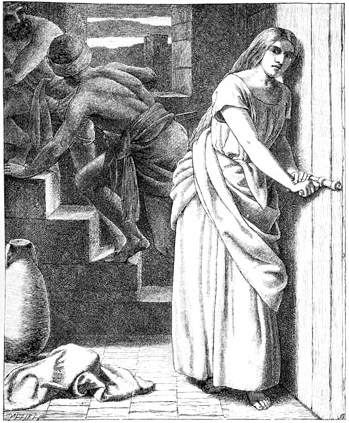
Even the news circulating about the divine judgment that fell upon Pharaoh, Sihon, and Og moved other Canaanites to repentance. Rahab, a prostitute of Jericho, hid two Israelite spies and helped them find a way out of the city. Seeking deliverance and preservation from the inevitable calamity, Rahab said,
I know that the Lord has given you the land, and that the fear of you has fallen upon us, and that all the inhabitants of the land melt away before you. For we have heard how the Lord dried up the water of the Red Sea before you when you came out of Egypt, and what you did to the two kings of the Amorites who were beyond the Jordan, to Sihon and Og, whom you devoted to destruction. And as soon as we heard it, our hearts melted, and there was no spirit left in any man because of you, for the Lord your God, he is God in the heavens above and on the earth beneath. Now then, please swear to me by the Lord that, as I have dealt kindly with you, you also will deal kindly with my father’s house, and give me a sure sign that you will save alive my father and mother, my brothers and sisters, and all who belong to them, and deliver our lives from death (Josh. 2:9-13).
Yahweh entered into the stream of history to deliver the Israelites from Pharaoh, Sihon, and Og, the news spread throughout Canaanite cities and villages, and the penitent were saved. Rahab received a scarlet chord to be a sign of protection, and she along with her family were preserved through the destruction of Jericho. These survivors subsequently dwelt among the Israelites (Josh. 2:15-21; 6:15-25).
Rahab had an authentic living faith. The Epistle to the Hebrews tells us, “By faith Rahab the prostitute did not perish with those who were disobedient, because she had given a friendly welcome to the spies” (Heb, 11:31). Likewise, the Apostle James wrote, “Was not also Rahab the prostitute justified by works when she received the messengers and sent them out by another way? For as the body apart from the spirit is dead, so also faith apart from works is dead” (Jas. 20:25-26). She even became a great matriarch among the Israelites, and from her womb came both David, Israel’s quintessential king, and the Messiah — Jesus of Nazareth (Matt. 1:1-17; cf. Ruth 4:18-20). Ruth is a living example of the way God’s steadfast love endures forever. The Lord brought her out of the kingdom of darkness and into the kingdom of light, and adopted into the family of daughters and sons of God.
We sing about the steadfast love of God, because God has proven it time and time again. God “remembered us in our low estate,” “rescued us from our foes,” and “gives food to all flesh” (vv. 23-25).
God’s steadfast love endures forever, even when we become distant and estranged from Him. When we come to our senses, find ourselves in the mire of prodigal living, and return home to the House of the Lord, His steadfast love endures forever.
— WGN
- All Scripture cited from The Holy Bible: English Standard Version (Wheaton, IL: Crossway Bibles, 2016) unless noted.
- Gordon D. Fee and Douglas K. Stuart, How to Read the Bible Book by Book: A Guided Tour (Grand Rapids, MI: Zondervan, 2002), 142.
- James Luther Mays, ed., Harper’s Bible Commentary (San Francisco: Harper & Row, 1988), 490.
- The words “steadfast love,” “mercy” and “lovingkindness” from modern Bible versions are used to translate the Old Testament Hebrew word ḥesed and the Greek word eleos from the Septuagint (LXX).
- Paul Copan and Matthew Flannigan, Did God Really Command Genocide? Coming to Terms with the Justice of God (Grand Rapids, MI: Baker Books, 2014), 75.

 Love Truth Blog