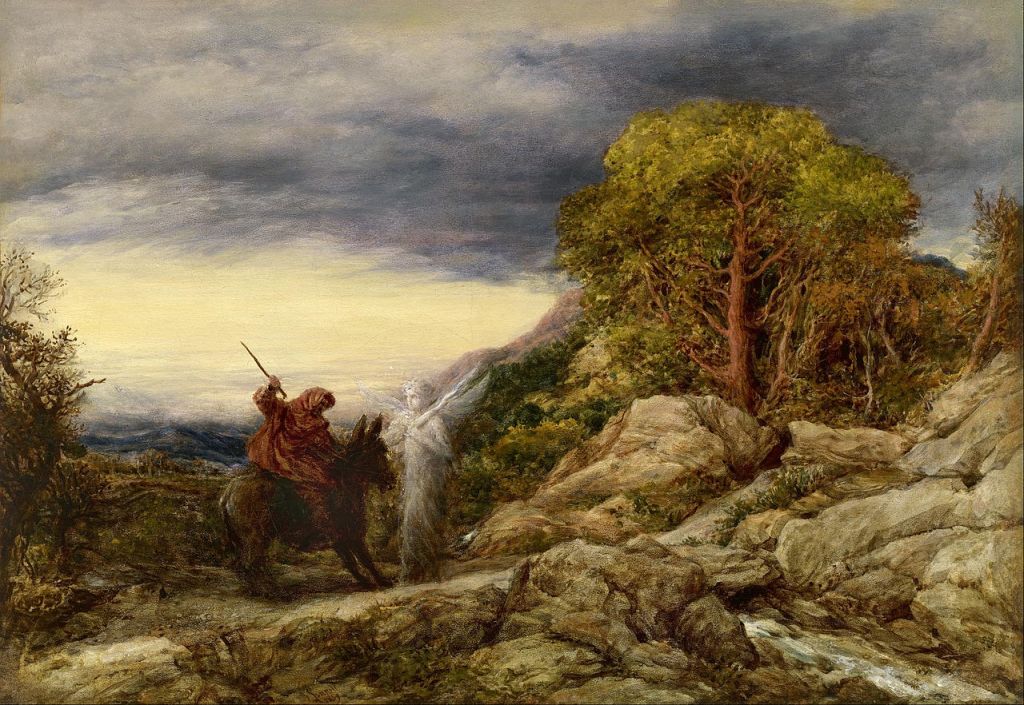
Balaam the son of Beor is truly fascinating person written about in the Book of Numbers. He is a Mesopotamian pagan soothsayer, not an Israelite, but God still speaks to and through him. Although Balaam witnesses the marvelous wonders from the Lord, such as a donkey being endowed with the capacity to speak along with a visible manifestation of the angel of the Lord, he still attempts to turn Yahweh against the Israelites, but he fails to do so, and suffers a tragic end. There are many lessons to learn from Balaam, which I will try to put forth below.
Balaam received special revelation from the Lord. The Israelites were sojourning through Moab on their way from Egypt to the promise land; however, this displeased the king of Moab, Balak the son of Zippor. He wanted to drive the Israelites out of Moab but knew that the forces of the Amorite kings Sihon and Og were utterly destroyed when they attacked the Israelites (cf. Num. 21:21-35; Psa. 136: 17-22). Balak resolves to place a curse upon the Israelites in hopes to weaken them and give his troops enough edge to drive them out of Moab.
Balak sends an envoy of elders with money to hire Balaam to pronounce the curse. The soothsayer has them spend the night so that he can receive instruction from the Lord on the matter, but God says, “You shall not go with them. You shall not curse the people, for they are blessed” (Num. 22:12).1 More than just the imagination, it is Yahweh speaking to the soothsayer. The next morning, the soothsayer declines the offer and the elders return home.
The Moabite king then decides to send a second envoy of princes with the same request. These princes were of higher social status than the elders. Balaam asks the second envoy to spend the night so that he can receive instruction from the Lord, but this time the God says, “If the men have come to call you, rise, go with them; but only do what I tell you” and “Balaam rose in the morning and saddled his donkey and went with the princes of Moab” (Num. 22:20-21).
Here is the problem: “The messengers set out to return home without calling him, and he took off after them anyway, thus violating the Lord’s condition.”2 Yahweh’s instruction to only go if the envoy calls is ignored.
Balaam witnessed marvelous wonders from the Lord. Balaam’s actions kindle the wrath of God and the angel of the Lord with a sword in hand comes to strike down the sinner. Ironically, it is the mute animal who can perceive the supernatural being whereas the professional seer is oblivious to the fact.
The donkey sees the angel of the Lord and begins to act erratically. The angel approaches, the donkey turns off the road, and the rider strikes the donkey. The angel approaches again, the donkey pushes against a wall, Balaam’s foot gets pinched between the beast and the stone, and he strikes the donkey again. The angel approaches third time, the donkey just lays on the ground, and once again Balaam strikes the beast. Next comes something extraordinary — “the Lord opened the mouth of the donkey” (Num. 22:28a).
“What have I done to you, that you have struck me these three times?” said the donkey. Balaam replies, “Because you have made a fool of me. I wish I had a sword in my hand, for then I would kill you.” The donkey retorts, “Am I not your donkey, on which you have ridden all your life long to this day? Is it my habit to treat you this way?” “No,” answers Balaam (Num. 22:28b-30).
The soothsayer concedes that the donkey is acting abnormally and the creature has never been known to be difficult to ride. Amazingly, the diviner of spiritual mysteries fails to realize he is actually having a conversation with a speechless animal in the presence of the angel of the Lord! Ronald B. Allen in the Expositor’s Bible Commentary points out that “the internationally known seer is blind before the living God on the path,” but “here his animal saw what he was blind to observe.”3
Aesop wrote many fables that featured talking animals, like the one about the fox and the grapes, but we never suppose the ancient Greek storyteller was conveying history. Yet, Moses hardly appears to be passing on fables but a historical narrative concerning the soothsayer Balaam the son of Beor. God enables a donkey to speak with its rider. Put it another way: “What keeps this story from the genre of legend or fairy tale is the clear factor that the animal did not speak of its own accord but as it was given the power to do so by the Lord. Only an exceeding limited view of God would deny him the ability to open the mouth of a dumb animal.”4
Miracles are extraordinary occurrences which can only be attributed to God, as opposed any natural phenomena. A donkey is typically incapable of conversing in the speech and language of humans, but Balaam’s donkey is an exceptional case. Although one never sees miracles happening all the time, as they are non-normative, but this hardly makes them impossible. We are wise to keep an open mind to the miraculous.5
The Lord then opens Balaam’s eyes, and seeing the angel of the Lord, he falls prostrate upon the ground. “Why have you struck your donkey these three times? Behold, I have come out to oppose you because your way is perverse before me. The donkey saw me and turned aside before me these three times. If she had not turned aside from me, surely just now I would have killed you and let her live,” says the angel of the Lord. Balaam cries out, “I have sinned, for I did not know that you stood in the road against me. Now therefore, if it is evil in your sight, I will turn back.” The angel of the Lord then reiterates the previous instruction: “Go with the men, but speak only the word that I tell you” (Num. 29:32-35). Interestingly, Balaam “bowed down and fell on his face” (Num. 22:31), but the angel of the Lord remains silent about this fact, which suggest the encounter may very well be with the preincarnate Christ, since non-divine good spirit would refuse to receive the same kind of worship due only to God (Rev. 22:8).
A donkey supernaturally endowed with speech, a visible manifestation of the angel of the Lord, and spiritually blind eyes being given the ability to see the unseen, Yahweh made Himself known to Balaam.
Balaam was used by the Lord to speak blessings upon Israel. The soothsayer meets up with Balak, seven altars are erected and seven bulls along with seven rams are sacrificed as burnt offerings, but the Spirit of the Lord only permits the oracle to speak blessings upon Israel. This is done three times in three different places with the same outcome. Much to his own chagrin, Balak finds out that “God is not man, that he should lie, | or a son of man, that he should change his mind” (Num. 23:19).
Balak and Balaam then go their separate ways.
Here the Abrahamic covenant is being upheld. As Balaam says, “Blessed are those who bless you, | and cursed are those who curse you” (Num. 24:9), so too Yahweh promises Abraham, “I will bless those who bless you, and him who dishonors you I will curse, and in you all the families of the earth shall be blessed” (Gen. 12:3). It is because God “loved” Israel, that He “turned the curse into a blessing” (Deut. 23:5).
God had led the Israelites for forty years through the wilderness. The four hundred years that the descendants of Abraham were to live outside their promise land were coming to an end and the iniquity of the Amorites was just about complete (Gen. 15:13-16). The Lord thus uses Balaam to pronounce the arrival of the Israelites from Egypt along with the coming day of reckoning for Moab and surrounding pagan nations (Num. 24:15-24).
We can also point out up to this point nobody was beyond hope. Whereas Balak knew what the Israelites had done to the Amorite kings Sihon and Og yet wrongly chose to fight against the Israelites and their God (Num. 22:1-6), Rahab knew of the same things and she sought mercy and mercy she received. Moreover, she and her family were assimilated into the Israelite community (Josh. 2:1-24; 6:1-27).
Caleb the son of Jephunneh was likewise faithful to God (Num. 14:24), and he played a key role in bringing the Israelites across the Jordan into the promise land (Josh. 1, 15); yet, he is specifically identified as a “Kenizzite” (Josh. 14:6; 1 Chron. 4:14-15). The Kennizites were “a leading Edomite family, tracing descent from Eliphaz, Esau’s eldest son (Gn. 36:11, 15, 42; 1 Ch. 1:36, 53).”6 Caleb is another non-Israelite faithful worshiper of Yahweh who gets to partake in the blessings of the Abrahamic covenant. To all who repent, God will nowise cast out.
Moses is even careful to remind the Israelites: Do not say in your heart, after the Lord your God has thrust them out before you, “It is because of my righteousness that the Lord has brought me in to possess this land,” whereas it is because of the wickedness of these nations that the Lord is driving them out before you. Not because of your righteousness or the uprightness of your heart are you going in to possess their land, but because of the wickedness of these nations the Lord your God is driving them out from before you, and that he may confirm the word that the Lord swore to your fathers, to Abraham, to Isaac, and to Jacob (Deut. 9:45). As such, if the Israelites fell into the same abominable practices as the Canaanites, they too would be exiled from their promise land (Deut. 18:9-14; Lev. 18:1-30).
It is never the absence of divine revelation that condemns but the despising of the divine revelation received that condemns.
Balaam perished for leading the Israelites into idolatry. Balaam failed at invoking the Lord to curse the Israelites but succeeded in getting the Israelites to commit idolatry, the worship of the pagan god Baal of Peor in particular. He did this by encouraging Midianite women to invite the Hebrew men into their cultic practices. The soothsayer seduced thousands of Israelites to forsake their covenant with the Lord and the seducer along with the seduced perished in the wilderness (Num. 25:1-16; 31:1-20).
Balaam hears the voice of the Lord, he witnesses the miraculous, namely his donkey being supernaturally endowed with speech along with the visible manifestation of the angel of the Lord, through him the Spirit of the Lord pronounced blessings upon Israel, but why did the soothsayer persist in trying to destroy the Israelites? Balaam was blinded by his own greed.
New Testament writers equate the name Balaam the son of Beor with greed and seduction. Peter warns of false teachers in the midst of Christian assemblies who “have followed the way of Balaam, the son of Beor, who loved gain from wrongdoing, but was rebuked for his own transgression; a speechless donkey spoke with human voice and restrained the prophet’s madness” (2 Pet. 2:15-16; cf. Jude 11).
A divination fee for setting the curse had been provided for Balaam (Num. 22:7), albeit the soothsayer admits he could only speak the words the Lord gives regardless of the amount of payment received. He says, “Though Balak were to give me his house full of silver and gold, I could not go beyond the command of the Lord my God to do less or more” and “If Balak should give me his house full of silver and gold, I would not be able to go beyond the word of the Lord, to do either good or bad of my own will. What the Lord speaks, that will I speak’?” (Num. 22:18; 24:13). All this appears to be noble but it is an attempt to hide his own greed.
What Peter states concerning the soothsayer’s greed comports with what other first century Jewish interpreters of the Scriptures. D.A. Carson notes, “Balaam’s love for money surfaces in the work of Philo (Moses 1.268; Cherubim 33–34). Especially in the rabbinic literature one finds a strong emphasis on the view that Balaam ultimately received the appropriate ‘wages’ of his wickedness: he was killed by Israel (Num. 31:8; cf. Sipre Num. 157 on Num. 31:9; Num. Rab. 22:4).”7 Balaam’s underlying greed suspected by Philo and other Jewish interpreters of the Pentateuch is confirmed with Peter under the inspiration of the Holy Spirit.
The Apocalypse, likewise, tells of Balaam’s greed. In the epistle to the church at Pergamum, the Lord says, “But I have a few things against you: you have some there who hold the teaching of Balaam, who taught Balak to put a stumbling block before the sons of Israel, so that they might eat food sacrificed to idols and practice sexual immorality. So also you have some who hold the teaching of the Nicolaitans. Therefore repent. If not, I will come to you soon and war against them with the sword of my mouth” (Rev. 2:14-16).8
Balaam is the one who gives up eternal heavenly treasures for temporal earthly treasures which can be destroyed by moths and rust or stolen by thieves. He gains the world yet forfeits his own soul. He holds on to things that ought to be discarded and neither acquires the treasure hidden in the field nor the oyster with the pearl of great price. What happens to Balaam comports well with the words of Paul: “Those who desire to be rich fall into temptation, into a snare, into many senseless and harmful desires that plunge people into ruin and destruction. For the love of money is a root of all kinds of evils. It is through this craving that some have wandered away from the faith and pierced themselves with many pangs” (1 Tim. 6:9-10).
Nevertheless, for every breath we take, there is still the opportunity to leave behind worthless vanities and receive by the grace of God an eternal treasure of infinite worth. Realize that apart from the Lord we are but wallowing in the mire and craving food meant for the swine. So, get up, go back to the House of the Lord, and here He comes running to bring us in as His own daughters and sons.
— WGN
- All Scripture cited from The Holy Bible: English Standard Version (Wheaton, IL: Crossway Bibles, 2016), unless noted.
- Roy E. Gane, The Baker Illustrated Bible Commentary, ed. Gary M. Burge and Andrew E. Hill, (Grand Rapids, MI: Baker Books, 2012), 137.
- Ronald B. Allen, The Expositor’s Bible Commentary, vol. 2, ed. Frank E. Gaebelein (Grand Rapids, MI: Zondervan Publishing House), 893.
- Ibid., 893-894
- For further related reading, see “Hendrik van der Breggen, “The Seeds of Their Own Destruction,” Christian Research Journal, 30, 1 [2007]: https://www.equip.org/article/seeds-destruction/, James N. Anderson, “The Inescapability of God,” Christian Research Journal, 40, 5 [2017]: https://www.equip.org/article/the-inescapability-of-god/ and Paul Chamberlain, “Why People Stop Believing,” Christian Research Journal, 41, 4 [2018]: https://www.equip.org/article/why-people-stop-believing/
- J. P. U. Lilley, New Bible Dictionary, ed. ed. D. R. W. Wood et al (Downers Grove, IL: InterVarsity Press, 1996), 643.
- D. A Carson, “2 Peter,” in Commentary on the New Testament Use of the Old Testament (Grand Rapids, MI; Nottingham, UK: Baker Academic; Apollos, 2007), 1056.
- The Nicolaitans severely compromised the purity of Christ’s teachings, although there is uncertainty of the origin of this early schism. Steve Gregg notes: “A tradition having the support of some of the early church fathers identifies the Nicolaitans with the followers of Nicolas, who was one of the seven men selected to serve the church in Acts 6:5, but later became a heretical teacher. Some modern commentators (e.g., F. F. Bruce) suggest that Nicolas was a disciple of the Gnostic heretic Cerinthus. Whoever the Nicolaitans may have been, their teaching is compared, in verse 15, with that of Balaam, who advocated sinful license in idolatrous practices and sexual immorality. Jesus shared the Ephesian church’s hatred for this movement, which also had some advocates in the church of Pergamos (v. 15)” (Steve Gregg, Revelation, Four Views: A Parallel Commentary [Nashville, TN: T. Nelson Publishers, 1997], 64–65).

 Love Truth Blog