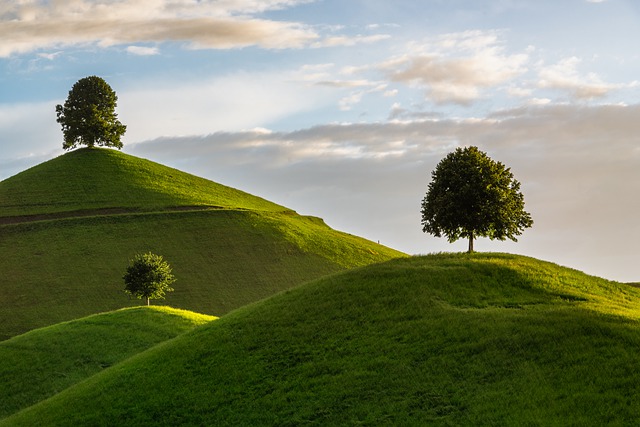
Trees play a significant role in our lives that is taken for granted. They absorb carbon dioxide release oxygen, regulating greenhouse gases. They filter pollution out of the air we breathe and the water we drink. They provide homes for wildlife. They give us shade protecting us from life threatening heat. They provide fruits and nuts to eat. The wood from trees can be used as fuel for fire or materials for constructing homes, carving works of art, and crafting musical instruments. Trees stand tall, they live for eons, and their steadfastness makes them useful landmarks, giving us an enduring reference point to find our way from place to place, especially in places where the streets have no names.
God even saw fit to set three trees to mark key turning points in the unfolding plan of redemption revealed in the Scriptures — the tree of life, the tree of the knowledge of good and evil, and the tree of the cross. We are all on an eternal journey and these three trees intersect each of our lives. The trees teach us. If we are teachable, they can direct us in the way to go. Our response to the guidance of these trees makes all the difference in the world.
The Lord planted a garden in Eden and “the tree of life was in the midst of the garden, and the tree of the knowledge of good and evil” (Gen. 2:9).[1] Adam was created by the Lord and appointed to tend the garden. Out of the rib of the man, the Lord created Eve to be a suitable helper to Adam. The Lord then said, “You may surely eat of every tree of the garden, but of the tree of the knowledge of good and evil you shall not eat, for in the day that you eat of it you shall surely die” (Gen. 2:16-17).
It was the crafty serpent whom tempted Eve to partake of the forbidden fruit. “Did God actually say, ‘You shall not eat of any tree in the garden’?” asked the serpent (Gen. 3:1). More than just an inquiry for clarification, it is a loaded question meant to generate doubt. The serpent then adds, “You will not surely die. For God knows that when you eat of it your eyes will be opened, and you will be like God, knowing good and evil” (Gen. 3:4-5).
Eve and Adam must have thought: “Maybe the Lord is really holding something back from us?” “Why is God saying ‘No’ in the first place, after all the fruit looks good enough to eat?” “What is so wrong with having our eyes opened and being like God in knowing good and evil?” Even then ate the fruit from the tree of knowledge, she then served some to Adam, he ate, and they both lost their innocence and tried to hide their guilt by covering themselves with fig leaves.
The serpent contradicted the Lord, but what the Lord said was the truth. Death came to Adam and Eve as the result of their own disobedience in eating the forbidden fruit from the tree of knowledge. Although death was not immediate in their cases, it was inevitable, and the fact that they lived many years after the partaking of the forbidden fruit is inconsequential. Why? Adam and Eve were created to live eternally with God, but they lost their immortality on account of sin. Cherubim and a flaming sword would keep them from partaking in the tree of life and they were unable on their own to attain the fruit that would allow them to live forever.[2]
When Adam and Eve ate from the tree of knowledge, they took for themselves a prerogative only meant for God. Instead of receiving the instruction of the Lord, they went the way of doing whatever was right in their own eyes. They set out to defined for themselves their good and evil, right and wrong, truth and fiction. Unfortunately, they lost the objective point of reference for moral knowledge, which is rooted in the Moral Law Giver. The very ground for moral decision making was lost, and the outcome was a topsy-turvy world with everchanging opinions on what is good, right and true yet notion of enduring substance ever remains.
The very image of God (imago Dei) imbued in the man and woman was defaced as the result of eating from the tree of knowledge. They ceased reflecting the light of God’s glory, and they plunged into darkness. Humanity was severed from the source of life, and just as the branch withers and dies once severed from the vine that provides its vital nutrients, so death comes to humanity once served from a right relationship with God. All the disorder — enmity with the serpent, pain in child birth, marital difficulties, fruitless labor, and death — results from humanity’s estrangement from their Creator.
God never left fallen humanity in their miserable fallen condition of sin and death. The Father sends the Son to be born of a virgin. His name is Jesus Christ. He dies upon the tree of the cross for sinners, and rises again on the third day that whosoever believes in Him shall not perish but have everlasting life. Peter writes, “He himself bore our sins in his body on the tree, that we might die to sin and live to righteousness. By his wounds you have been healed” (1 Pet. 2:24). Likewise, Paul states, “Christ redeemed us from the curse of the law by becoming a curse for us—for it is written, ‘Cursed is everyone who is hanged on a tree’” (Gal. 3:13). This is good news. It is through the crucifixion that Christ takes upon the curse of sin and suffers on behalf of fallen people. He dies so others can live.
The crucifixion is the apex of redemptive history. It is the epicenter of a wave of saving grace which is able to erase the curse of sin. Here is another way to put it:
Sandwiched between Genesis and Revelation is the tree, the cross of salvation, which is the ultimate ground of both curse and blessing, judgment and healing. The apostle Paul (Gal 3:13) speaks of the curse on the sin-bearing Savior who hung on the tree, a theme picked up again by the apostle Peter (1 Pet 2:24). These draw upon the OT tradition (Deut 21:23) that an executed person who is hung on a tree is under God’s curse. The cursing of Christ brought about both the destruction of death and the renewal of life and immortality through the gospel; all this came through the tree.[3]
Christ makes it possible to partake in the tree of life. An angel revealed to the John “the river of the water of life, bright as crystal, flowing from the throne of God and of the Lamb through the middle of the street of the city; also, on either side of the river, the tree of life with its twelve kinds of fruit, yielding its fruit each month. The leaves of the tree were for the healing of the nations” (Rev. 22:1-2). The imagery draws from Ezekiel 47:1-12, Joel 3:18, Zechariah 14:6-9 and Genesis 2:5-24, and looks forward to a time when “God ‘will make the end like the beginning’ (Barn. 6:13), though the consummated garden will exist on an escalated scale in comparison to the first.”[4] One day Paradise lost will become the Paradise restored. The very glory of the latter will surpass the former.
Those who receive the tree of life are faithful to Christ. “To the one who conquers I will grant to eat of the tree of life, which is in the paradise of God,” says the Lord (Rev. 2:7). The Apostle John, likewise, tells us, “Blessed are those who wash their robes, so that they may have the right to the tree of life and that they may enter the city by the gates” (Rev. 22:14) and “I warn everyone who hears the words of the prophecy of this book: if anyone adds to them, God will add to him the plagues described in this book, and if anyone takes away from the words of the book of this prophecy, God will take away his share in the tree of life and in the holy city, which are described in this book (Rev. 22:18-19).
The Christian is to remain in Christ. The Lord says, “I am the true vine, and my Father is the vinedresser…Abide in me, and I in you. As the branch cannot bear fruit by itself, unless it abides in the vine, neither can you, unless you abide in me. I am the vine; you are the branches. Whoever abides in me and I in him, he it is that bears much fruit, for apart from me you can do nothing” (Jn. 15:1, 4-5). Vital life support is channeled from Christ to the Christian. The tree sustains the life of the branches, but the severed branch is cut off from the source of life, and it withers and dies. People cut off from the Lord are severed from their source of life. It is for those in union with Christ that everlasting life becomes a reality.
God gives life to the Christian through Christ. We were dead in our sins, but on account of the mercy and grace of God, we are saved by grace through faith in Jesus Christ, and we are the workmanship of God created for good works, which was meant to be from the very beginning (Eph. 2:1-10). We were once no people but we are now God’s people, never before given mercy now receiving mercy, God has called us out of darkness into His marvelous light, and sets us up as a chosen race, a royal priesthood, a holy nation, a people of his own possession, and these excellencies of God we will proclaim (1 Pet. 2:9-11). Christians are united with Christ, and eternal life flows from Christ to the Christian. He is the vine and we are the branches.
Union with Christ makes it possible for us to find our way back to Eden and eat from the tree of life.
Daily we come face to face with depravity, deceptions, disease, death, and decay. These are all symptoms of life in a sinful and fallen world. We hurt on account of the sins of others. Others hurt on account of our sins. Nobody is innocent. The victim is the perpetrator and the perpetrator is the victim. Our world experiences devolution and degeneration because we have been severed from our source of life.
Lent is that season wherein we take time to grieve over human sinfulness. We repent and call upon the Lord for forgiveness. All this prepares us for Good Friday and Easter Sunday. Christ death upon the tree of the cross establishes the way that we can be restored to God. He puts an end to the curse that brings about depravity, deceptions, disease, death and decay. Our life really begins with our union with Christ. When we are in union with Christ will we be reconnected to the source of life, the very life that can sustain us forever. Just as Christ rose from the dead on the third day, we who are in union with Christ, though we die, we will live. God will resurrect us immortal, imperishable, incorruptible.
Some go by the maxim YOLO (i.e., “you only live once”). This is shortsighted. Sure we can never get back wasted opportunities, but there is more to this life than the present moment. We actually only die once, but then comes the judgment (Heb. 11:27).[5] Our lives are potentially infinite and death is one transition along the way. When Jesus Christ appears again, the dead shall be raised from the graves. The saints shall be resurrected to eternal life but the unrighteous to eternal condemnation in the lake of fire (Acts 1: 9-11; John 5:28-29; 1 Cor. 15:1-58; 2 Cor. 5:9-10; Heb. 9:27-28; Dan. 12:2; Rev. 20:11-12).
— WGN
[1] All Scripture cited from The Holy Bible: English Standard Version (Wheaton, IL: Crossway Bibles, 2016), unless noted.
[2] If Adam and Eve obeyed the Lord’s commandment, and rejected the serpent, it is plausible that God would have allowed them to eat from the tree of life and even granted them permission to eat from the tree of knowledge (cf. Hank Hanegraaff, Truth Matters, Life Matters More: The Unexpected Beauty of an Authentic Christian Life [Nashville, TN: Thomas Nelson, 2019], 105-106).
[3] Leland Ryken et al., Dictionary of Biblical Imagery (Downers Grove, IL: InterVarsity Press, 2000), 890.
[4] G. K. Beale and Sean M McDonough, “Revelation,” in Commentary on the New Testament Use of the Old Testament (Grand Rapids, MI; Nottingham, UK: Baker Academic; Apollos, 2007), 1154.
[5] For an excellent critique on the YOLO maxim, see Anne Kennedy, “You Only Die Once: Why It’s Okay Not to Live in the Present,” Christian Research Journal, https://www.equip.org/article/you-only-die-once-why-its-okay-not-to-live-in-the-present/

 Love Truth Blog
One thought on “Three Trees on the Way to Eternity”