“Cast me not away from your presence, | and take not your Holy Spirit from me” (Psa. 51:11).[1] This is without a doubt one of the most provocative lines from Hebrew poetry. Take away the Holy Spirit? What does this mean? Is David afraid of being eternally condemned to hell? Did he have something else in mind? What is it?
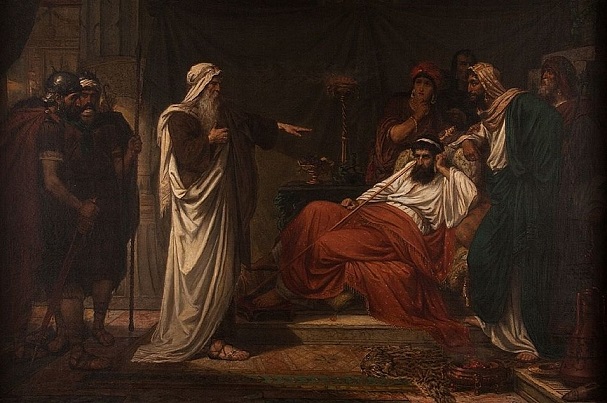
Psalm 51 pours out from David’s broken and contrite heart over transgressions committed before the Lord. This is his response to the Word of the Lord spoken through Nathan the prophet exposing the affair with Bathsheba, the wife of Uriah the Hittite,[2] and the subsequent murder of the husband to cover up the misdeed. The prophet rebukes the wayward king and coming to a true evaluation, David confesses, “I have sinned against the Lord” (2 Sam. 12:13; cf. 11:1-12:15).
David understood the weight of his transgressions and seeks the Lord for mercy, forgiveness, and reconciliation. If there is any positive move forward from the scandal, he knows it is never going to happen apart from God. He cries out: “Cast me not away from your presence, | and take not your Holy Spirit from me” (Psa. 51:11). The wayward monarch dreads the very thought of being separated from presence of the Lord.
It is doubtful that David fears the removal of the Spirit will set him upon an irreversible life trajectory towards eternal damnation (i.e., a loss of salvation). The very fact that Yahweh sends Nathan to confront His servant shows that the Lord is still extending grace and opportunity to repent. If grace for redemption and forgiveness is available, David is far from despising it, but he is earnestly seeking for it. Neither does Psalm 51 hint at anything to come beyond the grave.[3] It has to do with sins committed by David related to the violation of Bathsheba. Death would have certainly been the penalty for a man guilty of premeditated murder and adultery as stipulated in the Mosaic Law (Num. 35:30-31; Lev. 20:10; Deut. 22:22), but David’s life is spared (1 Sam. 12:13).
But David knows nothing good comes from a life apart from God and “to have that presence removed or to be excluded from communion with God is the ultimate punishment imaginable. On a national scale it would be the end of the covenant relationship and the total destruction of the people…For a reigning monarch, who is God’s representative, being cut off from Yahweh’s voice or presence would be the signal that his dynasty has been rejected and will come to an end.”[4]
David even understands what life could be like apart from the presence of the Lord. He had witnessed from the life of Saul the misery that comes with the removal of the Holy Spirit.
Saul was anointed to be the king of Israel, the Spirit of the Lord came upon him, and he prophesied before the people (1 Sam. 9:1-10:13). Unfortunately, Saul failed at being a faithful God-fearing king. Israel’s first monarch offered profane worship to the Lord, and failed to fulfill the “ban” (harem or devotion to total destruction or) placed upon certain Amalekites for their persistent opposition to God and His people.[5] Saul’s disobedience resulted in God transferring the rule of Israel to a man after His own heart (1 Sam. 13:1-15; 15:1-34; cf. Exod. 17:8-13). Afterwards “the Spirit of the Lord departed from Saul, and a harmful spirit from the Lord tormented him” (1 Sam. 16:14). David received an appointment as a court musician to play the lyre for the purpose of soothing the king whenever he became afflicted by the harmful spirit (1 Sam. 16:15-23). But upon more than one occasion, Saul attempted to run a spear through David (1 Sam. 18:5-11; 19:9-10). The removal of the Spirit left Saul deranged. His life came to a tragic end, after attempting to consult the death through a pagan medium, he perished in battle against the Philistines (1 Sam. 28:1-24; 31:1-13).
Removal of the Spirit meant for David “more than the loss of his ability to govern in Jerusalem;” rather, the “he feared losing the indwelling comfort and help of the Paraclete himself. That would be tantamount to standing outside the presence of God.”[6] Great offenses were done before the eyes of the Lord, but being a man after God’s heart, David sought for mercy, purification, and restoration. More than anything else, David yearns to be restored to a right relationship with Lord. This is the core of what Psalm 51 is all about.
Psalm 51 reminds us that there will be occasions to lament and grieve over our own sinfulness. Our lives are stained by sin yet God is holy, holy, holy. But when we sin in thought, word, or deed, the Spirit is grieved (Eph. 4:30) and quenched (1 Thess. 5:19). Our transgression estranges us from God, who is source of life. Things need to be set to right. David stumbles; yet, being a man after God’s own heart, he comes before the Lord with a humble and contrite heart seeking mercy, purification, and restoration. We too must do likewise. From Christ we receive the grace that restores us into fellowship with God. He redeems us from the bondage of sin. He cleanses us from unrighteousness. He heals from the infirmity of sin that could never be cured otherwise. He cloaks us in righteousness. He makes atonement to appease the wrath of a holy and righteous God.
“Thy Spirit is my wisdom, leave me not to my folly; he is my strength, O desert me not to my own weakness. Drive me not away from thee, neither do thou go away from me. Keep up the union between us, which is my only hope of salvation. It will be a great wonder if so pure a Spirit deigns to stay in so base a heart as mine; but then, Lord, it is all wonder together, therefore do this, for thy mercy’s sake, I earnestly entreat thee.”[7]
— WGN
Notes:
[1] All Scripture cited from The Holy Bible: English Standard Version (Wheaton, IL: Crossway Bibles, 2016), unless noted.
[2] Bathsheba was essentially power raped, as she could never really have maintained her fidelity without suffering the consequence of disobeying the king.
[3] We find the future dealt with in other portions of the Old Testament: Daniel 12:1-2; Isaiah 65:17-66:24; Job 19:25-27.
[4] Victor Harold Matthews, Mark W. Chavalas, and John H. Walton, The IVP Bible Background Commentary: Old Testament, electronic ed. (Downers Grove, IL: InterVarsity Press, 2000), Ps 51:11.
[5] For response to criticisms about the God of the Old Testament calling for the genocide of nations, cf. Paul Copan and Matthew Flannagan, “Was Israel Commanded to Commit Genocide?” Christian Research Journal, 34, 5 (2011): https://www.equip.org/article/israel-commanded-commit-genocide/ A lengthier treatment on the same subject can be found in Paul Copan and Matthew Flannagan, Did God Really Command Genocide? Coming to Terms with the Justice of God (Grand Rapids, MI: Baker Books, 2014).
[6] Walter C. Kaiser Jr. et al., Hard Sayings of the Bible (Downers Grove, IL: InterVarsity, 1996), 274.
[7] Charles Haddon Spurgeon, Treasury of David, https://archive.spurgeon.org/treasury/ps051.php

 Love Truth Blog