“I believe in one God, Father Almighty, Creator of heaven and earth, and of all things visible and invisible.” Thus begins the Nicene Creed. The creedal framers were convinced that the eternal God spoke all things into existence. This belief reflected hearts and minds deeply influenced by the constellation of biblical texts that testified to the all things coming into existence by the decree of God. They were holding fast to what had been taught by Moses and the prophets in the Old Testament and Christ and the apostles in the New Testament.
One of the bright stars in that Scriptural constellation on our Maker comes from the heart and mind of David, who proclaims:
For you formed my inward parts;
you knitted me together in my mother’s womb.
I praise you, for I am fearfully and wonderfully made.
Wonderful are your works;
my soul knows it very well.
My frame was not hidden from you,
when I was being made in secret,
intricately woven in the depths of the earth.
Your eyes saw my unformed substance;
in your book were written, every one of them,
the days that were formed for me,
when as yet there was none of them.How precious to me are your thoughts, O God!
How vast is the sum of them!
If I would count them, they are more than the sand.
I awake, and I am still with you (Psa. 139:13-18). [1]
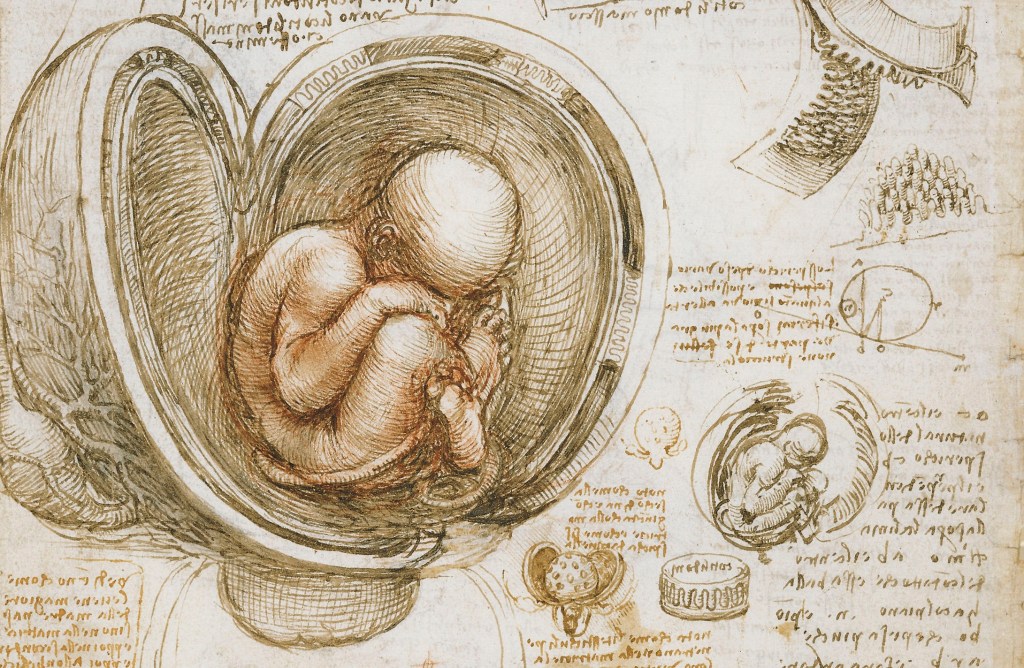
God is intimately involved in David’s life and David expresses this truth in vivid poetic images. God fashions the psalmist from inside his mother’s womb (v. 13). What goes on inside the womb is a mystery to David; yet, he realizes that God knows all that happens inside there, and He is even involved in the entire process. The psalmist sees himself as being “fearfully and wonderfully made,” and praises the Lord for His wonderful works (v. 14). Nothing was hidden from the God’s eyes as He oversaw the psalmist being constructed inside the secrecy of his mother’s womb (vv. 15-16a). The very book of David’s life is authored by the Lord (v. 16b). God thoughts about the psalmist are precious countless (vv. 17-18a) and David always awakes in the presence of the Lord (v. 18b). The life of the psalmist matters to the Lord.
David possessed the knowledge, strength and talents to tend flocks, play the lyre, compose psalms, dance, lead troops, and rule a kingdom; yet, none of these things really determined his true worth. Even if the psalmist lost the abilities to do any of these things, the true value of his life still remains. His inherent moral worth never changes regardless of the gain or loss of any ability. The psalmist possesses intrinsic worth because he has been made by God, and this makes all the difference in the world.
The mystery of the child developing inside the womb known and superintended by God leaves David in awe and wonder. The psalmist responds in worship and praise. Yet, even though modern science has discovered a great many things about human biology, reproduction in particular, we are nonetheless left in awe and wonder in the complex beauty of what has been discovered. There are hundreds of different types of cells that make up the trillions of cells comprising the human body, each cell contains its own miniature factory, warehouse, transport system, and power plant, yet each cell connects and communicates with all other cells in the body, and the cells work together as a unit.[2] But it is the genetic information contained in DNA (deoxyribonucleic acid) that determines the form and function of the cell within the body. This information is unlikely to have come about by random unguided processes; it is far too complex for that, rather, it is best understood to be the result of intelligence. [3] Information rich human DNA ultimately points to the mind of a Maker. Moreover. human consciousness and rationality along with the philosophical foundations for doing science presuppose the existence of God.[4] We are made by God, and God is worthy of praise for His wonderful works.
Atheists interject: If there is a Maker, why are we so badly designed? One example given to prove the point is the human eye. Michael Shermer purports, “For optimal vision, why would an intelligent designer have built an eye upside down and backwards? This ‘design’ makes sense only if natural selection built eyes from available materials, and in the particular configuration of the ancestral?”[5]
Any apparent design flaw in the healthy functioning human eye really has nothing to do answering the question of whether or not the human eye is the product of an intelligent designer. Even if the healthy functioning human eye could supposedly be improved upon, such never precludes an intelligent designer. William Dembski and Sean McDowell explain:
Shermer has overlooked a basic point, however: design does not have to be perfect—it just has to be good enough. Imperfection speaks to the quality of design, not its reality. Consider successive versions of the iPod. The various versions have minor imperfections, but each clearly was designed; none evolved without guidance from programmers. Our ability to envision a better design hardly means the object in question lacks design.
What is true for the iPod is also true in biology. Living systems bear unmistakable marks of design, even if such design is, or appears to be, imperfect. In the real world, perfect design does not exist. Real designers aim for the best overall compromise among constraints needed to accomplish a function. Design is a give-and-take process. For instance, a larger computer screen may be preferable to a smaller one, but designers must also consider cost, weight, size, and transportability. Given competing factors, designers choose the best overall compromise—and this is precisely what we see in nature….
What about the human eye? Is the eye built upside-down and backwards, as many critics of design argue? Despite common claims that the eye is poorly designed, there actually are good reasons for its construction, and no one has demonstrated how the eye’s function might be improved without diminishing its visual speed, sensitivity, and resolution.[6]
Human eyes function within certain capacities, though there are certain things our naked eyes are unable to detect. We cannot see everything in the light spectrum, like gamma rays, x-rays, ultraviolet, infrared, microwaves and radio waves. But such neither constitutes a flaw in the design nor the designer. There is a constrained optimization with human eyes but the light we can detect with our eyes allows us to have adequate vision in this world to go about our lives.
Even if examples of human eye components can be identified in other lifeforms, such never really necessitates a common descent. Nor does it tell us that the human eye is the result of a random unguided coalescing of components from eyes of other lifeforms that was naturally selected as the fittest for homo-sapiens among other random coalescing of parts that came about. Random unguided process makes a terrible inventor.
Common components to all car engines are pistons and gears. While we can find gears and pistons in both the iconic Ford Model T and the Lamborghini Sián Roadster. Yet, neither engine came by happenstance. Mechanics never just came up with something in the garage in either case. Rather, intelligent minds produced the respective designs, the parts were manufactured according to intended specifications, and only then the mechanics assembled the engines, putting all the components together in the right order according to the overall design plan. All car engines, whether the early designs (Model T) or current designs with advanced modern innovations for higher performance (Sián Roadster) are the result of intelligent causes. Car motors existed before the Model T and new designs will be invented after Sián Roadster, such will be the case when the need for speed spurs a car designer to take it to the next level, but whatever the case, all innovations upon car motors call for intelligent causes.
The same goes to show the human eye is the product of intelligent causes. In The Creation Answer Book, Hank Hanegraaff points out:
Human eyes are organs of extreme perfection and complication. Even now a vast number of impulses are traveling from your eyes through millions of nerve fibers transmitting information to a complex computing center in the brain called the visual cortex. Linking visual information from the eyes to motor centers in the brain is crucial to the very process of daily living. Without the coordinated development of the eye and brain in synergistic fashion, the isolated developments of either are not only meaningless but counterproductive. The eye was flawlessly designed by God to work in synergy with the entire body.[7]
It is not so much that we can find components of the human eye in other lifeforms in nature; rather, it is improbably to suppose the individual components of the human eye coalesced together as the result of random mutations and natural selection as presumed in Darwinian evolution. We are fearfully and wonderfully made by the Intelligent Designer.
What is true for David applies to all of us. Our lives are fashioned by God, and God is involved in our lives from the womb to the tomb and beyond. Life is sacred. Each person has intrinsic worth because we are God’s creation. The complexity of human biology is a testimonial to intelligent design. The moral implication of divine creation is evident. All people are created equal but nobody would really evolve equally. For one person to count another as inferior desecrates the work of the Maker, since each person is a creation of God with intrinsic worth. Life is sacred both inside and outside the womb. Preservation of life both inside and outside the womb is the moral right of greatest incumbency to strive to uphold.[8]
— WGN
Notes:
[1] All Scripture cited from The Holy Bible: English Standard Version (Wheaton, IL: Crossway Bibles, 2016), unless noted.
[2] Cf. Tim Newman and Alana Biggers, “What is a Cell?” Medical News Today, https://www.medicalnewstoday.com/articles/320878; AAAS Science NetLinks, “The Cells in Your Body,” http://sciencenetlinks.com/student-teacher-sheets/cells-your-body/
[3] Cf. Stephen Meyer, “Unlocking the DNA Enigma,” Christian Research Journal, 35, 1 [2012]: https://www.equip.org/article/unlocking-dna-enigma/#christian-books-1; Donald Calbreath, “Intelligence or Chance?” Christian Research Journal, 32, 6 [2009]: https://www.equip.org/articles/intelligence-or-chance-/
[4] James N. Anderson, “The Inescapability of God,” Christian Research Journal, 40, 5 [2017]: https://www.equip.org/article/the-inescapability-of-god/
[5] Michael Shermer, Why Darwin Matters: The Case against Intelligent Design (New York: Times Books, 2006), 17.
[6] William Dembski and Sean McDowell, “Objections Overruled! Responding to the Top Ten Objections Against Intelligent Design,” Christian Research Journal, 31, 5 [2008]: https://www.equip.org/articles/objection-overruled/
[7] Hank Hanegraaff, The Creation Answer Book (Nashville, TN: Thomas Nelson, 2012), 165; access at https://www.equip.org/bible_answers/god-create-inherently-flawed-eyes-2/ Additional discussion on the argument against an intelligent designer based on the bad design of the human eye story, cf. Otangelo Grasso, “The Evolution of the Eye, Demystified,” https://evolutionnews.org/2020/02/the-evolution-of-the-eye-demystified/ and Jonathan Wells, “Is the Human Eye Really Evidence Against Intelligent Design?” https://evolutionnews.org/2018/04/is-the-human-eye-really-evidence-against-intelligent-design/
[8] This has relevance to the abortion debate. The developing child has intrinsic worth regardless of its capacities between conception and birth. As such, the best move is to do all that is possible to preserve the life inside the womb.

 Love Truth Blog