Washing cloths is regular chore that needs to get done. All the dirt and grime from daily use needs to be cleansed from our apparel. Cloths that become too tattered and torn to wear are thrown out and replaced with new attire. New dress replaces the old dress. The old is thrown out and the new is worn.
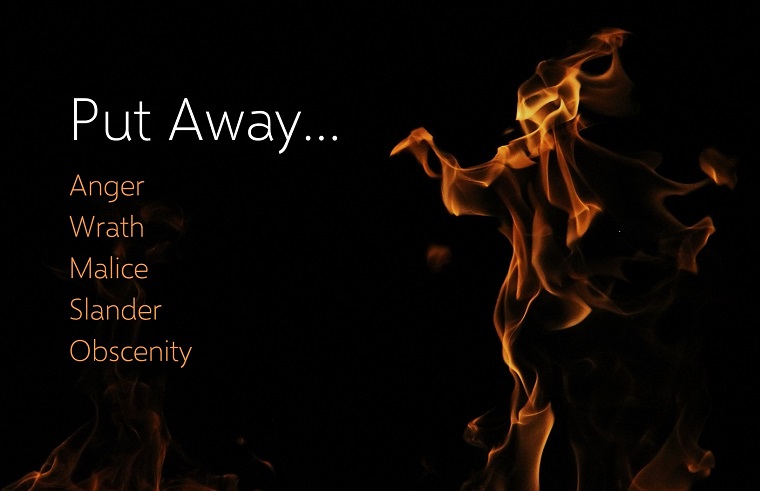
The new position in Christ calls Christians to put away old attitudes and habits. Even though their condition is sojourning through life in a sinful and fallen world, they move to a new rhythm set by their Lord. Paul thus instructs believes: “But now you must put them all away: anger, wrath, malice, slander, and obscene talk from your mouth” (Col. 3:8).[1]
Vices to “put away” include:
- Anger
- Wrath
- Malice
- Slander
- Obscene talk
Above are sins of attitude and speech. They are interrelated one to another. The inner disposition of anger and wrath leads to malice, which is the intent to do evil, then comes the outward expressions of slander and obscene talk. Paul reminds Christians, “Now you must put them all away” (3:8). Habits of the old life in sin being put away invokes “the imagery…of putting off clothes—like stripping off from oneself a filthy garment.”[2]
Anger runs amok in this sinful and fallen world, Cain being a prime example of how this comes about. The Lord rejected Cain’s offering, and Cain became very angry. Yahweh then says to the sinner, “Why are you angry, and why has your face fallen? If you do well, will you not be accepted? And if you do not do well, sin is crouching at the door. Its desire is contrary to you, but you must rule over it.” Just as the Devil was a murderer from the beginning, Cain identified with the evil one, and murdered his brother (Gen. 4; cf. vv. 5b-7; Jn. 8:44; 1 Jn. 3:11-12). Cain’s actions stand contrary to the way of those who are united in Christ.
Did not Jesus Christ show anger? The Lord did express anger towards the Pharisees who were opposed to the performing of a miraculous healing on the Sabbath and indifferent to the suffering of a man with a withered hand who attended the same synagogue (Mk. 3:1-6; cf. Matt. 12:9-14; Lk. 6:6-11). Mark tells us that Jesus “looked around them with anger.” Neither is there anything calm and gentle about Jesus expelling the money changers from the temple court. The Lord turned over tables, chased out the money changers, and used a whip of chords to get it done (Matt. 21:12-13; Mk. 11:15-19; Lk. 19:45-48; Jn. 2:13-22). Jesus’ attitude and actions are hardly sinful or falling short of God’s glory. Here it can be pointed out that “In light of the NT insistence that Jesus, the Son of God incarnate, was totally sinless (John 8:46; 2 Cor. 5:21; Heb. 4:15; 7:26; 1 Pet. 2:22), these passages must be held to show that anger at what dishonours God, so far from being sinful, may be just the reverse—a truth already modelled in the Psalms and prophets (Ps. 139:21–22; Jer. 15:17).”[3]
Cannot even the God of the Old Testament be provoked to anger? Moses did admonish us: “The Lord, the Lord, a God merciful and gracious, slow to anger, and abounding in steadfast love and faithfulness, keeping steadfast love for thousands, forgiving iniquity and transgression and sin, but who will by no means clear the guilty, visiting the iniquity of the fathers on the children and the children’s children, to the third and the fourth generation” (Exod. 34:6-7). Yahweh is never to be trifled with. Make no mistake, the wrath of God can be incurred. Yet, goodness and righteousness are intricately woven into the fabric of divine wrath: “Conceived in a way that excludes the fitfulness, arbitrariness, waywardness and foolishness that disfigure human anger, God’s wrath is viewed as a judicial expression of holiness repudiating unholiness, as it must. God’s wrath is retribution re-establishing righteousness where unrighteousness was before, so vindicating God’s goodness.”[4] God is patient, but divine holiness, righteousness, goodness, calls for the eventual setting things to right. Sin must be punished.
One can never speak of divine wrath without considering the propitiation made by the Son of God. Propitiation has to do with “pacifying God’s judicial anger by removing sin from his sight, which is what the atoning blood of Christ has done. Sinners with faith in Christ are no longer in the hands of an angry God…but enjoy the forgiveness and favour of the God who quenched his own wrath by sending his Son to be the propitiation for our sins.”[5] The Apostle John thus tells us: “My little children, I am writing these things to you so that you may not sin. But if anyone does sin, we have an advocate with the Father, Jesus Christ the righteous. He is the propitiation for our sins, and not for ours only but also for the sins of the whole world” (1 Jn. 2:1-2).
The kind of sustained rage so often displayed by sinful and fallen people is hardly of the righteous indignation sort.
New life in Christ calls for self-control and the shedding off of anger to keep sin from manifesting. Prompt resolution to grievances needs to take place: “Be angry and do not sin; do not let the sun go down on your anger, and give no opportunity to the devil” (Eph. 4:26-27). Brothers and sisters in the Lord are to be “quick to hear, slow to speak, slow to anger; for the anger of man does not produce the righteousness of God” (Jas. 1:19-20). Just as judgment comes upon the murderer, it will also come upon the one who harbors anger, and when anger wells up, finding a way to reconcile is the priority, and for the worshipper of God this comes even before setting an offering upon the altar (Matt. 5:21-25).
Old Testament wisdom likewise extols the virtue of controlling keeping one’s temper in check. Solomon tells us: “A man of quick temper acts foolishly, | and a man of evil devices is hated” (Prov. 14:17). Again, he says, “Whoever is slow to anger has great understanding, | but he who has a hasty temper exalts folly” (Prov. 14:29). “Be not quick in your spirit to become angry, | for anger lodges in the heart of fools” declares the Preacher (Eccl. 7:9).
Colossians 3:5-8 presents two entreaties: “put to death” and “put…away.” Both “introduce two lists of vices, one relating to sexual sin, the other to sins of anger. The two lists are classic statements of the ways in which Christians can be untrue to themselves and, more importantly, to God.”[6] All vices characteristic of the former life in sin and separation from God are to be put to death and put away for good. Here is the problem:
Many Christians tend to concentrate on one list or the other: one knows of Christian communities that would be appalled at the slightest sexual irregularity but which are nests of malicious intrigue, backbiting, gossip and bad temper, and, conversely, of others where people are so concerned to live in untroubled harmony with each other that they tolerate flagrant immorality. The gospel, however, leaves no room for behaviour of either sort.[7]
It is never about singling out the other person’s flaw while patting one’s own back on being kept clean from that sort of wickedness. But, all stumble in a variety of different ways, and all have sinned and fall short of the glory of God. All need redemption and reconciliation with God. Redemption and reconciliation with God is accomplished through union with Christ.
Believers are united with Christ in death, resurrection and glory. This is their new position in Christ. Their very lives are hidden with Christ in God. Yet, their condition is living life in this sinful and fallen world. During their earthly sojourn, the believer’s position in Christ and condition in the world is experienced simultaneously. Even so, for those who are in Christ, everything changes. The old way life comes to an end and a new life begins. Like disposing of filthy rags, the sinful remnants of the old life are put to death and put away. Daily the believer is being transformed closer and closer into the image of Christ.
— WGN
Notes:
[1] All Scripture cited from The Holy Bible: English Standard Version (Wheaton, IL: Crossway Bibles, 2016), unless noted.
[2] Curtis Vaughan, The Expositor’s Bible Commentary: Ephesians through Philemon, vol. 11, ed. Frank E. Gaebelein (Grand Rapids, MI: Zondervan Publishing House, 1981), 212–213. One can find further explication on the vices in F.F. Bruce, The New International Commentary on the New Testament: The Epistles to the Colossians to Philemon and to the Ephesians (Grand Rapids, MI: William B. Eerdmans Publishing Company, 1984), 145n-146n, N.T. Wright, Tyndale New Testament Commentaries: Colossians and Philemon (Grand Rapids, MI: Wm. B. Eerdmans Publishing Co., 1986), 136-137
[3] J. I. Packer, “Anger,” in New Dictionary of Biblical Theology, ed. T. Desmond Alexander and Brian S. Rosner, electronic ed. (Downers Grove, IL: InterVarsity Press, 2000), 382.
[4] Ibid., 382
[5] Ibid., 383.
[6] Wright, 133
[7] Ibid..

 Love Truth Blog