Christmas time springs up fond memories of celebrating the end of one year and anticipation of something better in anticipation of the new year. Gatherings with family and friends clustered around December 25 and January 1. Advent is really the epicenter of what gives the whole season its meaningfulness. Without Advent there would have nothing to spark the first Christmas candle that set all celebrations in motion. It marked an end of a great season and the beginning of a new.
The Gospel of Luke begins with the announcement of the birth of John the Baptist, the last of the Old Testament prophets. We are told of the priest Zechariah and his wife lived blamelessly before the Lord, yet they were without children. Elizabeth was barren. But then the angel Gabriel appears inside the temple and Zechariah is informed that he and his wife will conceive a child and the child would be named John. Zechariah is skeptical and the angel leaves him mute until the birth and naming of his son.
Elizabeth was 90-years old when she conceived the child. Her experience parallels another saintly woman who gave birth at a very old age. Sarai was also 90-years old when she conceived and gave birth to Isaac. Isaac was the son that Yahweh promised to Abraham (Gen. 17:15-21; 18:1-15; 21:1-7). Sarai thus became the mother of a new nation whose people numbered like the stars in the sky and the sand upon the seashore. But Elizabeth became the mother of John the Baptist — the prophet filled with the Holy Spirit ever since he was inside mother’s womb who ministered in the spirit and power of Elijah. John turned the hearts of fathers to their children, turn the hearts of children to their fathers, and herald the day the Lord comes to His temple (Mal. 3:1, 4:5-6; Lk. 1:16-17; Matt. 17:12).
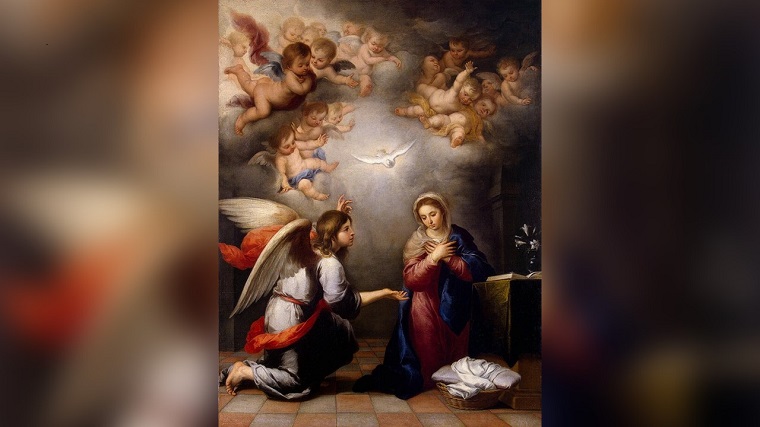
Gabriel next appears to Mary, a virgin from Nazareth betrothed to a man from Bethlehem named Joseph. The angel informed her that she will give birth to a son, he will be named Jesus, he will be great, he will be the Son of the Most High, and he will received from the Lord God the throne of David. Mary was perplexed about how all of this could happen since she was a virgin, but Gabriel explained that she would conceive through coming of the Holy Spirit and the overshadowing of the power of the Most High. The child will be the holy Son of God. Mary humbly replies, “Behold the maidservant of the Lord! Let it be to me according to your word” (Lk. 1:38). [1]
Mary is unique and unparalleled among other women. Whereas Sarai and Elizabeth conceived in their old age, very remarkable happenings for women in their 90s, Mary conceives while still a virgin. Untouched by any male companion, she miraculously brings forth the Son of God. Even Elizabeth identifies Mary as “the mother of my Lord” (Lk. 1:43). Early Christians dubbed Mary the mother of God (theotokos). Rather than speaking to the quality of Mary’s character, though she was virtuous, they used the title to emphasize and recognize the nature of the Child born to Mary. They used the title to counter the false teachers who rejected the true divinity of the Christ, such as Arius.
The Child of Mary is deity incarnate. So goes the carol:
Silent night, holy night,
Son of God, love’s pure light
Radiant beams from Thy holy face,
With the dawn of redeeming grace,
Jesus, Lord, at Thy birth,
Jesus, Lord at Thy birth.
Yes, God came to us. But this time it was neither in the appearance of a burning bush, nor as a pillar of clouds in the day and a pillar of fire by night, nor as a mysterious whirlwind with cherubs moving about with wheels within wheels, but the Lord entered into the stream of history as one of us. From inside the womb to new born infant to a fully mature adult male — He is incarnate deity. The God-man. The one person who is both fully divine and fully human. God dwelt among us! He is in fact still with us. Jesus says, “I am He who lives, and was dead, and behold, I am alive forevermore” (Rev. 1:18).
John the Baptist prepared the way for Jesus the Christ. Whereas Christ’s ministry would ultimately increase, John’s would decrease.
I remember having participated in a few weddings as a groomsman. It is always an honor. But it is nothing you just show up for and there is degree of preparation that comes with the role. There is a fitting for a tuxedo. There is showing up for the rehearsal. There is the bachelor party. There are certain duties assigned (seating guest, transporting the gifts, cleaning up, etc.). The “best man” is traditionally the custodian of the wedding rings. All this leads up to the main event — the joining of one man and one woman in holy matrimony. The groomsmen are there to support the groom, but the day is about the groom being joined with the bride, which marks a new milestone in their lives together as husband and wife. The groomsmen look their best for the occasion with their tuxedos and all, but they must decrease and the day is about celebrating the union of the bride and groom.
It was right for John to decrease and for Jesus to increase. As groomsmen prepare for the arrival groom, John prepares the way for the arrival of the Christ. “He who has the bride is the bridegroom; but the friend of the bridegroom, who stands and hears him, rejoices greatly because of the bridegroom’s voice. Therefore this joy of mine is fulfilled. He must increase, but I must decrease,” says John the Baptist (Jn. 3:29-30). This principle is true for us all. Christ must always increase in our own lives and our own sinful inclinations to rule our own world must decrease into nothing.
Advent is so great because God has come to dwell with us as one of us. God is with us. Christ came to reconnect us with God. When we unite with Christ, we connect with God, for Christ is fully divine and fully human. Moreover, when we connect with Christ, we connect to our humanity, for Christ is fully divine and fully human. If we want to know about God, we look to Christ. If we want to know what it is to be human, we look to Christ, He is one of us. Christ really shows us what humanity is all about, since He is the sinless and perfect man. When we connect with Christ, we see the part of our humanity that was lost on account of the fall but we also experience the restoration of all that is broken with our humanity. When we connect to Christ, we experience the everlasting life that God meant for us to experience from the very beginning.
Merry Christmas!!!
— WGN
[1] All Scripture cited from The New King James Version (Nashville: Thomas Nelson, 1982), unless noted.

 Love Truth Blog