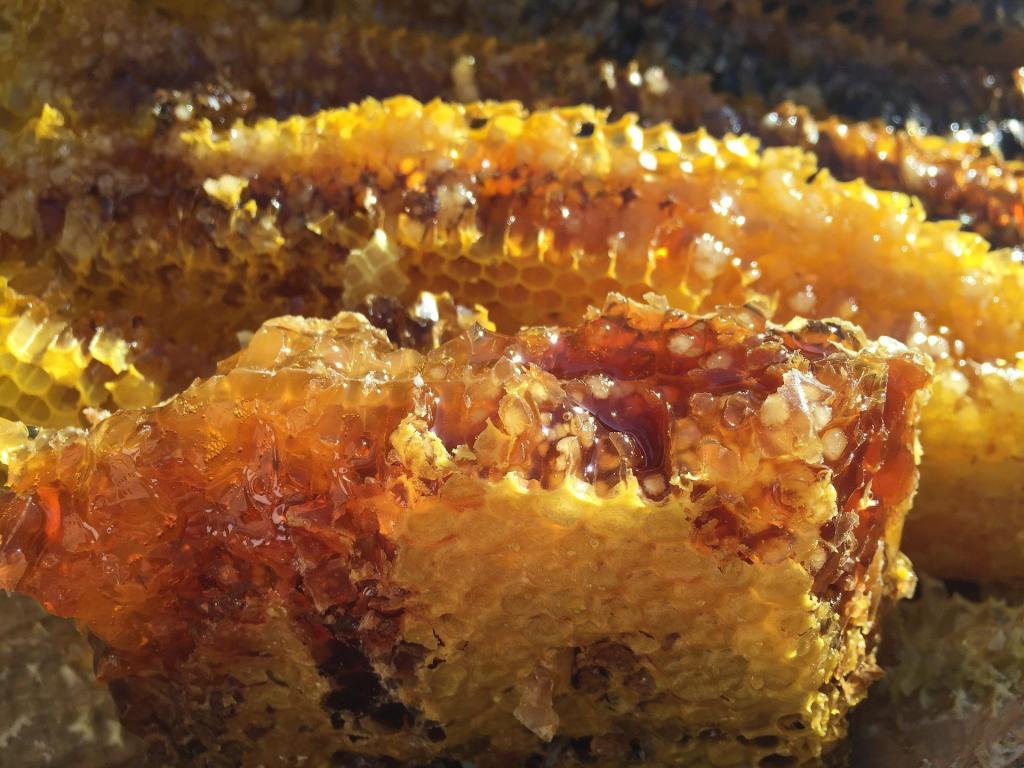
Honey in the Rock is a song that has been resonating in my head lately. It is a lovely tune. The song is about how the Lord feeds us with honey from the rock in the wilderness, which points to the reality that we can still experience sweetness because we trust and know Jesus. The imagery comes from a line from one of the psalms of Asaph, “But he would feed you with the finest of the wheat, | and with honey from the rock I would satisfy you.”[1]
Psalm 81 reflects upon the sojourn of the Hebrew people from Egypt to the promise land. What a treat it would have been to find delicious sweet wild honey in bee combs between rocks in the desert. Not only does it taste good, it also provides them with the energy to traverse the arid wilderness.
This imagery of honey in the rock speaks to the way the Lord provided for His people through out their travels. Willem VanGemeren notes, “The Lord will richly supply the needs of his people. The blessings of God’s shepherding care are expressed in terms of rich foods (cf. Isa 25:6). He lavishes on his own the best care, expressed in the metaphor of ‘the finest of wheat’ (Num 18:12; Deut 32:14; Ps 147:14) and of ‘honey from the rock’ (cf. Deut 32:13).”[2]
Connected to the honey in the rock is the entreaty to listen to the voice of the Lord against all the voices to the contrary (Psa. 81:8, 11). The Hebrews were “tested…at the waters of Meribah” (Psa. 81:7). Remember the water from the rock? Water was scarce. An opposition arose against Moses and Aaron. They complained, “Would that we had perished when our brothers perished before the Lord! Why have you brought the assembly of the Lord into this wilderness, that we should die here, both we and our cattle? And why have you made us come up out of Egypt to bring us to this evil place? It is no place for grain or figs or vines or pomegranates, and there is no water to drink” (Num. 20:3-5). They were trying the make God out to be the bad guy keeping them from something good. Yet, the Lord provided a great abundance of water from the rock (Num. 20:11). The Rock, of course, was Christ (1 Cor. 10:4).
The opposition perished. Even Moses missed the mark in following the Word of the Lord, which is why he only could see the promise land from a distance prior to be taken into glory (Num. 20:12; Deut. 32:48-51).
Satan tempted Jesus to turn stone to bread, but rather than sating His appetite, the Lord remained faithful to the leading of the Spirit in keeping His forty-day fast. Jesus responded, “Man shall not live by bread alone, but by every word that comes from the mouth of God” (Matt. 4:4). The Lord reiterates what Moses taught to those entering the promise land: “And he humbled you and let you hunger and fed you with manna, which you did not know, nor did your fathers know, that he might make you know that man does not live by bread alone, but man lives by every word that comes from the mouth of the Lord” (Deut. 8:3).
There are many voices today telling the Christian that God is not good, the ways of God are keeping people from the good things of life, and it is better to forget about that horrible religion altogether. “The God of the Old Testament is arguably the most unpleasant character in all fiction: jealous and proud of it; a petty, unjust, unforgiving control-freak; a vindictive, bloodthirsty ethnic cleanser; a misogynistic, homophobic, racist, infanticidal, genocidal, filicidal, pestilential, megalomaniacal, sadomasochistic, capriciously malevolent bully,” says Richard Dawkins.[3] Such sledgehammer rhetoric has hardly any basis in reality.[4] There is no need to heed the voice of the New Atheist. It is folly to portray the Lord as morally reprehensible.
Malevolent spirits and people are always bidding us to abandon the Lord. They intend to lure us into questioning the Lord’s wisdom, goodness, and power. The sinful inclinations of the heart pull us to join them. Yet, it is upon forsaking the Word of the Lord that we find ourselves in dangerous waters. We set our feet upon shifting sands and fall into peril.
Rather, we are to set ourselves upon the Rock. It is in trusting and knowing Jesus that we can experience the sweetness of that honey in the rock. He gives us life. He sustains us through the wilderness. He makes a way for us to reunite with the Heavenly Father through the power of the Holy Spirit. Moreover, every good and perfect gift from the Father of Lights from who there is no variation or shadow due to change (Jas. 1:17). When the storms come, and the waves crash, only those who are set upon the rock will endure.
Our human wisdom and power can and does fail. Forgetfulness, confusion, fatigue, paralysis and the like are part and parcel of life in this fallen world. But our constant is the trustworthiness of the Word of the Lord. God’s promises never fail. He sustains us. He raises the dead, immortal, imperishable, incorruptible. God is good all the time.
— WGN
[1] All Scripture cited from The Holy Bible: English Standard Version (Wheaton, IL: Crossway Bibles, 2016), unless noted.
[2] Willem A. VanGemeren, “Psalms,” in The Expositor’s Bible Commentary: Psalms, Proverbs, Ecclesiastes, Song of Songs, ed. Frank E. Gaebelein, vol. 5 (Grand Rapids, MI: Zondervan Publishing House, 1991), 532.
[3] Richard Dawkins, The God Delusion (Boston: Houghton Mifflin, 2006), 31.
[4] For responses to Dawkins, cf. Douglas Groothuis, “Darwin’s Rottweiler: Fierce Barks, Feeble Bites,” Christian Research Institute, 30, 6 [2007]: https://www.equip.org/article/the-god-delusion/ and Douglas Groothuis, “Christopher Hitchens’s Sledgehammer Rhetoric,” Christian Research Journal, 31, 3 [2008] https://www.equip.org/article/god-is-not-great-how-religion-poisons-everything/ Also consult, Paul Copan, Is God a Moral Monster? Making Sense of the Old Testament God (Grand Rapids, MI: Baker Books, 2011).

 Love Truth Blog