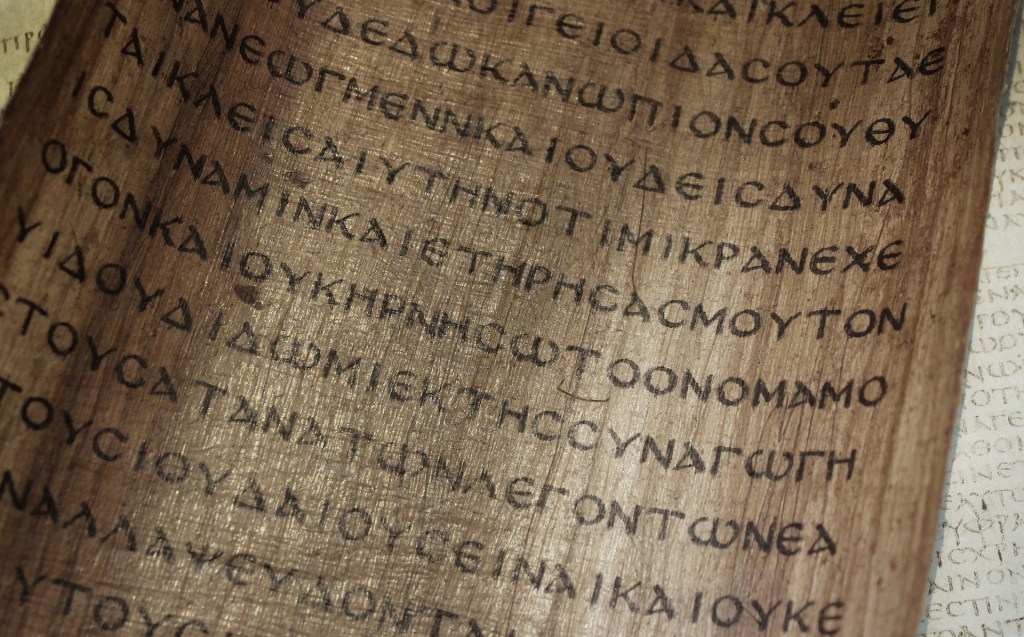
I occasionally come across the assertion that first century Christians were illiterate and incapable of producing the New Testament. The New Testament is then comprised of writings from a different era of church history from writers who could have falsified stories and teachings of Jesus Christ and the apostles.
A good example of this comes from Bart D Ehrman, the James A. Gray Distinguished Professor at the University of North Carolina at Chapel Hill, writes,
As churches multiplied, each of them could no longer claim to have as its leader someone who had known an apostle or even someone who knew someone who once knew an apostle. An even bigger problem was the fact that different leaders of churches, not to mention different Christians in their congregations, could claim they taught the apostolic truths. But these “truths” stood at odds with what other leaders and teachers said were the teachings of the apostles.
How then was one to get around these problems? The obvious answer presented itself early on in the Christian movement. One could know what the apostles taught though the writings they left behind. These authoritative authors produced authoritative teachings. So the authoritative truth could be found in the apostolic writings.
Even though this might sound like a perfect solution to the problem, the solution raises problems of its own. One involves a reality that early Christians may not have taken into account, but scholars are keenly aware of. Most of the apostles were illiterate and could not in fact write…They could not have left an authoritative writing if their souls depended on it.[1]
This attempt to undermine the reliability and authority of the Scriptures is without basis in reality. Ehrman simply overexaggerates the illiteracy rates in the ancient world to sow skepticism.
I am reading through Rethinking the Dates of the New Testament: The Evidence for Early Composition by Jonathan Bernier, which is a positive case for a pre-AD 70 composition of the New Testament. Bernier raises this interesting point to the matter of there being literate Christians prior to AD 50,
It has become conventional wisdom to say that 5 to 15 percent of persons in the ancient world were literate. More recent work has suggested that the range was more likely 2.5 to 5 percent for the adult population of Roman Judea. Properly speaking, both the presence within early Christian communities of persons from the diaspora and the spread of the new movement into broader eastern Mediterranean limits the propriety of utilizing statistics specific to Judea, but our argument is only strengthened if we use the numbers that are least favorable rather than most favorable. For the sake of argument, let us suppose that 2.5 percent most closely approximates the literacy rate among early Christian communities. When we are told, then, that three thousand joined the church during the first Christian Pentecost (Acts 2:41), we have reason to think that seventy-five of these were literate; when we are told that five hundred brothers and sisters saw the risen Jesus (1 Cor. 15:6), we have reason to think that twelve of these were literate; and when we are told that 120 persons were present when Matthias was chosen to succeed Judas (Acts 1:15), we have reason to think that three of these were literate. Even allowing for the possibilities that these demographics are exaggerated and the early Christians likely came disproportionately from lower social classes and thus might have had a lower rate of literacy than the general population, there is good reason to think that already within the first decade of Christianity there were dozens if not hundreds of literate persons within the new movement. This is apart from the possibility that members of the movement could have potentially hired scribes to assist them in composing documents of various sorts.[2]
Even with the minimal facts there would have been plenty of literate members of the first century Christian community.
The level of education of Jesus and the apostles is a mystery. But the religious leaders were astonished that uneducated men like Peter and John could teach with such boldness, and the two were recognized having been with Jesus (Acts 4:13).
Tradition informs us that among the twelve apostles both Matthew (Levi) and John composed gospels. John also composed epistles and the Apocalypse. Other gospel writers were either among or closely associated with the eyewitnesses to the resurrected Jesus. Mark was a companion to Peter. Luke was a companion to Peter. The Acts of the Apostles was also written by Luke. Paul wrote the bulk of the New Testament (Romans, 1-2 Corinthians, Galatians, Ephesians, Philippians, Colossians, 1-2 Thessalonians, 1-2 Timothy and Philemon). The writer to the Epistle to the Hebrews is uncertain, though many have credited it to Paul. Epistles were also contributed by Peter and the half-brothers of Jesus — James, and Jude.
New Testament writers could have used secretaries (amanuenses) to compose their works (Rom. 16:22). Even if some of them were illiterate from youth, nothing would have ever precluded them from acquiring reading and writing skills as adults, and there were the literate members within the Christian community who could teach them. Any of them could have acquired the skills to compose writings with their own hand (Gal. 6:11). Nothing makes it impossible for these men to have produced the New Testament under the inspiration of the Holy Spirit.
Stories about the first century Christian community being totally illiterate incapable of producing the New Testament are fiction.
— WGN
[1] Bart D.Ehrman, Forged: Writing in the Name of God — Why the Bible’s Authors Are Not Who We Think They Are (New York: HarperOne, 2011), 7- 8
[2] Jonathan Bernier, Rethinking the Dates of the New Testament: The Evidence for Early Composition (Grand Rapids, MI: Baker Academic,2022), 20-21.

 Love Truth Blog