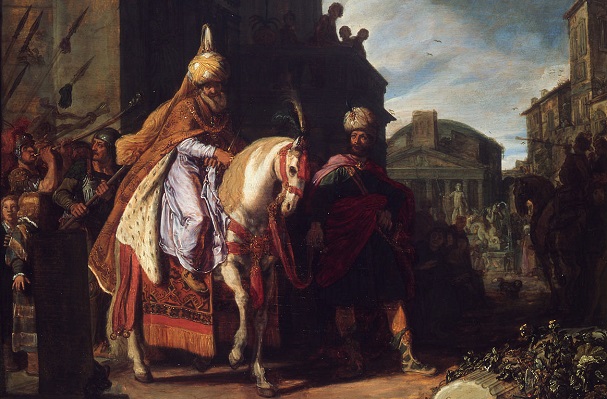
“On that day I will give to Gog a place for burial in Israel, the Valley of the Travelers, east of the sea. It will block the travelers, for there Gog and all his multitude will be buried. It will be called the Valley of Hamon-gog” (Ezek. 39:11).[1]
The oracles in Ezekiel 38-39 tell of the Lord defending the people dwelling in the land of Israel against an attack force led by Gog of Magog the chief prince of Meshech and Tubal. It has been said that “Gog’s invasion cannot be identified with any known historical event.”[2] On the contrary, I believe that the fulfillment of Ezekiel 38-39 coincides with the events in the Book of Esther.[3] I will use the remainder of this post to further expound on this connection.
The Crisis: Gog attacks “the land that is restored from war, the land whose people were gathered from many peoples upon the mountains of Israel,” and “the land of unwalled villages…without walls, and having no bars or gates (Ezek. 38:8, 11. This situation best fits the time after the decree of Cyrus allowing Jewish exiles to resettle the land of Israel but prior to the rebuilding of the walls of Jerusalem in the days of Nehemiah.[4]
Now the events in the Book of Esther take place over the course of one year during the reign of Ahasuerus, who also goes by Xerxes (486-465 BC). [5] This is after Zerubbabel begins rebuilding the temple (538/7 to 516 BC) but prior to the arrivals of Ezra (458 BC) and Nehemiah (444 BC).[6]
Ahasuerus’s domain extended from India to Ethiopia over 127 provinces (Est. 1:1). Thus, Haman’s decree to exterminate all the Jewish people in Persia included those dwelling in the land of Israel (Est. 3:1-5; cf. Ezra 1-2; Ezek. 38:10-12; Neh. 1-2). The peoples of Magog, Meshech, Tubal, Persia, Cush, Put, Gomer and Beth-torgarma who conspired with Gog were likewise within King Ahasuerus’ domain (Ezek. 38:1-6; Gen. 10:1-32). Thus, both Ezekiel and Esther tell of Jewish people being attacked from all providences of Persia.[7]
The Gog and Haman Connection: Commonalities between the descriptions of Gog of Magog and Haman the Agagite are such that we can rightly conclude that both refer to the same person is being. This will be explicated below.
Since there was a descendant of Ruben named Gog (1 Chron. 5:4), one might suppose Gog is the proper name of the attacker from Magog. Yet, the oracles of Ezekiel are rich with prophetic symbolisms, and there is more to Gog of Magog than a proper name and nationality. Whereas no names are mentioned in chapters 25-32, the two names in chapter 23, namely Oholah and Oholibah, are definitely “metaphorical.”[8] “Oholah is Samaria, and Oholibah is Jerusalem,” says the Lord (Ezek. 23:4).[9] Gog of Magog thus connotes a sinister oligarch intent on attacking and pillaging God’s people, particularly those who have resettled the land of Israel. Moreover, Haman the Agagite embodies the enemy of God’s people connoted by the name of Gog of Magog chief prince of Meshech and Tubal.
What of the other interpretations? Gog of Magog has been identified with others enemies to God’s people, but none are convincing alternatives. For example, various commentaries identify Gugu (Gyges) the king of Lydia as Gog, though this is unlikely as that ruler lived almost a century prior to Ezekiel.[10] Gog has also been identified with Antiochus IV Epiphanes, the Syrian despot from the second century BC. [11] Antiochus committed abominable acts against God and the people of God; however, the crisis with the Syrian despot happened well beyond the timeframe suggested from the text of Ezekiel 38-39.
Below presents the uncanny connections between Gog of Magog and Haman the Agagite.
Authority: Just as Gog is the chief prince of Meshech and Tubal, Haman is the vizier appointed to the highest position among the royal officials of Persia (Est. 3:1, 6). Just as Gog of Magog leads troops from Meshech, Tubal, Persia, Cush, Put, Gomer and Beth-torgarma, Haman dispatches orders to exterminate all Jews sealed with the king’s signet ring and delivers them to the satraps, governors and officials throughout all the provinces of Persia (Est. 3:12-15).
Plunder: Just as Gog intends to attack and plunder the people in Israel (Ezek. 38:10-13), Haman intends to exterminate all the Jewish people in the Persian Empire and plunder their possessions (Est. 3:13).
Defeat: Just as Gog suffers a humiliating defeat by the hand of God (Ezek. 39:2-6), Esther wins the favor of King Ahasuerus, exposes Haman’s treachery, reverses the decree to exterminate the Jews are and empowers them to put an end to those who conspired with Haman (Est. 8:1-14, 9:2). The great slaughter of Gog’s army depicted in Ezekiel 39 fits with the 75,000 deaths of Haman’s conspirators in Esther 9:16. We are told, “the Jews defeated all their enemies with the stroke of the sword, with slaughter and destruction” (Est. 9:5).
Ancient Rivalries Resolved: Despite Haman being appointed to the highest position among the Persian officials, Mordecai refuses to pay any homage to the top vizier (Est. 3:1-6). This enmity between Mordecai and Haman comports with the longstanding rivalry between the Amalekites and Israelites.
Amalekites sought to exterminate the Hebrews sojourning to the promise land (Exod. 17:8-16; Deut. 25:17-18; 1 Sam. 15:1-3). Haman the Agagite, likewise, strikes at Mordecai with orders to exterminate all the Jewish people in the Persian Empire (Est. 3).[12]
Rivalry between Mordecai and Haman even resolves the major upset that occurred at the showdown between Saul and Agag. Saul and Mordecai are both Benjaminites from the line of Kish (Esther 2:5; 1 Sam. 9:1-2) whereas Agag is an Amalekite (1 Sam. 15:7-8, 20) and Haman is an Agagite (Esther 3:1, 10; 8:3, 5; 9:24).[13] Josephus indicates the Agagite descends from the Amalekite (Antiquities 11.209).[14] Whereas Saul fails to neutralize the Amalekite threat to Israel in sparing Agag (who was subsequently executed by the prophet Samuel), Mordecai comes out victorious through the heroism Esther. We can say that “Although the Amalekite king Agag was captured, Saul spared him (he was ultimately slain by Samuel); thus his descendant Haman survived to contend with the Jews…Likewise, the mention of Kish (the father of Saul) at the end of Mordecai’s genealogy (2:5) shows that he was descended from the mortal enemy of the Agagites. Mordecai would thus fulfill the command of God to Saul.”[15]
Interestingly, the Amalekite ruler “Agag” [אֲגָג] mentioned in Numbers 24:7 is translated “Gog” [Γωγ] in the Septuagint (LXX).[16] Moreover, the burial place of Gog is the Valley of Hamon-gog (Ezek. 39:11-16). Intertestamental Jews familiar with Ezekiel and Esther may very well have paused to consider the possible connection.[17] Could there be a play on words with Hamon-gog and Haman the Agagite? This subtle tie with Gog of Magog and Haman the Agagite is uncanny.
Divine Wrath: Ezekiel 38-39 tells of God sending “an earthquake” along with “torrential rains and hailstones,” “fire and sulfur” upon the armies of Gog of Magog (Ezek. 38:19, 22). But such forces of nature are never mentioned in the Book of Esther. Esther simply tells of Ahasuerus sending Haman to the gallows, and the Jewish people being permitted to defend themselves against those who conspired with Haman (Est. 7:1-9:19). Yet, these accounts only appear disparate. Both actually tell of the same conflict from different vantagepoints: “Ezekiel describes events from a God’s-eye-view, while Esther explains things from a man’s-eye-view.” [18]
The wild idea of the Lord sending “fire on Magog and on those who dwell securely in the coastlands” (Ezek. 3:6) is a reference to nuclear weapons used against Russia and the United States of America[19] is a stretch of the imagination. This is a missing of the mark.
Ezekiel 38-39 employs vivid apocalyptic imagery to tell of God entering into the stream of history to save His people. What is described is a theophany or “a manifestation of the deity.”[20] It is the kind of theophany wherein “God is personified in the forces of nature: ‘The Lord also thundered in the heavens.… And he sent out his arrows, and scattered them; he flashed forth lightnings, and routed them’ (Ps 18:13–14 NRSV),” thus “Fire, lightning, storm and cloud often mark these descriptions, along with fear on the part of any observing the deeds of the Almighty.”[21] The theophany manifests with the earthquake, rain, hail, fire, and sulfur. Such is a befitting way to describe the arrival of Israel’s defender against the genocidal Haman.
The Book of Judges likewise utilizes both historical narration and apocalyptic images to tell of the same defeat of Sisera. We first are told about Deborah and Barak defeating the army of Sisera and Sisera being killed with a tent spike through the temple driven by the hand of Jael; yet it is the Lord who brings about the victory (Jdg. 4). Next the same incident is retold in the Song of Deborah. The prophetess sings, “Lord, when You went out from Seir, | When You marched from the field of Edom, | The earth trembled and the heavens poured, | The clouds also poured water; | The mountains gushed before the Lord, This Sinai, before the Lord God of Israel” (Judg. 5:4-5). Moreover, she says, “From heaven the stars fought | from their courses they fought against Sisera” (Jdg. 5:20) What is described is the appearance of a theophany accompanied by earthquakes, rains, and floods. The Song of Deborah in Judges 5 gives us additional insights into the battle never mentioned in the historical narrative of Judges 4.[22]
If the arrival of the theophany involved literal displays of natural forces in the forms of an earthquake, rain, hail, fire and sulfur, such describes the local judgment occurring in Israel, as opposed to things happening on a global scale.[23]
The Book of Esther offers a straightforward narration of the crisis with Haman. Even the term “God” is never employed in the Hebrew text of Esther;[24] however, those with eyes of faith[25] can perceive the hand of the Lord at work behind the scenes delivering the Jewish people from trouble. God working behind the scenes in the Book of Esther never precludes the theophany appearing in Israel depicted in Ezekiel 38-39 during the same crisis affecting the entire Persian Empire.
Timeless Truth? A number of Bible interpreters are reticent to connect a particular historical crisis with Ezekiel 38-39; rather, they contend the oracles convey transcendent truth about God delivering His people from antigod forces. The prophet then spoke of the perennial struggle within the present age against dark forces opposed to God and the people of God.
If one sees Ezekiel 38-39 as a perennial struggle between good and evil, then Gog can easily be taken as a representation of “the people of the world who are arraigned against the people of God.”[26] They are antigod in thoughts, words, and deeds. They are relentless in their attempts to snuff out God’s people. But God will ultimately put an end to their evil ways. One can the say, “Any threatening, militaristic, self-aggrandizing nation of any era has the potential to be Gog. But in any showdown of God versus Gog we know who will be the victor and who will be the victim.”[27]
Spiritual warfare may also be imbued within the perennial struggle between good and evil view of Ezekiel 38-39. The prophet then uses the names of the historic enemies of Israel in reference to Satan and his confederates. Satan’s forces come against God and God’s kingdom, but they are wiped out ultimately at the Second Coming of Christ.[28]
Gog represents all those opposed to God and the people of God who wage ongoing spiritual warfare against the faithful offers the right idea. But the perennial struggle between good and evil interpretation has things reversed. What this view presents is the manifold application to the Ezekiel 38-39. Yet, prophet had a particular crisis in mind that would come about in the “latter days” after the Jewish exiles began to return and resettle to their homeland. God’s deliverance of His people from the terror of Gog of Magog, i.e., Haman the Agagite, reminds that our God is the God who saves. Yahweh defeats Gog of Magog and saves His people from destruction.
Closing Thoughts: What Ezekiel predicted concerning Gog of Magog has come to pass, but this fulfilled prophecy has manifold application. Many Gog-like enemies of God and God’s people have come and gone throughout history (e.g., Antiochus Epiphanies, Nero, Domitian, Trajan, etc.). Christians will experience the arrivals of many antichrists (1 Jn. 2:18). But God vindicates those who suffer for the sake of righteousness (Matt. 5:10; 1 Pet. 3:13-17; Jas. 1:12; Psa. 135:14).
We are never told that today’s war is the final war of all the wars to ever happen. Nevertheless, Christ will appear a second time, the righteous will be raised to eternal life, the unrighteous to eternal condemnation, and all things will be set to right (Jn. 5:28; 1 Cor. 15:51-52; 1 Thess. 4:16-18; Titus 2:11-14; Heb. 9:27-28; 1 Jn. 3:2-3; Rev. 20:11-15).
— WGN
Notes:
[1] All Scripture cited from The Holy Bible: English Standard Version (Wheaton, IL: Crossway Bibles, 2016),unless noted.
[2] F. F. Bruce, New International Bible Commentary (Grand Rapids, MI: Zondervan Publishing House, 1979), 839.
[3] I learned of the connection between Ezekiel 38-39 and the Book of Esther from Gary DeMar, Last Days Madness: Obsession of the Modern Church (Atlanta, GA: American Vision, 1999), 368-369. See also Gary Demar, Why the End of the World is Not in Your Future (Powder Springs, GA: America Vision, 2008), Kindle Location 1265-1548 and James B. Jordan, “No. 2: The Battle of Gog and Magog,” Biblical Horizons Newsletter, http://www.biblicalhorizons.com/biblical-horizons/no-2-the-battle-of-gog-and-magog/ A caveat needs to be made. The novelty of the Ezekiel 38-39 being fulfilled in the events surrounding the Book of Esther viewpoint is cause to avoid dogmatism. On the other hand, the interpretation of Russia being Rosh signaling a twenty-first century end time battle is likewise a novel innovation upon the text. Moreover, the various identifications of Gog and Magog with Goths, Moors, Huns, Muslims, Turks, Mongols, the Papacy, Native Americans, and leaders of Communist Russia which have come about over the centuries are likewise novel interpretations in their own respects. But, in my humble opinion, the view of Ezekiel 38-39 finding fulfillment in events surrounding the Book of Esther comports best with a historical grammatical interpretation of the biblical text.
[4] See post: “Ezekiel 38-39 Part 2: Gog is Vladimir Putin?”
[5] Gordon D. Fee and Douglas K. Stuart, How to Read the Bible Book by Book: A Guided Tour (Grand Rapids, MI: Zondervan, 2002), 114.
[6] Ibid., 108-109, 111-112.
[7] Gary DeMar, Last Days Madness: Obsession of the Modern Church (Atlanta, GA: American Vision, 1999), 369.
[8] Victor P. Hamilton, “Ezekiel,” The Baker Illustrated Bible Commentary, ed. Gary M. Burge and Andrew E. Hill, (Grand Rapids, MI: Baker Books, 2012), 775.
[9] Ezekiel 23 concerns the spiritual apostasy of the northern tribes of Israel associated with Samaria and the southern tribes of Judah associated with Jerusalem which led to their respective exiles Civil war broke out after Solomon was taken into glory. The kingdom of David was divided in two. The tribes of Judah and Benjamin formed the southern kingdom under the rule of Rehoboam. The remaining ten tribes of Israel formed the northern kingdom under the rule of Jeroboam. Nineteen generations of kings reigned in the northern kingdom of Israel until they were taken into Assyrian captivity in the eighth century BC. Twenty generations of kings reigned in the southern kingdom of Judah until the Babylonian captivity in late sixth century BC. The times of the kings of Israel and Judah are described in 1-2 Kings and 2 Chronicles. See especially 2 Kings 17:6-21, 21:1-17, 22:1-23:27.
[10] Victor Harold Matthews, Mark W. Chavalas, and John H. Walton, The IVP Bible Background Commentary: Old Testament, electronic ed. (Downers Grove, IL: InterVarsity Press, 2000), Eze 38:2. Ralph H. Alexander indicates Gog has been identified with various people, places, and things: 1) Gugu or Gyges, the king of Lydia; 2) the Sumerian gug (“darkness”); 3) Gagu ruler of Sakhi north of Assyria; 4) a mountainous district north of Melitene; 5) an official title or “a general name for any enemy of God’s people; 6) a derivative of Magog, But indicates none of these have sufficient support (Ralph H. Alexander, Expositor’s Bible Commentary: Ezekiel, vol. 6, ed. Frank E. Gaebelein [Grand Rapids, MI: Zondervan Publishing House, 1986], 929).
[11] See Matthew Poole, Matthew Poole’s Commentary, Ezekiel 38, https://biblehub.com/commentaries/poole/ezekiel/38.htm, Adam Clarke, Commentary on the Bible, Ezekiel Introduction, https://biblehub.com/commentaries/clarke/ezekiel/1.htm and Ezekiel 38, https://biblehub.com/commentaries/clarke/ezekiel/38.htm, Hamilton, 775.
[12] Demar, Why the End of the World is Not Your Future, Kindle location, 1347, 1367.
[13] Ibid., Kindle Location, 1347, 1367.
[14] See J. S. Wright, “Agagite,” New Bible Dictionary, ed. D. R. W. Wood et al., (Downers Grove, IL: InterVarsity Press, 1996), 18.
[15] Mark W. Chavalas, “Esther, Theology Of,” in Evangelical Dictionary of Biblical Theology (Grand Rapids: Baker Book House, 1996), 208. See also comments on the Amalekite connection to the Haman and Mordecai rivalry in Tremper Longman III and Raymond B. Dillard, An Introduction to the Old Testament, Second Edition. (Grand Rapids, Michigan: Zondervan, 2007), 221–222.
[16] Alexander, 929. The LXX is an ancient Greek translation of the Hebrew Old Testament in circulation between BC 100 and AD 100. LXX consulted was Alfred Rahlfs, Septuaginta: With Morphology (Stuttgart: Deutsche Bibelgesellschaft, 1996). English translations of the LXX consulted were Sir Lancelot C.L. Brenton, The Septuagint with Apocrypha: Greek and English (Peabody, MA: Hendrickson, 1986), and St. Athanasius Academy Septuagint (Elk Grove, CA: St. Athanasius Academy of Orthodox Theology, 2008) in Jack Sparks, The Orthodox Study Bible: Ancient Christianity Speaks to Today’s World (Nashville, TN: Thomas Nelson, 2008).
[17] See James B. Jordan, “No. 2: The Battle of Gog and Magog,” Biblical Horizons Newsletter, http://www.biblicalhorizons.com/biblical-horizons/no-2-the-battle-of-gog-and-magog/ Note that “Meshech and Tubal were probably situated in Asia Minor…‘Cush’—Upper Egypt. ‘Put’—Libya [and] ‘Gomer’—a land in Asia Minor” (L. John McGregor, New Bible Commentary: 21st Century Edition, ed. D. A. Carson et al. [Downers Grove, IL: Inter-Varsity Press, 1994], 742). Magog is in the table of nations appearing in Genesis 10 and in the genealogy from Adam to Abraham in 1 Chronicles 1.
[18] Demar, Why the End of the World is Not in Your Future, Kindle Location 3595.
[19] Hal Lindsey, Late Great Planet Earth (Grand Rapids, MI: Zondervan, 1970), 161-162.
[20] Leland Ryken et al., Dictionary of Biblical Imagery (Downers Grove, IL: InterVarsity Press, 2000), 857.
[21] Ibid.
[22] The appearance of a theophany in the forces of nature is also depicted in David’s psalm about being saved by God from all his enemies and the hand of Saul (2 Sam. 22; Psa. 18). For additional discussion, see Demar, Why the End of the World is Not in Your Future., Kindle Location, 3509, 3585
[23] Demar, Why the End of the World is Not in Your Future., Kindle Location, 3616, 3632.
[24] The additions found in the Greek version of Esther from the LXX presents a vision of Mordecai accompanied with noises, confusion, thunders, earthquake, and tumult on the earth (Est. 11:1-12; 10:4-13). There are also prayers lifted up by Mordecai (Est. 13:8-17) and Queen Esther (Est. 14:3-19). Intertestamental Jews and early Christians would have been familiar with the Greek version of Esther. Nevertheless, the additions from the Greek version of Esther are apocryphal and outside the Old Testament Canon. Only the shorter Hebrew version of Esther is recognized as Scripture.
[25] Faith is the assurance of things hoped for and the conviction of things unseen (Heb. 11:1). We walk by faith not by sight (2 Cor. 5:7).
[26] L. John McGregor, New Bible Commentary: 21st Century Edition, 4th ed., ed. D. A. Carson et al. (Downers Grove, IL: Inter-Varsity Press, 1994), 741.
[27] Hamilton, 775.
[28] See The Narrow Path, “08. Ezekiel 38-39 (Gog and Magog)” https://www.thenarrowpath.com/verse_by_verse.php#Ezekiel; download at https://www.thenarrowpath.com/audio/verse-by-verse/ezekiel/08_0000_Ezekiel_38-39_(God_and_Magog).mp3

 Love Truth Blog