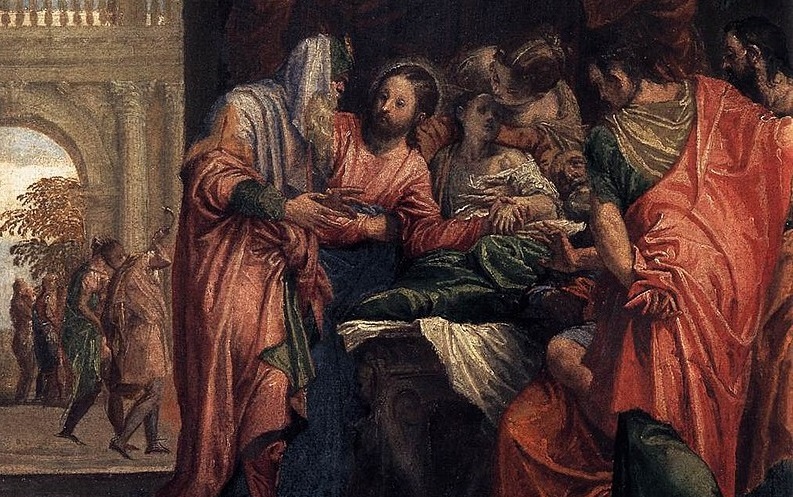
Imagine disease and death personified. Unobjectionably, the pair would be of the most contemptable, misanthropic sadistic individuals we would ever come across. Released long ago, they have been lurking about since the time of Adam and Eve. These monsters roam about unfettered relentlessly striking anyone who comes in their path whether day or night. They inflict their miseries without concern for whatever sort of pain they brought upon us and our loved ones. All mourn in their devastating wake.
Luke tells us good news about Jesus Christ the Redeemer who has come to stop the terror of Disease and Death.
Jesus sails back to the Capernaum side of the Sea of Galilee and He is welcomed by a large crowd of people. Jairus, a synagogue ruler, meets with Him, “and falling at Jesus’ feet, the synagogue ruler implored him to come to his house, for he had an only daughter, about twelve years of age, and she was dying” (Lk. 8:41-42).[1] They started heading down to the house but “people pressed around” Jesus (Lk. 8:42).
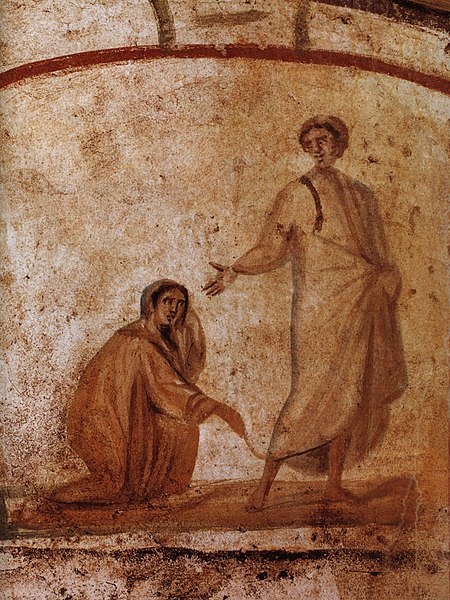
But the advance towards the house is suddenly interrupted: “There was a woman who had had a discharge of blood for twelve years, and though she had spent all her living on physicians, she could not be healed by anyone” (Lk. 8:43). Twelve years is a long time to suffer from a bleeding ulcer, and “This woman’s sickness was reckoned as if she had a menstrual period all month long; it made her continually unclean under the law (Lev 15:19–33)—a social problem on top of the physical one.”[2] Perpetually bleeding, this woman became a ritually unclean outcast. The woman heard about Jesus’ miracles, and thought, “If I touch even his garments, I will be made well” (Mk. 5:28). Without anybody taking notice, “she came up behind him and touched the fringe of his garment,[3] and immediately her discharge of blood ceased” (Lk. 8:44). Her twelve years of battling against Disease ends.
“Who was it that touched me?” asked Jesus. “Someone touched me, for I perceive that power has gone out from me” (Lk. 8:45, 46). Christ was giving attention to Jairus, but such hardly means an absence of awareness about anyone else, especially the woman with the incurable bleeding issue. Power flowed from Christ, and she was healed of her infirmity by the grace of the Lord. She was powerless to save herself but Christ is mighty to save.
The frightened woman then confesses what she had done and how she was immediately healed. Jesus responds, “Daughter, your faith has made you well; go in peace” (Lk. 8: 48). Her faith went beyond just knowing the stories about Jesus’ miracles (i.e., information) and believing they were true (i.e., correspondent to reality). Faith moved her to venture out to touch the hem of the Lord’s garment. “Having lost everything she possessed, because her life was wasting away within her, she cried out to the Lord in anguish. Her touch on the hem of his garment was the cry of a believing heart,” said the early church father Jerome (Homily 33).[4] Disease stole her health, Christ returned it to her.
Death strikes back. A messenger from the house delivers the bad news: “Your daughter is dead; do not trouble the Teacher any more” (Lk. 8:49). Dead a twelve-years-old, life for her had only started. Jairus had the plan to get Jesus to the house and heal his daughter, but the crowds get in the way, and Jesus gets sidetracked healing this woman, and now it is all too late — Death took his daughter. The plan ended in a complete wreck.
“Do not fear; only believe, and she will be well,” assures Jesus (Lk. 8:50).Leaving the crowds outside, Jesus enters the house with Peter, James, and John along with the parents of the child. The mourners were already inside the house. Jesus then says, “Do not weep, for she is not dead but sleeping” (Lk. 8:52). Because they knew the girl had died, they mocked Him (Lk. 8:53).
Taking the child by the hand, Jesus pronounces, “Child, arise” (Lk. 8:54).[5] Then the beyond extraordinary takes place: “Her spirit returned, and she got up at once. And he directed that something should be given her to eat. And her parents were amazed, but he charged them to tell no one what had happened” (Lk. 8:55-56). Apparently, Jesus’ agenda included exercising the value of silence on the reporting of miracles. No explanation is immediately provided for why silence was needed, but Luke saves that for later, and the reasons become clear as events surrounding the Transfiguration are presented.
Jesus’ healing of the diseased woman and raising of the dead daughter are more than coincidental, and “In both, the power and compassion of Jesus are notably displayed. Also, in both we see the importance of faith. Another point of comparison may be that Jairus’s daughter was about twelve years old, while the woman (vv. 43–48) had suffered a hemorrhage the same time length.”[6]
Twelve years. Disease inflicts a woman for twelve years but Jesus ends the affliction. Death takes the life of a twelve-year-old girl, Jesus brings her back to life. Death and Disease are defeated by Christ. But this is just a foretaste for the greater still yet to come.
Despite all the troubles and pains experienced in the present life. Disease and Death unrelentingly unmercifully pummel at us all. They leave us drowning in a river of tears. Will we ever beat them? Alone, not a chance. United with Christ, they can strike at us with all their might but will still be standing, for Christ has risen from the grave and shall one day raise us up immortal, imperishable, and incorruptible. We, therefore, have hope.
— WGN
[1] All Scripture cited from The Holy Bible: English Standard Version (Wheaton, IL: Crossway Bibles, 2016), unless noted.
[2] Craig S. Keener, The IVP Bible Background Commentary: New Testament (Downers Grove, IL: InterVarsity Press, 1993), Lk 8:43.
[3] The “fringe” would be one of the tassels common to Hebrew clothing, which were there as reminders to do all the commandments of the Lord as opposed to pursuing whatever fancied their hearts and eyes (Num. 15:38-39; Deut. 22:12). But the tassel was attached to the corner of the robe not a prayer shawl. “Medieval Jews adopted the garment styles of their non-Jewish neighbors. Since those garments were not rectangular, the biblical law of fringes did not apply to them. In order to comply with the law of tzitzit, the prayer tallit came into vogue.” (Abraham P. Bloch, The Biblical and Historical Background of Jewish Customs and Ceremonies [New York: Ktav Publishing House, Inc., 1980], 81). The tallit was never in used in Jesus’ day.
[4] Cited from Thomas C. Oden and Christopher A. Hall, eds., Mark (Revised), Ancient Christian Commentary on Scripture (Downers Grove, IL: InterVarsity Press, 1998), 69.
[5] Mark reports Jesus’ words in Aramaic were “Talitha cumi,” meaning “Little girl, I say to you, arise” (Mk. 5:41).
[6] Walter L. Liefeld, “Luke,” in The Expositor’s Bible Commentary: Matthew, Mark, Luke, ed. Frank E. Gaebelein, vol. 8 (Grand Rapids, MI: Zondervan Publishing House, 1984), 915–916.

 Love Truth Blog