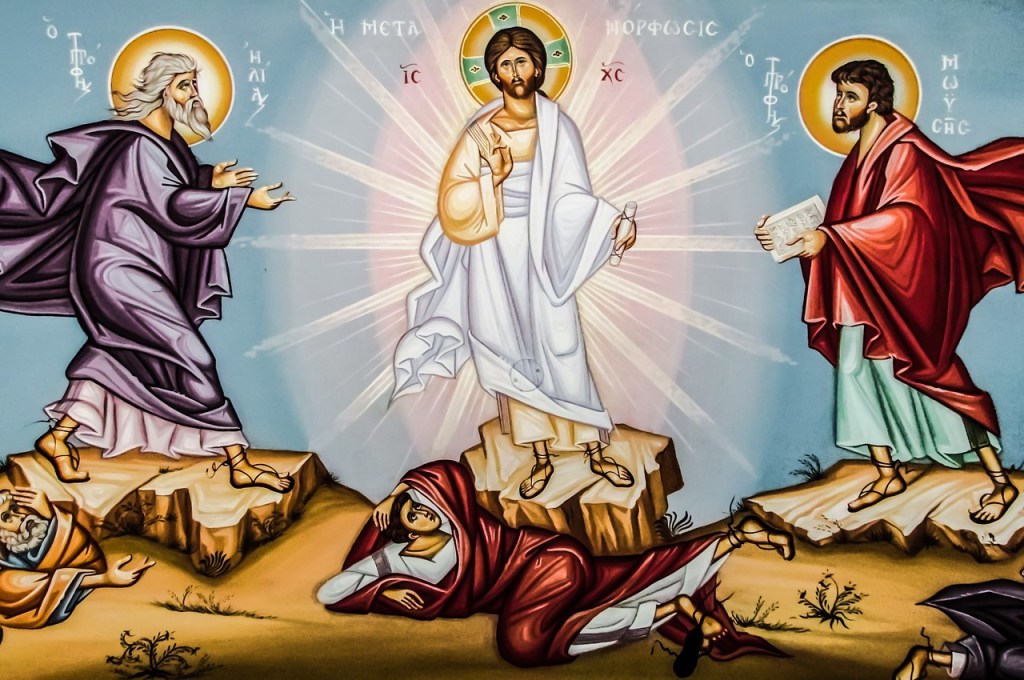
Peter, James, and John were with Jesus on a mountain praying when something extraordinarily took place. The three disciples noticed Jesus praying when “the appearance of his face was altered, and his clothing became dazzling white” (Lk. 9:29). [1] Mark and Matthew describe the appearance of the Lord as being “transfigured” (Mk. 9:3; Matt. 17.2).[2] The divine glory emanating from Jesus hidden behind the veil of invisibility became unveiled and visible for the disciples to behold!
Luke indicates the transfiguration happened “about eight days” or approximately a week after Peter’s confession of Jesus as Messiah and the Son of God (Lk. 9:28).[3]
Appearing with the transfigured Jesus were Moses and Elijah (Lk. 9:30).[4] Both these prophets finished the course in a way that was nothing short of extraordinary. Who could ever forget how the God took Elijah up to glory in a whirlwind (2 Kings 2:1-4). Likewise, Moses died in Moab and God interred him in Moab opposite of Beth-peor (Deut. 34:5). But two venerable Old Testament saints visibly manifested at the transfiguration mount, and “spoke of his departure, which he was about to accomplish at Jerusalem” (Lk. 9:31). What departure? Luke does not tell us that immediately but saves that for later. But the “departure” refers to Christ own death, resurrection, and ascension (see Lk. 23-24 and Acts 1).
Simon Peter then tells the Lord, “Master, it is good that we are here. Let us make three tents, one for you and one for Moses and one for Elijah,” but Luke wants the audiences to understand the ole fisherman was “not knowing what he said” (Lk. 9:33). Erecting three tabernacles for Jesus, Moses and Elijah missed the mark on what the transfiguration signified.
Luke then points out that “a cloud came and overshadowed them” (Lk. 9:34). The cloud in this context is far from water vapor variety. The Book of Exodus tells of the Hebrew people being led through the wilderness by a cloud in the day and a pillar of fire in at night. Moreover, it is understood that “Exodus 16:10 associates the cloud in the wilderness with the ‘glory of the Lord,’ and that “the cloud represents God’s presence but also his hiddenness (see Lam 2:2). No one can see God and live, so the cloud shields people from actually seeing the form of God. It reveals God but also preserves the mystery that surrounds him.”[5] The disciples are witnesses to the cloud that surrounded the presence of the Almighty, and they were moved into a place of worship. They displayed reverent fear.
God the Father thus spoke from the cloud, “This is my Son, my Chosen One; listen to him!” (Lk. 9:35). The identification of Jesus as the “Son” also happened at His baptism (Lk. 3:22; Mk. 1:11; Matt. 3:17). The same connection is even witnessed and testified by John the Baptist (Jn. 1:32-33). Note that Jesus is the Son of God. He did not become the Son. There was never a time He was not the Son. He is the eternally begotten Son of the Father.[6]
Jesus is also God’s “Chosen One,” this hearkens to the messianic servant of the Lord who would bring justice to the nations spoken about in Isaiah 42:1ff. God the Father has appointed Jesus with the task of being the Christ (i.e., the Messiah) and ushering in the everlasting heavenly kingdom.
God’s command to “listen” is thus the proper response to Jesus. The very word “listen” recalls Moses’ instruction: “The Lord your God will raise up for you a prophet like me from among you, from your brothers—it is to him you shall listen” (Deut. 18:15). This call to action extends beyond listening attentively but receiving the instructions of the Son.
Peter, James, and John — the inner circle of the Twelve — figured the crowds were wrong about the identity of Jesus being John the Baptist, Elijah or another prophet risen (Lk. 9:18-19). Peter nailed it on identifying Jesus as “The Christ of God” (Lk. 9:20). But the Lord still needed to move His disciples to jettison their own misconceptions about the Christ. He tells them, “The Son of Man must suffer many things and be rejected by the elders and chief priests and scribes, and be killed, and on the third day be raised” (Lk. 9:22). The disciples never expected messiah to be a suffering servant.[7] But they needed to mortify their own misconceptions about the messiah. They were to deny themselves, take up their cross, and follow Jesus (Lk. 9:23-25).
Peter, James, and John needed to experience the transfiguration. They needed to witness Moses and Elijah speaking to Jesus about His departure. They needed to receive Almighty ‘s instruction: Listen to My beloved Son.[8] Darrell Bock points out that “Jesus is a second Moses who brings a new way for God’s people. The disciples must listen to this Jesus. Their tendency is to assume they know who Jesus is and what he is about, but as his instruction shows, there are some surprises coming. He is greater than his extremely illustrious witnesses. The disciples need to sit at his feet and learn.”[9]
The transfiguration served to awaken Peter, James, and John to the fact that Jesus’ glory and passion were inextricably woven together. Thomas Schreiner indicates, “The purpose of the story is to confirm Jesus’s sonship and glory. The disciples think that Jesus’s passion rules out his glory, but actually the passion is the route to glory.”[10] Jesus’ path to glory involved the cross. It involved setting aside the satisfying of His own will and letting the will of the Father be done (Lk. 22:41-42; cf. Mk. 14:36, 39; Matt. 26:39, 42, 44).
The transfiguration, I dare say, is Christological orthodoxy visibly manifest. True divinity and true humanity in perfect union emanating divine glory in the form of brilliant light. What an unforgettable extraordinary theophany![11]
The divine light emanating from Jesus Christ is a reminder to us that God has come to dwell among us through the incarnation of the Son. John tells us “And the Word became flesh and dwelt among us, and we have seen his glory, glory as of the only Son from the Father, full of grace and truth” (Jn. 1:14). Yes, divine glory shines brightly all around us, and the voice from heaven tells us, “This is my Son, my Chosen One; listen to him!”
Jesus, likewise, bids us to deny the self, daily take up the cross, and follow Him. We are to mortify our seven deadly sins of lust, gluttony, sloth, greed, pride, envy, and anger. Harboring them ultimately destroys us all. But it is through the cross that we receive the grace to exchange these old vices for the truest virtues: lust for purity, gluttony for temperance, sloth for diligence, greed for generosity, pride for humility, envy for appreciation, and anger for peace.[12] These truest virtues build up our world. The seven deadly sins turn it to a wasteland.
— WGN
Notes:
[1] All Scriptures cited from The Holy Bible: English Standard Version (Wheaton, IL: Crossway Bibles, 2016), unless noted.
[2] The word metamorphoō [μεταμορφόω] translated “transfiguration” likely had problematic connotations for Luke’s predominantly Greek audience. Craig Keener notes, “Greek gods and magicians transformed themselves into other forms, though Mark, like Luke, was alluding to Moses, not to magicians” (Craig S. Keener, The IVP Bible Background Commentary: New Testament [Downers Grove, IL: InterVarsity Press, 1993], Lk 9:29)
[3] Mark and Matthew indicate the transfiguration occurred “after six days” of Peter’s confession. But there is no contradiction with Luke. D.A. Carson writes, Luke’s ‘about eight days after Jesus said this’ (9:28) is based on a Greek way of speaking and means ‘about a week later’” (D. A. Carson, “Matthew,” in The Expositor’s Bible Commentary: Matthew, Mark, Luke, ed. Frank E. Gaebelein, vol. 8 [Grand Rapids, MI: Zondervan Publishing House, 1984], 384.). Since an event taking place in “about eight days” is tantamount to saying, “after six days.” It is silly to fuss about Matthew and Mark stating “after six days” and Luke stating “about eight days” since such would be making a distinction without a difference.
[4] How did Peter, James and John know the two who appeared were Moses and Elijah? No answer is given. Yet, it is clear from the Synoptic witnesses that the three came to understand the identities of the two men conversing with Jesus. The Spirit could have revealed to the disciples the identities. Jesus could have done the same. The disciples never lacked ways to find out.
[5] Leland Ryken et al., Dictionary of Biblical Imagery (Downers Grove, IL: InterVarsity Press, 2000), 157.
[6] For further discussion on Jesus being the eternally begotten Son of God, see Charles Lee Irons, “Begotten of the Father before All Ages: The Biblical Basis of Eternal Generation according to the Church Fathers,” Christian Research Journal, 40, 1 [2017]: https://www.equip.org/articles/begotten-father-ages/
[7] Matthew and Mark tell us that Peter opposed Messiah’s mission to the cross. He is severely rebuked. Jesus said,: “Get behind me, Satan!” (Mk. 8:33; Matt. 16:23).
[8] Years later, Peter recalled the transfiguration to remind his community on the importance of heeding to the Word of the Lord: “For we did not follow cleverly devised myths when we made known to you the power and coming of our Lord Jesus Christ, but we were eyewitnesses of his majesty. For when he received honor and glory from God the Father, and the voice was borne to him by the Majestic Glory, “This is my beloved Son, with whom I am well pleased,” we ourselves heard this very voice borne from heaven, for we were with him on the holy mountain. And we have the prophetic word more fully confirmed, to which you will do well to pay attention as to a lamp shining in a dark place, until the day dawns and the morning star rises in your hearts, knowing this first of all, that no prophecy of Scripture comes from someone’s own interpretation. For no prophecy was ever produced by the will of man, but men spoke from God as they were carried along by the Holy Spirit” (2 Pet. 1:16-21).
[9] Darrell Bock, Luke: The IVP New Testament Commentary Series, vol. 3, ed. Grant Osborne (Downers Grove, IL: InterVarsity Press, 1994), 174.
[10] Thomas Schreiner, The Baker Illustrated Bible Commentary, ed. Gary M. Burge and Andrew E. Hill (Grand Rapids, MI: Baker Books, 2012), 1080.
[11] A theophany is a visible manifestation of divine glory.
[12] The seven deadly sins include: 1) lust — chasing after sinful passions or inordinate sexual desires; 2) gluttony — over indulging in food and intoxicants; 3) sloth — shrugging off work and being idle; 4) greed — chasing after material possessions; 5) pride — distorting the true self with an exaggerated façade; 6) envy — distaining others for possessing what I am without but which to possess, but the opposite of the jealousy that seeks to protecti and preserve that which I love from being unjustly stolen away by another; 7) anger — unbridled rage that brings about dissension and isolation. For more on this topic, see Paul Copan, “The Seven Deadly Sins and the Path to Virtuous Character,” 38, 2 [2015]: https://www.equip.org/articles/seven-deadly-sins-path-virtuous-character/

 Love Truth Blog