Back in Jesus’ day there were conversations about the tragic falling of the Siloam tower in Jerusalem which ended eighteen lives. Another happening discussed concerned the Galileans who were pilgrimaging to Jerusalem but were apprehended and executed by Pilate.[1] The question inevitably came up: Did these people perish because of some sin each one of them committed? Why did such tragedy befall them?
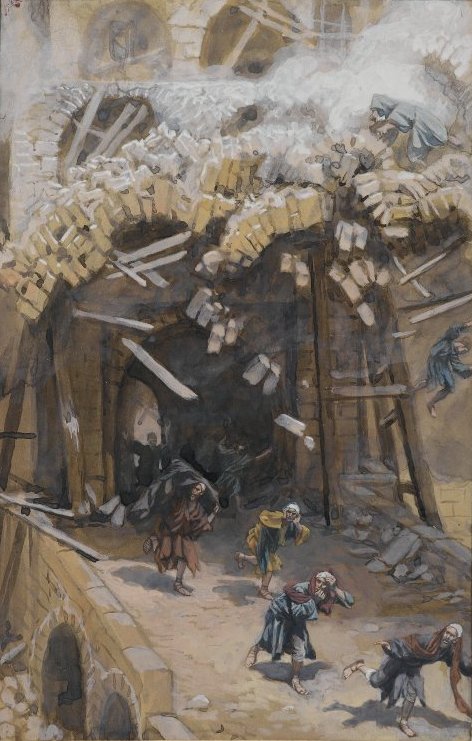
When Jesus was asked to comment on Pilate’s execution of the Galileans, the answer given was unexpected: “Do you think that these Galileans were worse sinners than all the other Galileans, because they suffered in this way? No, I tell you; but unless you repent, you will all likewise perish. Or those eighteen on whom the tower in Siloam fell and killed them: do you think that they were worse offenders than all the others who lived in Jerusalem? No, I tell you; but unless you repent, you will all likewise perish” (Lk. 13:2-5).[2]
Notice that Jesus never answers the “why” question. No connection is made between the Galileans and the Jerusalemites to any sin committed to explain the cause of their demise. Moreover, the Lord points out that none of those who perished were worse sinners than anyone else. The question of why is then left to mystery. There are simply matters we remain ignorant about. But this is different than being an ignoramus. The ignoramus speaks on what he knows nothing about or knows nothing of what he ought to know. Such is to be condemned. On the other hand, there are things that we remain ignorant about even when we have been illuminated with divine revelation. It is with the ignorance of things unrevealed to us by divine revelation that we must still orient our lives under God. Douglas Groothuis explains: “Jesus did not explain why the victims died as they did. He was not going to work a calculation of the likelihood of violent death because of sin. The issue was life and death — repentance unto salvation”[3] Put another way, “There is no call and there is no room for the Christian to be an ignoramus about the gospel or the Bible. However, the wise follower of Jesus will know what she cannot know under the sun.”[4]
Now the crushing of the Jerusalemites and the murder of the Galileans were unspeakable evils. They were happenings that would leave anyone feeling as if they got sucker punched in the gut. “Some are murdered in a terrorist act, and others are killed by a tower’s collapse” writes Clay Jones, “The deaths, in both cases, seem pointless; they seem willy-nilly. This is what philosophers call ‘gratuitous evil’…This is supposed to be the hardest question regarding theodicy. But these questions didn’t trouble Jesus. In fact, we are surprised by His blunt, even nonchalant response that people who died in these incidents weren’t worse sinners. They were just sinners, and unless you repent, you’ll die too.”[5] Thus Jesus redirects our attention to the primary matter of repentance.
Jesus wanted the audience to look beyond the tragic demise of the Jerusalemites and Galileans. He wanted them to understand that “more than determining death’s cause or timing is dealing with the fact of death and subsequent judgment,” which “quickly levels the playing field and calls on each person to consider where God stands in the equation — or better, where one stands before him.”[6] Since they all lived in this sinful and fallen world, they too would come to their own demise. Moreover, there will come a day when God judges the wicked (Psa. 1:5; Eccl. 3:17; 11:9), and in the end the righteous will be raised to everlasting life but the unrighteous to everlasting condemnation (Dan. 12:2). Jesus thus calls His audience to repent lest they perish.
The teachings of Jesus emphasized repentance. Twice He says, “Unless you repent, you will all likewise perish” (Lk. 13:3, 5). The Lord even began His earthly ministry with the call: “Repent, for the kingdom of heaven is at hand.” (Matt. 4:17). Prior to ascending into glory, Jesus again reminds His disciples “that repentance for the forgiveness of sins should be proclaimed in his name to all nations, beginning from Jerusalem” (Lk. 24:47).
What does it mean to repent? Simply put: “repentance refers to the radical turning away from anything which hinders one’s wholehearted devotion to God, and the corresponding turning to God in love and obedience.”[7] Repentance is more than just a mere acknowledgment of wrongdoing or feeling sorrow over transgression. It can include as such, but there is more to it. Repentance is a profound change of heart, a turning away from sin, and complete reorientation of life. It is coming alongside Christ and allowing Him to reorder and redirect our lives according to His plans and purposes. It is alongside Christ that we truly experience transformative grace, union with God and everlasting life.
Repentance is the call to turn from sin, come alongside Christ, and let Him work out His plans and purposes in our lives. Neglecting this call leads to tragedy, while embracing it opens the door to redemption, forgiveness, and everlasting life in Christ. The place where Christ plans and purposes are worked out in our lives is the kingdom of God.
— WGN
Notes:
[1] Thomas Schreiner indicates, “Pilate, probably at Passover, had some Galileans slaughtered while they were preparing their sacrifices” (Thomas Schreiner, The Baker Illustrated Bible Commentary, ed. [Grand Rapids, MI: Baker Books, 2012]: 1088).
[2] All Scripture cited from The Holy Bible: English Standard Version (Wheaton, IL: Crossway Bibles, 2016).
[3] Douglas Groothuis, “God and Our Ignorance,” Christian Research Journal, 43, 3 [2020]: 36: https://www.equip.org/articles/god-and-our-ignorance/.
[4] Ibid., 37.
[5] Clay Jones, Why Does God Allow Evil? Compelling Answers for Life’s Toughest Questions (Eugene, OR: Harvest House, 2017), 70-71.
[6] Darrell L. Bock, The IVP New Testament Commentary Series: Luke, vol. 3, ed. Grant R. Osborne (Downers Grove, IL: InterVarsity Press,1994), 239-240.
[7] J. M. Lunde, “Repentance,” in New Dictionary of Biblical Theology, ed. T. Desmond Alexander and Brian S. Rosner, electronic ed. (Downers Grove, IL: InterVarsity Press, 2000), 726.

 Love Truth Blog