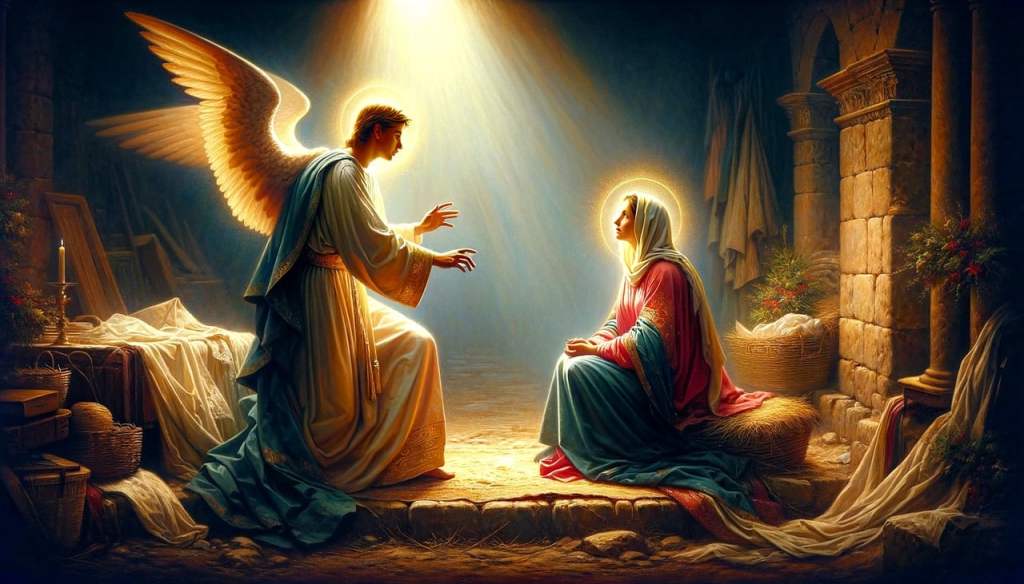
Angels move about us often unnoticed. They serve the Lord and God sends them out to minister to His people. Long ago, God sent an angel named Gabriel to “a virgin betrothed to a man whose name was Joseph, of the house of David. And the virgin’s name was Mary” (Lk. 1:27). [1] The angel came to deliver a message to Mary concerning an important assignment that God wanted her to carry out, which pertained to the long-awaited Messiah spoken of by the ancient Hebrew prophets.
Gabrial tells the Virgin: “Greetings, O favored one, the Lord is with you… Do not be afraid, Mary, for you have found favor with God. And behold, you will conceive in your womb and bear a son, and you shall call his name Jesus. He will be great and will be called the Son of the Most High. And the Lord God will give to him the throne of his father David, and he will reign over the house of Jacob forever, and of his kingdom there will be no end” (Lk. 1:28, 30-33).
Note that Mary is called the “favored one” (Lk. 1:28) who has “found favor with God” (Lk. 1:30). Because God’s favor is upon Mary, she has nothing to fear. Whether being startled by the appearance of an angel or anything else, she has nothing to fear. The favor that God bestows upon Mary is a special blessing. What is the special blessing? It is nothing shallow like beauty, fortune, and fame. Instead, it is an imperishable gift from God. God graces Mary with a male child: “You will conceive in your womb and bear a son” (Lk. 1:31a).
But this male child is extraordinary. “You shall call his name Jesus,” said Gabriel (Lk. 1:31b). The name “Jesus” (from the Hebrew Yeshua, meaning “The Lord is salvation”) encapsulates the child’s future mission, i.e., calling or assignment. Just as Joshua in the Old Testament led Israel into the Promised Land, Jesus leads humanity into the ultimate promise of everlasting life with God. The Lord is actively intervening to rescue His people, particularly through Jesus of Nazareth.
Gabriel additionally acknowledges Jesus’ unique relationship with God: “He will be great and will be called the Son of the Most High” (Lk. 1:32a).“The Most High” is a title for Yahweh. Here the angel speaks of Jesus’ unique relationship with God. The Son of the Most High designation applied to Jesus would have certainly signified to the young woman the child’s messianic vocation. One can wonder whether Mary at that moment realized the full import of the Son of the Most High title applied to Jesus.
The “Son of the Most High” title is never to be misconstrued as a biological offspring; rather, it would come to serve as an affirmation or acknowledgement of divine nature. Jesus thus shares in the same glorious essence or nature of God. Jesus subsequently makes the connection in saying, “I and the Father are one” (Jn. 10:30).[2]
Gabriel also indicates, “The Lord God will give to him the throne of his father David” (Lk. 1:32b).This proclamation ties Jesus to the Davidic covenant (2 Sam. 7:8–17), where God promised David an eternal kingdom. Jesus, as a descendant of David, fulfills this prophecy, not through political conquest but through carrying out His messianic mission. This messianic mission is flushed out in the rest of Luke’s Gospel.
Jesus being the Son of the Most High who receives the throne of his father David is messianic. New Testament scholar Darrell Bock indicates, “To Jewish ears this would be the same as calling him king (2 Sam. 7:8-17; Ps. 2:7). The Jews did not expect a ‘divine’ Messiah, as the Gospels themselves make clear. God had promised Dvid that the king would be God’s son, since Yahweh would be the son’s Father. This birth would be the first step in bringing the promise to David to its permanent, ultimate fulfillment. This long-held Father-son relationship was to reach unique heights in Jesus.”[3]
The child’s destiny is to “reign over the house of Jacob forever” and “his kingdom there will be no end” (Lk. 1:33). This speaks of the permanence of Christ’s rule. Earthly kingdoms rise and fall, but Jesus’ reign is eternal. Nations will come and go, but the enthroned Son reigns forever. It is by virtue of this everlasting reign that His promises are enduring and trustworthy.
Mary is perplexed about the prospect of conceiving a child and underscores the fact that she is a “virgin” (Lk. 1:34). But Gabriel reassures her that though she is a virgin, she will conceive a child through the Holy Spirit (Lk. 1:35). God’s Spirit thus brings about a miraculously pregnancy without a male contributor.[4] If there came about question about sinful indiscretion or speculation of a Roman solider violation, neither corresponded to reality, and the truth of the miraculous belonged to Mary. She was virtuous regardless of any opinion derived from fallible human wisdom.
Gabriel finishes the visitation by indicating that Mary’s close relative Elizabeth has also conceived despite being old and barren, and that shows “nothing will be impossible with God” (Lk. 1:37). The prospect of a young peasant girl form Nazareth of Galilee betrothed to a working-class carpenter could by a miracle bring forth the long-awaited messiah who would restore the throne of King David would have been far-fetched. Of course, this would be impossible according to the powers of mere mortals. But God did the impossible. Mary while still a virgin conceived a child.
The Virgin humbly receives the assignment: “Behold, I am the servant of the Lord,” (Lk. 1:38). Mary humbly receives the assignment given by God, and God uses her as vessel of honor to birth the Son of the Most High, the Davidic King whose reign would last forever. Christ literally dwelt inside Mary and Mary lived as the literal God bearer (Theotokos). God entered this world through the Virgin’s womb and dwelt among us.
The significance of the virgin birth and incarnation of the Son of God is encapsulated in these words from John the Monk: “Wonder! God is come among humanity; he who cannot be contained is contained in a womb; the timeless enters time, and great mystery: his conception is without seed, his emptying past telling! So great is this mystery! For God empties himself, takes flesh and is fashioned as a creature, when the angel tells the pure Virgin of her conception: ‘Rejoice, you who are full of grace; the Lord who has great mercy is with you!’” (Sticher of Annunciation)[5]
Merry Christmas!
— WGN
Notes:
[1] All Scripture cited from The Holy Bible: English Standard Version (Wheaton, IL: Crossway Bibles, 2016), Heb 1:14.
[2] “I and the Father are one” is understood as a self-identification of deity spoken by Jesus. The fact that the Jews sought to stone Him on the charge of blasphemy confirms the point (Jn. 10:31-33)
[3] Darrell I. Bock, The IVP New Testament Commentary Series: Luke, ed. Grant R. Osborne (Downers Grove, IL: InterVarsity Press,1994), 41.
[4] Matthew recalls the angelic announcement of the virgin Mary conceiving though the Holy Spirit to Joseph, and applies typologically to the miracle the words from the prophet Isaiah: Behold, the virgin shall conceive and bear a son, | and they shall call his name Immanuel” (Matt. 1:23; cf. Isa. 7:14).
[5] Cited from Arthur A. Just, ed., Luke, Ancient Christian Commentary on Scripture (Downers Grove, IL: InterVarsity Press, 2005), 17. John the Monk is a traditional name in The Festal Menaion, but the name is believed to be a reference to John of Damascus (Ancient Christian Commentary on Scripture: Introduction and Biographic Information [Downers Grove, IL: InterVarsity Press, 2005], 496). John of Damascus (c. 650-750) was an Arabic Christian monastic theologian whose writings greatly influenced the Eastern and Western Churches, particularly the work titled Exact Exposition of the Orthodox Faith (Ibid.).

 Love Truth Blog