Epic is the best word that can sum up the first time I sat in a theater to watch Star Wars (now Episode IV: A New Hope). This motion picture reorientated all my notions about great science fiction. The most immersive moment came during the opening scene showing the desert planet Tatooine below the darkness of space. Princess Leia’s blockade runner (Tantive IV), suddenly streaked across the horizon. Hot in pursuit comes the massive Imperial-class Star Destroyer—Darth Vader’s flagship (the Devastator). The shot of the Star Destroyer’s underside, speedily passing overhead before revealing its glowing blue ion engines in the rear, conveyed an overwhelming sense of scale. That was the moment I got hooked on the adventure from a long time ago in a galaxy far, far away.
What is the most epic that has ever happened in all of time and space? If Luke has anything say on the subject, it is the incarnation, crucifixion, resurrection, ascension, and return of the Son of God, who is Christ Jesus of Nazareth. Christ is the epicenter of the entire cosmos. He unites heaven and earth through the cross. He sets the vertical axis by coming from heaven to earth and even to the underworld, then He rises back up into glory. He forms the horizontal axis through His sending of the Spirit to empower the followers of Christ to carry out their assignment in proclaiming the good news throughout the world.
Acts 1:1–11 is more than a historical bridge between the life of Jesus and the mission of the apostles—it is a depiction of Jesus Christ as the epicenter of all time and history. Luke shows us heaven and earth reunited by Christ through the cross.
Luke was a physician and companion to Paul (Colossians 4:14). Little is known about the addressee Theophilus, but he is likely the “the patron of Luke-Acts…underwriting its publication,” and the implied audience were Gentile Christians.[1] “In the first book,” writes Luke, “I have dealt with all that Jesus began to do and teach” (Acts 1:1). [2] Key events of Jesus’ earthly ministry are narrated in this initial installment, such as the incarnation, death, resurrection, and ascension. But the sequel, known as the Acts of the Apostles, “tells how the good news of Jesus Christ spread from Jerusalem to Rome.”[3]
Four key doctrines essential to the Christian faith are introduced in Acts 1:1-11.
1. The Resurrection of Christ: The risen Christ appears to the apostles “over a period of forty days” (Acts 1:3), offering “many convincing proofs” that He is alive. More than just sentiment or metaphor, this post-resurrection interaction is an embodied encounter —it is a tangible, physical, bodily resurrection. Jesus’ resurrection from the dead vindicates His divine self-disclosures, fulfills the predictive prophecies He made concerning His own crucifixion, burial, and rising again on the third day, and serves as the cornerstone of hope for the Christian. Just as Christ died and rose again, believers likewise will follow Christ in death and resurrection to everlasting life. Christ defeats death through death. This is the good news about Jesus Christ delivered to the Twelve Apostles.
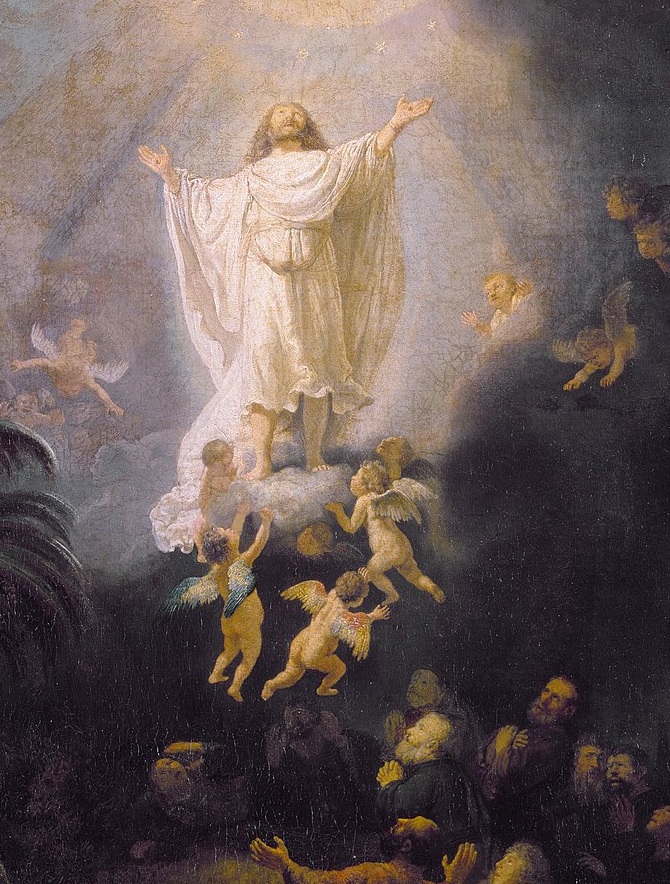
2. The Ascension of Christ: After instructing His followers, Jesus is “taken up” before their eyes (Acts 1:9). The ascension is beyond a dramatic exit; it marks Jesus’ enthronement at the right hand of the Father (cf. Acts 2:33; Hebrews 1:3). Christ’s ascension signals the completion of His earthly mission and the beginning of His heavenly intercession.
The ascension implies the incarnation of the Son of God. God came to dwell among us born of a virgin in the person of Christ Jesus of Nazareth. Christ’s descent from heaven to earth intersects at the cross, then comes the burial, and on the third day, the resurrection, followed by the ascent into glory. All this sets the vertical access of the cross. Both heaven and earth are jointed together by the Christ. The cross vertically connects humanity dwelling upon the Earth to the Father in Heaven through the way set by the Son.
Note that it would be wrongheaded to imagine that Jesus launched into outers space. Even traveling at the speed of light, it would take on the order of tens of billions of years to exit the extent of the reachable universe! There is more to existence than the material creation. What happening with the ascension is an interdimensional transition. Jesus is entering another heavenly dimension.[4]
But there are some final instructions that Jesus gives prior to ascending into glory, namely waiting for the Holy Spirit and taking the good news to the world.
3. The Coming of the Spirit: Jesus tells the apostles to wait in Jerusalem “for the promise of the Father” (Acts 1:4)—the gift of the Holy Spirit. Luke tells about the Holy Spirit like a dove descending upon Jesus (Luke 3:21) who then carried out His earthly ministry “full of the Holy Spirit” (Luke 4:1, 14, 18-19; cf. Isaiah 61:1-2). Likewise, the followers of Christ are “baptized with the Holy Spirit” (v. 5), and with the Spirit upon them, they are empowered to carry out their assignment as the Lord’s “witnesses in Jerusalem and in all Judea and Samaria, and to the end of the earth” (Acts 1:8). It is under the guidance of the Holy Spirit that the Christian advances as a dynamic witness of the Christ in the world.
The outpouring of the Holy Spirit would immerse the apostles and other followers of Christ into a dynamic relationship with God. All this was deeply yearned for and anticipated by the Old Testament prophets (Isaiah 32:15; 44:3; Ezekiel 36:25–28; 37:14; 39:29; Joel 2:28–3:1).
But the assignment given to the apostles would not be confined to a single city, ethnicity, or generation. It would be expansive, beginning in Jerusalem but designed to reach every nation. What enables such a global vision is not human strategy but divine empowerment. The Spirit is that divine enabler of gospel witness.
4. The Second Coming of Christ: “Will you at this time restore the kingdom of Israel?” the disciples asked. The Lord taught on the kingdom of God, and they wondered whether the moment had come for the manifestation of the final consummation anticipated by the ancients (Isaiah 65:17-25; 66:22-23; Jeremiah 31:31-34; Ezekiel 36-37; Amos 9:11-15; Joel 2:28-32). The Apostles wondered whether the moment for all those idyllic eschatological images would fully materialize.
But Jesus replies, “It is not for you to know times or seasons that the Father has fixed by his own authority” (Acts 1:7). The Lord corrects them. The times and seasons when the final consummation of the kingdom come will be fully realized remains hidden in the mind of God. No sign and wonder to initiate the countdown. The day and hour remain unknown. But in lieu of that end, the disciples receive their own earthly assignment to carryout under the power of the Holy Spirit.
As the apostles gaze heavenward at the ascending Christ, two angels appear and promise that “this Jesus, who was taken up from you into heaven, will come in the same way” (Acts 1:11). All that God’s people are called to do upon the Earth is bookended by the advents of Christ with the ascension in between. The ascended Christ will return. This expectation does not promote passive waiting, but active witness. The knowledge that Christ will return gives urgency, hope, and accountability to the church’s task.
Conclusion: Jacob witnessed angels ascending and descending from heaven upon a ladder. At that moment, Israel realized the awesomeness of the place he stood. He could only describe that place as the house of God with its gate in heaven. It is in that place that Jacob is assured that Yahweh is with him and that the Lord will multiply his descendants and bring him into the promise land (Genesis 28:10-17). Here there is a cross. Upon the vertical axis descends God’s promise to Israel. Along the horizontal axis is the anticipation that Jacob’s descendants will cover the earth from east to west and north to south.
Luke introduces us to the Cross of Christ. Upon the vertical axis in the incarnation, crucifixion, burial, resurrection, and ascension of the Son of God. The Son of God paves the way for humanity to be redeemed from sin and death and adopted as sons and daughters of God the Father. The Spirit also descends to us on the vertical axis, and brings us into the horizontal axis. Upon the horizontal axis we go out to the world under the power of the Spirit to share the good news of God coming to dwell with us and they too can be adopted as sons and daughters in His kingdom.
Acts 1:1–11 is more than a historical introduction—it is the narrative on the very theological epicenter of the church’s identity and calling. It teaches that the risen Christ has ascended into glory, that the outpouring of the Spirit empowers believers to carry on the assignment of bringing good news to the world, and that the future anticipates Christ’s triumphant return. Like the first disciples, we are not to stand gazing into the sky but to move forward, Spirit-empowered, and gospel-driven to herald the good news.
— WGN
Notes:
[1] Gordon D. Fee and Douglas K. Stuart, How to Read the Bible Book by Book: A Guided Tour (Grand Rapids, MI: Zondervan, 2002), 286.
[2] All Scripture cited from The Holy Bible: English Standard Version (Wheaton, IL: Crossway Bibles, 2016), unless noted.
[3] Fee and Stuart, How to Read the Bible Book by Book, 296.
[4] See Hank Hanegraaff, The Complete Bible Answer Book: Collector’s Edition, Revised & Expanded (Nashville, TN: Thomas Nelson, 2024), 257-258.

 Love Truth Blog