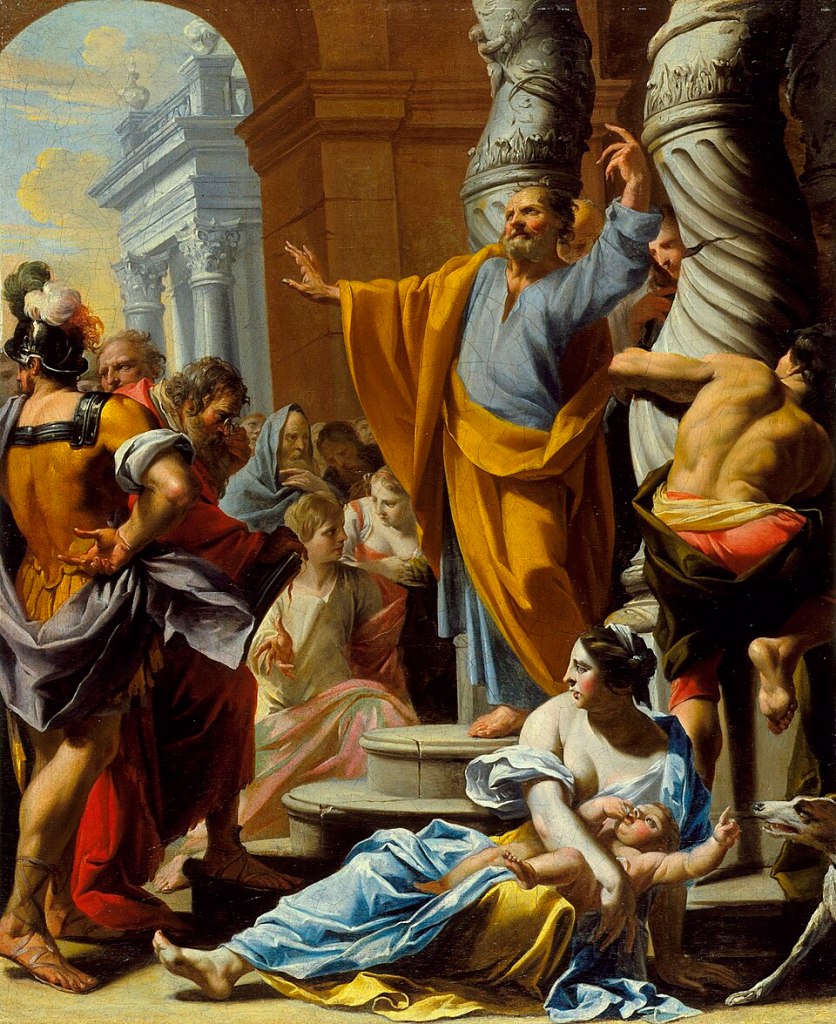
God became man in the person of Jesus Christ of Nazareth to redeem humanity from sin and dwell once again among His people. This profound truth resounds throughout the Acts of the Apostles. A striking example is found in the healing of the lame beggar at the Beautiful Gate.
Christ Heals the Lame Beggar: Peter and John went up to the temple for the afternoon prayer and encountered a man who had been lame from birth sitting at the Beautiful Gate begging for alms. Getting his attention, Peter said, “I have no silver and gold, but what I do have I give to you. In the name of Jesus Christ of Nazareth, rise up and walk” (Acts 3:6).[1] Immediately the man stood, walked and entered the temple leaping, walking, and praising God. The miracle restored the body and soul of the beggar at the Beautiful Gate. The restored man responded in worship.
All who witnessed the miracle were filled with wonder and amazement (Acts 3:9).
The temple worshippers who recognized that the paralyzed beggar at the Beautiful Gate had been miraculously healed ran to meet with Peter and John at Solomon’s Portico. Noticing their amazement, Peter said: “Men of Israel, why do you marvel at this, or why do you stare at us, as though by our own power or piety we have made him walk?” (Acts 3:12). Through this rhetorical question, Peter makes it clear that neither he nor John was the source of the miracle.
The Problem: But Peter confronts the crowd about their open opposition to the one who made the lame beggar whole — Jesus Christ. The apostle describes Christ as the Servant of the God of Abraham, Isaac, and Jacob whom they “delivered over and denied in the presence of Pilate” (Acts 3:13). Though Pilate sought to release Him, they “denied the Holy and Righteous One” and instead asked for the release of a “murderer,” i.e., Barabbas. They killed “the Author of life,” but God raised Him from the dead (Acts 3:15a). Peter then identifies himself and John as witnesses to the resurrected Lord (Acts 3:15b).
The apostle then clarifies: “And his name—by faith in his name—has made this man strong whom you see and know” (Acts 3:16a). Here the name signifies Jesus’ divine authority. Faith is the ventured trust placed in the name of Jesus. Both Peter and the lame beggar exercised faith. Faith is the instrument though which Jesus effected the divine healing.
Even so Peter also recognizes that “the faith that is through Jesus has given the man this perfect health in the presence of you all” (Acts 3:16b). Jesus is then the cause of faith. The miracle was not the result of human ability but of the authority of the risen Jesus Christ of Nazareth at work. It was the faith through Jesus.
Peter then indicates that both the people and their rulers “acted in ignorance” (Acts 3:17). This statement echoes Jesus’ own prayer from the cross: “Father, forgive them, for they know not what they do” (Luke 23:34). While the chief priests and elders deliberately plotted Jesus’ death (Matt. 26:3–4) and stirred up the crowd to demand the release of Barabbas and the crucifixion of Christ (Matt. 27:20), the people themselves did not fully grasp the gravity of their actions. Incited by the chief priests and scribes, they were swept into a frenzy, stirred to a bloodthirsty desire for the spectacle of a public execution. Had they truly realized that they were calling for the death of the Servant of the God of Abraham, Isaac, and Jacob—the Holy and Righteous One, the Author of Life—they would never have joined together in the cry, “Crucify Him!”[2]
What Was Meant for Evil God Permitted for Good: Yet there is more to the death of Christ than the conspiracy of chief priests and elders who plotted His murder and manipulated the crowds to carry out their wicked designs. The apostle also acknowledges that through these events God fulfilled what He had foretold through the prophets—”that His Christ would suffer” (Acts 3:18). Indeed, the risen Jesus Himself later explained this from the Scriptures, beginning with Moses and all the prophets, showing how they spoke of Him and of His mission to the cross (Luke 24:25–27). Moreover, Christ throughout His earthly ministry taught of His betrayal, death, and resurrection on the third day (Lk. 9:22; 9:43-45; 18:31-33).
The chief priest and elders carried out their scheme to murder Jesus, they rallied the Jerusalem crowd to support the crucifixion, the greatest act of injustice in history took place — the unjust execution of the Holy, Righteous, Servant of God, and Author of Life — nothing transpired outside of God’s plan and purpose for the Messiah. Whereas the chief priest and elders, along with the crowds, meant evil in crucifying Jesus, God meant it for good, to bring redeem sinful humanity (cf. Gen. 50:19-20; Matt. 20:28; Mk. 10:45).
God Saves Sinners: The crowds acted out of ignorance, yet they still bore the guilt of murdering the God’s Holy and Righteous Servant and Author of Life. God’s mercy and grace is still extended to even to those who committed such a horrendous sin. Peter thus calls out: “Repent therefore, and turn back, that your sins may be blotted out” (Acts 3:19). Repentance means ceasing opposition to Christ and turning toward Him in faith. The result is forgiveness and the promise that “times of refreshing may come from the presence of the Lord” and that God will send the Christ appointed for them — Jesus (Acts 3:20).
“Heaven must receive Him until the time restoring all things about which God spoke by the mouth of his holy prophets long ago” (Acts 3:21). Concerning the “times of refreshing,” notice “times” is plural, signifying periodic seasons wherein believers are forgiven and restored experiencing the refreshing nearness of the Lord.[3] But the “time of restoring” concerns the second coming of Jesus. Peter is addressing a Jewish audience who anticipates the restoration of all things according to the Old Testament prophets, thus “The times of refreshing that come as a result of repentance and faith are harbingers of the time of complete restoration.”[4] The healing of the lame man thus becomes a sign pointing forward to the ultimate restoration that will accompany Christ’s return.
Peter declares that receiving the Christ appointed by God had long been foretold by Moses and the prophets. He identifies Jesus as the prophet like Moses whom God promised to raise up—one to whom the people were to listen and obey, warning that every soul who refuses Him will face destruction (Acts 3:22–23; cf. Deut. 18:15, 18–19). In this way, true belief in Moses ultimately leads to faith in Jesus, and faith in Jesus places one in true continuity with Moses. [5] The apostle further affirms that all the prophets, from Samuel onward, proclaimed these very days (Acts 3:24). He then reminds the Jewish crowd that they are the sons of the prophets and heirs of the covenant God made with Abraham, through whose offspring all the families of the earth would be blessed (Acts 3:25; cf. Gen. 12:3; 22:18). God therefore raised up His Servant and sent Him first to them, blessing them by turning each one from wickedness (Acts 3:26), so that by coming to Christ they would stand in harmony with the prophets and partake in the fulfillment of Yahweh’s covenant promise to Abraham.
The physical healing at the Beautiful Gate becomes a sign of a greater reality: true wholeness—of both body and soul—flows from union with the risen Christ, who forgives sins now and will one day restore all things. If the crowds who stood in awe of this miracle wrought by Christ would repent of their sins, God would grant them forgiveness and bring them into the “times of refreshing.” In doing so, they would find themselves aligned with the vision of Moses and the prophets, and through them the blessing promised to Abraham would extend to all the families of the earth. They too would come to experience the true wholeness of being found in Christ.
For us today, Acts 3:12-26 is a call to personal repentance and faith. Just as the crowd was summoned to turn from sin and receive the “times of refreshing” that come from the Lord, we too are invited to turn from our own self-reliance and brokenness and entrust ourselves to Christ. In Him we find forgiveness, renewal of heart, and the promise that our lives are drawn into God’s larger redemptive story—the fulfillment of what He promised through Moses, the prophets, and to Abraham. As we walk with Christ, His restoring grace begins to shape our lives so that we, in turn, become instruments through whom His blessing reaches others.
— WGN
[1] All Scripture cited from The Holy Bible: English Standard Version (Wheaton, IL: Crossway Bibles, 2025), unless noted.
[2] The former persecutor of Christians turned apostle to the Gentiles even testified, “I had acted ignorantly in unbelief” (1 Tim. 1:13) but Paul’s eyes were opened to the truth (cf. Acts 8:1-3; 9:1-18; 22:6-16; 26:12-18).
[3] Simon J. Kistemaker and William Hendriksen, Exposition of the Acts of the Apostles, vol. 17, New Testament Commentary (Grand Rapids: Baker Book House, 1953–2001), 135.
[4] Kistemaker and Hendriksen, 136.
[5] Richard N. Longenecker, “The Acts of the Apostles,” in The Expositor’s Bible Commentary: John and Acts, ed. Frank E. Gaebelein, vol. 9 (Grand Rapids, MI: Zondervan Publishing House, 1981), 298.

 Love Truth Blog