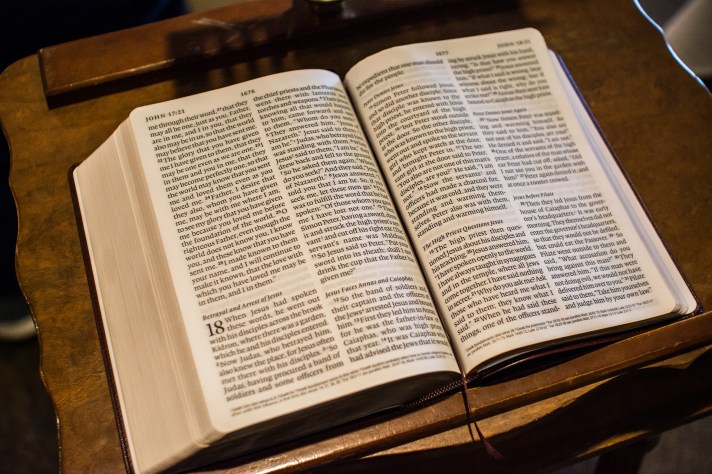
One of the most beautifully incredible features of Christianity is this: God comes to meet and spend eternity with us. We typically stumble into this religious mode that tries to perform some deed or display certain virtues in hopes of being worthy to come into the presence of God, but that is getting things backwards. Rather, the good news is that God enters into the world, meets us here, and invites us into communion with Him. Whatever obstacle stands between us and God, it is God who removes it not us. God actually reveals Himself to us in His writings (Scriptures) and incarnation (Jesus Christ).
I intend to spend the remainder of this blog post addressing the written Word of God.
God moved certain ancient writers to compose works that would reveal Himself to the world. Although these ancient writers wrote in their own respective languages (Hebrew, Aramaic and Greek), used literary forms generally familiar to their audiences (narrative, law, poetry, proverb, parable, epistle, apocalyptic, etc.), their message was nevertheless the Word of God. Their sacred writings are referred to as the Scriptures or the Bible.
The biblical writers unambiguously declared their contributions to the Scriptures came as the result of divine inspiration. For example, Moses wrote down the Law given by God (Exod. 34:27-28; Deut. 31:24-26; cf. Josh. 1:8). After Moses, the Lord spoke through many other prophets as well. Statements like “the Lord said” and “thus says the Lord,” which are repeated throughout the Bible, imply the message the ancient prophets delivered to their audience was divine revelation received from God. The Apostle Peter wrote, “No prophecy of Scripture comes from someone’s own interpretation. For no prophecy was ever produced by the will of man, but men spoke from God as they were carried along by the Holy Spirit” (2 Pet. 1:20-21).1 Peter even testified to Paul as an author of Scripture (2 Peter 3:14-16). Paul, likewise, wrote, “All Scripture is breathed out by God and profitable for teaching, for reproof, for correction, and for training in righteousness, that the man of God may be complete, equipped for every good work” (2 Tim. 3:16). Elsewhere, he stated, “If anyone thinks that he is a prophet, or spiritual, he should acknowledge that the things I am writing to you are a command of the Lord” (1 Cor. 14:37).
Scriptures were penned by human agents; however, the Spirit led them through the writing process, and the end result was the written Word of God. J.I. Packer puts it this way:
Inspiration is a work of God terminating, not in the men who were to write Scripture (as if, having given them an idea of what to say, God left them to themselves to find a way of saying it), but in the actual written product. It is Scripture — graphe, the written text — that is God-breathed…Scripture is not only man’s word — the fruit of human thoughts, premeditation, and art — but also and equally God’s word, spoken through man’s lips or written with man’s pen. In other words, Scripture has a double authorship, and man is only the secondary author; the primary author, through whose initiative, prompting, and enlightenment, and under whose superintendence each human writer did his work, is God the Holy Spirit.2
It is utterly wrong to imagine that ordinary writings containing the ideas of mortal men were in some way given an elevated status of Holy Scripture by the ratification of a Council with some kind of religio-political agenda. Rather, the Scriptures are the Word of God, and we are correct to recognize the Scriptures as the Word of God.
The Scriptures are organized into two parts. The Old Testament includes: Genesis, Exodus, Leviticus, Numbers, Deuteronomy, Joshua, Judges, Ruth, 1-2 Samuel (1-2 Kingdoms), 1-2 Kings (or 3-4 Kingdoms), 1-2 Chronicles (1-2 Paraleipomenon), Ezra (1 Ezra), Nehemiah (2 Ezra), Esther, Job, Psalms, Proverbs, Ecclesiastes, Song of Solomon (Song of Songs or Canticle of Canticles), Isaiah, Jeremiah, Lamentations, Ezekiel, Daniel, Hosea, Joel, Amos, Obadiah, Jonah, Micah, Habakkuk, Zephaniah, Haggai, Zechariah, and Malachi. The New Testament includes: Matthew, Mark, Luke, John, Acts, Romans, 1-2 Corinthians, Galatians, Ephesians, Colossians, 1-2 Thessalonians, 1-2 Timothy, Titus, Philemon, Hebrews, James, 1-2 Peter, 1-3 John, Jude, and Revelation. These writings are recognized as the Canon of Scripture. The word “canon,” according to F.F. Bruce, refers to “the list of books which are acknowledged to be, in a unique sense, the rule of belief and practice.”3
Note that that the text as it was written in their original languages — the Old Testament in Hebrew with some sections in Aramaic and the New Testament in Greek — are recognized as having been produced under the inspiration of the Holy Spirit; albeit we recognize fallibility of translators and interpreters.
We can never climb infinitely high mountain separating us on Earth from God in Heaven. None of us could ever find the base to place our finite feet much less ascend to the summit. However, God came down to us, shared with us His most intimate thoughts, and preserved them in the Scriptures. God exists, He is not silent, but He has spoken to us. The Scriptures preserve for us the Word of God.
“Your word is a lamp to my feet | and a light to my path” (Psalm 119:105).
— WGN
P.S. In the next blog post, I will offer some reasons to believe the testimonial of the Scripture of being the Word of God.
Notes:
1. All Scripture cited from The Holy Bible: English Standard Version (Wheaton, IL: Crossway Bibles, 2016), unless noted.
2. J.I. Packer, “The Inspiration of the Bible,” The Origin of the Bible ed. Philip W. Comfort (Carol Stream, IL: Tyndale House Publishers, Inc., 2012), 30-31.
3. F.F. Bruce, The Canon of Scripture (Downers Grove, IL: InterVarsity Press, 1988), 18.

 Love Truth Blog
Excellent series Warren, thank you so much for endeavouring to do this, really looking forward to the rest of the series. I took the liberty of reposting your series in one of my posts (just the direct links). God’s grace, peace and blessings to you and yours.
LikeLiked by 1 person
This is a great series… praise God. Would you please send me the whole series. Thanks
LikeLike
Sure, you can access the series here… https://lovetruth1.wordpress.com
LikeLike