Jesus Christ is the ultimate revelation of God. Let me explain. The universe bears the indelible fingerprints an intelligent designer,1 which is why Christians rightly call it the Book of Nature. However, God is far from silent. Scriptures teach us that “long ago, at many times and in many ways, God spoke to our fathers by the prophets, but in these last days he has spoken to us by his Son” (Heb. 1:1-2).2 The Bible is the written Word of God,3 and Jesus is the Living Word of God. The Scriptures point us to Christ and Christ reveals God to us. This is a primary teaching of historic Christianity.
The first century Christians were convinced that Jesus of Nazareth was both the Messiah (i.e. the Christ) spoken about by the Old Testament prophets and the very incarnation of the God. Their belief came from their interactions with Jesus. They heard His teachings and witnessed His works. Through these interactions, they became convinced that He was more than merely human. They believed Him to be incarnate deity — Theanthropos (i.e. the God-man).
The New Testament makes undeniable statements to the divinity of Jesus Christ. The Apostle John proclaimed: “In the beginning was the Word, and the Word was with God, and the Word was God…and the Word became flesh and dwelt among us” (Jn. 1:1, 14). Elsewhere John wrote, “We know that the Son of God has come and has given us understanding, so that we may know him who is true; and we are in him who is true, in his Son Jesus Christ. He is the true God and eternal life” (1 Jn. 5:20).
Matthew informs us that the Child born to the Virgin was named “Immanuel,” which means “God with us” (Matt. 1:21-23). Note that “Matthew probably intends the words of Jesus at the end of his Gospel — “Behold I am with you always, until the end of the age” — to correspond to the meaning of Emmanuel. Jesus is God, among his people to accomplish their salvation.”4
The Epistle to the Hebrews identifies the Son (i.e. Jesus Christ) as the one who “created the world.” Moreover, Christ is described as being “the radiance of the glory of God” and “the exact imprint of his nature” (Heb. 1:3).
Upon witnessing the resurrected Lord, the Apostle Thomas declared, “My Lord and my God!” (John 20:28).
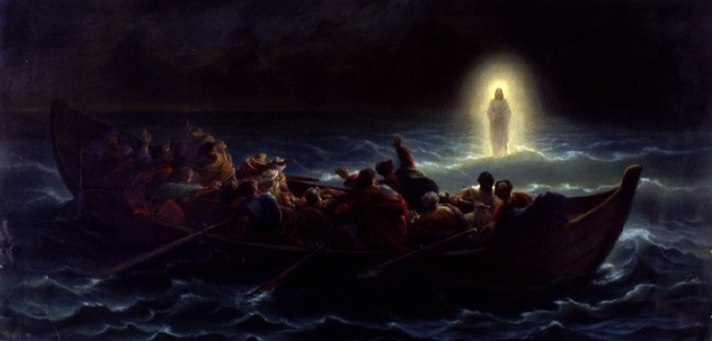
The disciples witnessed Jesus walking on water and they exclaimed, “Truly, you are the Son of God” (Matt. 14:22-33). On another occasion, Jesus was talking with the disciples about the various opinions their community had about the identity of the Son of Man. The Lord them asked them, “But who do you say that I am?” Simon Peter responded, “You are the Christ, the Son of the living God” (Matt. 16:13-16). The term “Christ” refers to an anointed one, i.e. messiah. However, “Son of God” essentially “defines the Messiah as more than a human figure, as someone who is uniquely a manifestation of God, the very agent of God who somehow participates in God’s being.”5
The Apostle Paul also made very explicit statements about the deity of Jesus Christ. In the Epistle to the Philippians, he proclaims:
Though he was in the form of God, did not count equality with God a thing to be grasped, but emptied himself, by taking the form of a servant, being born in the likeness of men. And being found in human form, he humbled himself by becoming obedient to the point of death, even death on a cross. Therefore God has highly exalted him and bestowed on him the name that is above every name, so that at the name of Jesus every knee should bow, in heaven and on earth and under the earth, and every tongue confess that Jesus Christ is Lord, to the glory of God the Father (Phil. 2:6-11).
Similarly, the Epistle to the Colossians, Paul tells us:
He is the image of the invisible God, the firstborn of all creation. For by him all things were created, in heaven and on earth, visible and invisible, whether thrones or dominions or rulers or authorities—all things were created through him and for him. And he is before all things, and in him all things hold together. And he is the head of the body, the church. He is the beginning, the firstborn from the dead, that in everything he might be preeminent. For in him all the fullness of God was pleased to dwell, and through him to reconcile to himself all things, whether on earth or in heaven, making peace by the blood of his cross” (Col. 1:15-20).
From Paul we learn that Jesus was truly human in every respect, experiencing death along with resurrection, which is common to all humans, but He never divested Himself of a single divine attribute. He is both fully divine and fully human. Christ is in fact the creator, sustainer, and redeemer of the universe, and that He is truly worthy to receive the same kind of worship reserved exclusively for God.
Jesus even received worship from His followers (Matt. 14:33; 28:9; Lk. 24:52; Jn. 9:38). This is significant since God alone is to be worshipped (Exod. 20:4-6; Deut. 6:13, 10:20), and while Jesus is well aware of that fact (Matt. 4:10; Lk. 4:8), He still received worship without any reservation.
God is neither impersonal nor absent. Neither unknowable nor mythical. No! God is with us. God enters into the stream of history to commune with humankind. Through the Virgin’s womb the Son of God enters into time and space to commune with us. Christ is incarnate deity — Theanthropos, the God-man, the perfect union between humanity and divinity. He is the mediator between God and humanity. To know Christ is to know God!
The next post will address Jesus’ claim to be God.
— WGN
- i.e. the reasons from the natural realm that point to God’s existence include: cosmology (see “Does God exist? Part 2: The Universe Presupposes the Existence of God)”, teleology or design (see “Does God exist? Part 3: How Complex Life on Earth Points to the Existence of God” and “Does God Exist? Part 4. How Earth’s Suitability to Support Life and the Search for Extraterrestrial Life Points to the Existence of God”), ethics (see “Does God Exist? Part 5: How Morality Points to the Existence of God”), and reason (see “Does God exist? Part 6: How Reason, Mathematics, Science Points to the existence of God”).
- All Scripture cited from The Holy Bible: English Standard Version (Wheaton, IL: Crossway Bibles, 2016), unless noted.
- The Bible declares itself to be God’s Word (see “Does God exist? Part 7: Knowing God from the Scriptures”), The Bible bears the marks of being from a divine source (see “Does God Exist? Part 8: Knowing and Showing the Bible is God’s Word”) and the Bible can be trusted becase it is without flaws, i.e. contradictions (see “Does God Exist? Part 9: Addressing the Apparent Contradictions in the Word of God”).
- Donald A. Hagner, Word Biblical Commentary: Matthew1-13, vol 33A, ed. David A. Hubbard and Glen W. Barker, (Dallas, TX: Word Books, 1993), 21.
- Hagner, 408.

 Love Truth Blog
Reblogged this on Truth2Freedom's Blog.
LikeLike