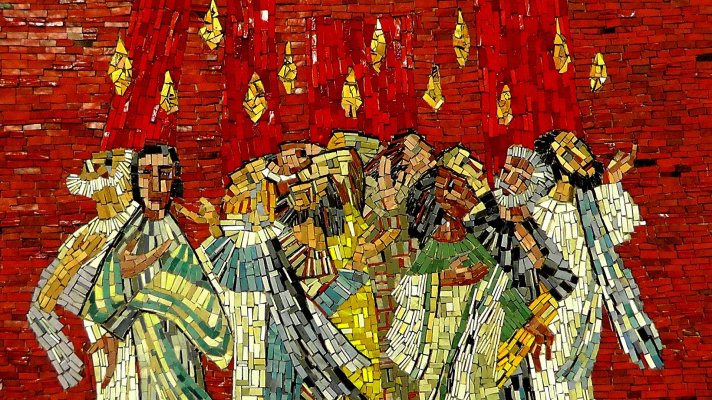
Christians refer to the Holy Spirit as the Paraclete. Paraclete comes from the Greek word paraklētos, which refers to “one who appears in another’s behalf” like a “mediator, intercessor, [or] helper.”1 Jesus Christ speaks of the Paraklētos in John 14-16. Here the Greek is translated “Helper” in the English Standard Version.2 Nevertheless, the Paraclete spoken about by Christ is far more dynamic than a lexical definition. Christ taught that the Paraclete is intimately united with the Christian and the Christian is brought by the Paraclete into union with the Father and the Son. The very end of Christianity is in fact union with the Triune God of the universe.
The Union with the Paraclete Sent from the Father though the Son
Christianity is all about being in a relationship with God grounded in love. This is why Christ says, “If you love me, you will keep my commandments. And I will ask the Father, and he will give you another Helper [paraklētos], to be with you forever, even the Spirit of truth, whom the world cannot receive, because it neither sees him nor knows him. You know him, for he dwells with you and will be in you (John 14:15-17).”3
Authentic Christianity is never about performing so well that we wind up earning and deserving a spot in heaven. It is never a deal wherein we do our part to obligate God to do His part — an exchange of goods and services. It is never about giving to God, and getting something from God in return.
Christianity is about loving God and being loved by God. Jesus taught the greatest commandment is to love God, and the second is to love one’s neighbor (Matt. 22:37-39; cf. Deut. 6:5; Lev. 19:18; Rom. 13:9-11). Love is the basis for all the commandments and prohibitions found in the Law and Prophets (Matt. 22:40). Moreover, the New Testament writers constantly remind Christians to love one another (John 13:34-35; 15:12, 17; Rom. 12:10; 1 Thess. 4:9; 1 Pet. 1:22; 4:8; 1 John 3:11, 23; 4:11-12; 2 John. 5)
Just as the way to cultivate loving relations with parents, spouses, children and friends is rooted in knowing and honoring their values and opinions, so too the Christian who loves Christ will keep His commandments. Love is lacking in those who fail truly know and honor the values and opinions of another.
Jesus Christ, interestingly, is also identified as our “advocate” [paraklētos] in 1 John 2:1-2. He is the one who intercedes on behalf of the Christian who stumbles in sin. The Lord provides the sacrifice which sets things right between God and the sinner. In John14:16 we find the Lord telling us of another Paraclete. Just as Christ has been a teacher, encourager, and counselor to the disciples, the Paraclete will come to do the same.
During the final Passover with the disciples, the Lord reiterated the fact thar He would be going away, referring to His own death, resurrection and ascension. Nevertheless, those who love the Lord would never be left behind. Christ will ask the Father, and the Father will send to the Paraclete. The disciples will be in an intimate everlasting union with the Paraclete. The Holy Spirit will dwell among them, and they will be indwelt by the Holy Spirit. On the other hand, sinful and fallen people never experiences this union because the neither see nor know God.
The Union with the Father and the Son through the Paraclete
The Christian is intimately united with the Paraclete sent from the Father through the Son (John 14:16-17). Moreover, Christ says, “Yet a little while and the world will see me no more, but you will see me. Because I live, you also will live. In that day you will know that I am in my Father, and you in me, and I in you.” (John 14:19-20). Here the Lord anticipates His death, resurrection, and ascension, which is followed by the coming of the Spirit. When the Paraclete is united with the Christian something beyond spectacular happens. Christians are able to perceive unseen realities for they are intimately united with the Trinity — Father, Son and Holy Spirit.
When we think about the way God brings people to faith in Jesus Christ, the “human mechanism” of “preaching and hearing the Word,” is necessary, but hardly sufficient. Donald Fairbairn, Professor of Early Christianity at Gordon-Conwell Theological Seminary, indicates that “These human actions alone do not bring about faith in Christ. Rather, Christian faith comes about as the Holy Spirit works to unite believers to Christ in his humanity, therefore bringing us by grace into the Father-Son relationship.”4 Commenting on John 14: 16-17 and 19-20, Fairbairn says, “Notice that the Spirit’s dwelling within believers is the key that enables us to know that the Son is in the Father, that believers are in the Son and that the Son is in believers. The mutual sharing of relationship between Father and Son and between Son and believers depends on the Holy Spirit. The Spirit in the one who links us to that relationship by uniting us to the Son.”5
Nobody earns nor deserves a place in God’s kingdom. It is Christ who paves the way for the Christian to enter into God’s kingdom, and it is through Christ that the Father sends the Paraclete. The Christian dwells with and is indwelt by the Triune God of the universe on account of the presence of the Paraclete.
We live in a world that is in many ways broken. Disease, death and decay can be found everywhere on this planet. The suffering of one is ultimately felt by all. Yet, Christians are reassured by Christ that the Paraclete is united with them through these sufferings. God is with us through thick and thin. The presence of the Holy Spirit in the Christian is truly a blessing given to us from the Father through Jesus Christ. Moreover, the Paraclete brings us into union with the Triune God of the universe. Mortal kings, rulers, and presidents rarely spend time with common people, and common people are lucky to even get a handshake with them. Yet, the God who created the universe, sustains all things, and providentially oversees all its happenings, still invites lowly humans to fellowship in the Trinity not just for a momentary handshake but forever and ever. Nothing gets better than that.
Life apart from God ends in death and separation from divine goodness and grace. Everlasting life in union with the Father, Son and Holy Spirit is what was meant to be from the beginning.
(The next post will look closer into the work of the Paraclete.)
— WGN
- William Arndt et al., A Greek-English Lexicon of the New Testament and Other Early Christian Literature (Chicago: University of Chicago Press, 2000), 766.
- The same word is rendered “Advocate” in the New Revised Standard Version, “Comforter” in the King James Version, and “Counselor” in the New International Version (1984).
- All Scripture cited from The Holy Bible: English Standard Version (Wheaton, IL: Crossway Bibles, 2016), unless noted.
- Donald Fairbairn, Life in the Trinity: An Introduction to Theology with the Help of the Church Fathers (Downers Grove, IL: IVP Academic, 2009), 192
- Ibid., 193


So winsomely written, brother Warren. Fills me with hope. Thanks
LikeLiked by 1 person