
“Thus says the Lord God: Behold, I am against you, O Gog, chief prince of Meshech and Tubal” (Ezek. 38:3).[1]
As a young lad, I wrongly equated Russia, then the Union of Soviet Socialist Republic (USSR), the evil empire of the day, with the kingdom of Gog mentioned in Ezekiel 38-39. The New King James Version of the Bible read, “Thus says the Lord God: ‘Behold, I am against you, O Gog, the prince of Rosh, Meshech, and Tubal’” (Ezek. 38:3).[2] I took “Rosh” for “Russia” and misinterpreted the apocalyptic images of earthquakes, crumbling mountains, and falling rain and hail with fire and sulfur as nuclear warfare. I thought last day of the last days was upon us. I would tell others that the Bible makes this prediction about Russia along with other nations attacking Israel prior to Christ’s Second Coming.
Where did I get all this? Like many evangelicals, I got it from The Late Great Planet Earth by Hal Lindsey.[3]
The same error of equating “Rosh” with Russia still circulates today. For example, back in February 2022, CBN Founder Pat Robertson made a special appearance to explain how the Russian invasion of the Ukraine fits into biblical prophecy, specifically Ezekiel 38-39.[4]
“But is Putin insane?” asks Robertson, “Well, yes and no. Because he is being driven to move against Israel because God says ‘I’m going to put hooks in your jaws and I’m going to bring you down on them.’” Moreover, Robertson says, “So you can look at your map. You can read your newspapers. You can listen to your news. But know of a fact that God is bringing to pass what he prophesied years ago through his servant Ezekiel…Is Putin crazy? Is he mad? Well, perhaps. But God says, ‘I’m going to put hooks in your jaws and I’m going to draw you into this battle whether you like it or not.”[6] God is forcing Putin to attack the Ukraine?
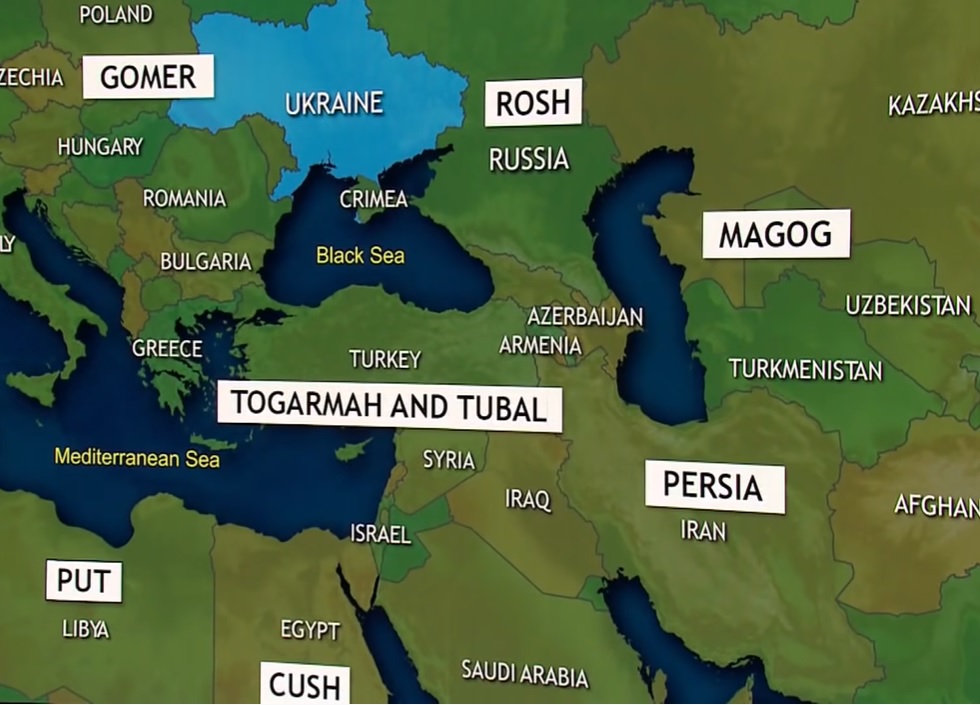
Robertson presents a map of regions surrounding the Black Sea and the Mediterranean. The map shows the modern nations with the names of the ancient nations from Ezekiel 38 superimposed: Gomer (Ukraine), Rosh (Russia), Magog (Kazakhstan, Uzbekistan, Turkmenistan, Azerbaijan and Armenia), Persia (Iran), Togarmah and Tubal (Turkey and Syria), Put (Libya) and Cush (North Sudan/Egypt). He then says, “All the troops there are going to be coming against Israel in the latter days. And God says, ‘I am going to take care of it.’”[5]
Lindsey and Robertson are hardly alone in the equating of Rosh with Russia, and many other influential preachers and teachers purport the same controversial doctrine.[7]
What makes the connection between Rosh with Russia and Gog with the ruler of Russia so wrong?
One problem is Bible translations differ on whether the Hebrew word rosh [רֹאשׁ] in Ezekiel 38:2 is a proper name (“Rosh”)[8] or an appellation (“chief”).[9] Another problem is even if rosh is meant to be a proper name, “such a country is unknown elsewhere in Biblical or extrabiblical literature” and “there is no evidence from the ancient Near East that a country named Rosh ever existed.”[10]
The etymological connection between rosh and Russia is tenuous, and “the word ‘Russia,’ insofar as can be determined, was brought into the region north of Kiev in the Middle Ages by the Vikings and therefore would not have been in use over a millennium earlier in Ezekiel’s time as a designation for modern Russia.”[11]
Another problem is that Ezekiel 38-39 describes an ancient battle not a futuristic one. Keep in mind that Ezekiel is ministering in the Babylonian captivity (Ezek. 1:1-3) which was about 598 BC. The prophet tells of a great army “clothed in full armor…with buckler and shield, wielding swords” (Ezek. 38:4). The Lord God even says, “I will strike your bow from your left hand, and will make your arrows drop out of your right hand” (Ezek. 39:3). Gog’s troops also use “clubs [javelins] and spears” (Ezek. 39:9). Such Iron Age weaponry is nothing like what is used on the twenty-first century battlefield.
Gog also has at disposal “horsemen” and “charioteers” (Ezek. 38:4, 39:20), but units of mounted troops are exceptional in modern armies, and nothing close to the scale of a vast hoard. Neither do modern armies use horse driven chariots.
Ezekiel describes Gog wanting “to seize spoil” and “to carry off plunder,” with the plunder being “silver and gold” along with “livestock and goods” (Ezek. 38:12; 39:10). Such was typical of ancient warfare. The geo-political issues surrounding current conflict between Russia and the Ukraine go beyond the simple looting of precious metals and agricultural commodities.[12] Neither should anyone suppose that Russia conflict with Ukraine is staging an invasion of the modern state of Israel “to take plunder and take booty.”
It also makes sense for ancients to use the wood components of the “shields and bucklers, bow and arrows, clubs and spears” for fires instead of clearing “field” and “forest” for fuel lasting “seven years” (Ezek. 39:9, 10). The “seven months” needed to bury the dead in the Valley of hamon-gog and cleanse the land of Israel (Ezek. 39:11-16) depicts the utter destruction of the enemy.[13]
What if the Holy Spirit was simply communicating to Ezekiel in a way the sixth-century BC prophet could understand? The future weaponry was known by the Spirit, but divine condescension was employed, and the terms for the actual future weaponry were substituted with ancient Iron Age weaponry equivalents. The Spirit knows of the names and borders of the future attacking nations (e.g., “Russia”) but uses Magog, Meshech and Tubal because they existed in the general vicinity, which allows the ancients to get the gist of things to come. Makes sense?
A still yet future fulfillment of Ezekiel 38-39 has bizarre implications! Ezekiel would have understood that long after the Jewish exiles returned to the promise land[14] an end time battle would take place against armies from nations located near and around the geographical regions formerly ruled by kingdoms that have long since disappeared (i.e., Magog, Meshech, Tubal, etc.) and that they would fight with weapons similar to but really different from the weapons that have long since fell out of use (i.e., swords, spears, and bows and arrows). Such a still yet future fulfillment of Ezekiel 38-39 would have been utterly irrelevant and nonsensical to the Jewish audience in the sixth-century BC.
Russia is waging unjust war against the Ukraine, but this battle is unlikely the one depicted in Ezekiel 38-39.
The very notion that Ezekiel can be identified as an authentic Old Testament prophet despite having uttered a vision that remains unfulfilled throughout history — neither having come to pass during the intertestamental period nor the subsequent eras of the New Testament, the early church fathers, the East-West schism, the Reformation up to the present and yet still unrealized — is beyond remarkable! Does this not contradict the test of a prophet set by Moses in Deuteronomy 18:15-22? The strictly futurist interpretation of battle in Ezekiel 38-39 is fraught with many problems.
Complicating matters is identifying the battle with Gog. This will be the topic for the next post.
— WGN
Notes:
[1] All Scripture cited from The Holy Bible: English Standard Version (Wheaton, IL: Crossway Bibles, 2016), unless noted.
[2] The New American Standard Version and the American Standard Version, likewise, read “Rosh.”
[3] Cf. Hal Lindsey, The Late Great Planet Earth (Grand Rapids, MI: Zondervan, 1970), 63-67, 160-161.
[4] CBN News. “Russia’s Role in the End Times: News on The 700 Club – February 28, 2022,” https://youtu.be/alymXhy-2-8 See also, Steve Warren, “’God is Getting Ready to Do Something Amazing:’ CBN Founder Pat Roberson on Russia and Its Place in Prophecy,” https://www1.cbn.com/cbnnews/2022/february/god-is-getting-ready-to-do-something-amazing-founder-pat-robertson-on-russia-and-its-place-in-prophecy
[5] CBN News. “Russia’s Role in the End Times: News on The 700 Club – February 28, 2022.”
[6] Ibid.
[7] Here are recent examples: Greg Laurie (https://www.facebook.com/harvest.greglaurie/videos/998315361061798/), Dr. David Jeremiah (https://davidjeremiah.blog/what-does-the-bible-say-about-modern-russia/) and Mark Hitchcock (Mark Hitchcock, “Gog and Magog,” in Tim LaHaye, ed., Tim LaHaye Prophecy Study Bible [Chattanooga, TN: AMG Publishers, 2000], 876). C.I. Scofield equated Meshech and Tubal with Moscow and Tobolsk (Scofield Reference Bible [New York: Oxford University Press, 1909], 883).
[8] Cf. New King James Version & New American Standard Bible
[9] Cf. King James Version, English Standard Version, New Revised Standard Version, New International Version and Christian Standard Bible.
[10] Ralph H. Alexander, “Ezekiel,” The Expositor’s Bible Commentary: Isaiah, Jeremiah, Lamentations, Ezekiel, vol. 6, ed. Frank E. Gaebelein (Grand Rapids, MI: Zondervan Publishing House, 1986), 930.
[11] Tremper Longman III and Raymond B. Dillard, An Introduction to the Old Testament, Second Edition. (Grand Rapids, Michigan: Zondervan, 2007), 365.
[12] Plundering may very well be happening on modern battlefields, otherwise modern international humanitarian law prohibiting the act of plundering would be senseless (see https://ihl-databases.icrc.org/customary-ihl/eng/docs/v1_rul_rule156), but the underlying reasons of the present Russia and Ukraine conflict really extends beyond plundering.
[13] A massive amount of wood would be needed to fuel fires for “seven years” and a staggering number of corpses would take “seven months” to bury. But the number “seven” really signifies “completeness or totality;” hence, the seven-day week (Gen. 1:1-2:3; Exod. 20:11) represents a “complete cycle of time,” the seven eyes of the Lord (Zech. 4:10) represents “the completeness of God’s sight in the creation,” and the Lamb with seven horns and seven eyes (Rev. 5:6) represents “complete power [and] complete knowledge and insight” (Leland Ryken et al., Dictionary of Biblical Imagery [Downers Grove, IL: InterVarsity Press, 2000], 774). Ezekiel is then telling of the utter destruction of Gog as opposed to heaps upon heaps of weapons and corpses.
[14] The Spirit essentially leaving out the expulsion of the Jewish people from Jerusalem and the extinction of Israel as a state for over a millennium between the end of the Bar Kokhba Revolt to AD 1948.

 Love Truth Blog
I don’t believe anything. The christian research place says because they think they know it.All they’re right, and everybody’s wrong.
Russia is north of israel.That settles it
LikeLike
This is a very narrow minded view. I don’t believe the Ukraine war is part of the Ezekiel war but it could certainly be a prelude to it. Putin’s invasion of Ukraine is literally about gaining power through seizing land and resources. The actions of modern tyrants are much the same as ancient tyrants.
Obviously we don’t know all the details about the Ezekiel War but to assume a conflict that large already took place with no evidence left behind is more violative of Deut. 18 than a futuristic view.
If a futuristic interpretation of the Ezekiel War violates the guidelines set forth in Deuteronomy 18, then so do the 2,000 year old promises in the New Testament that Jesus is coming back. Prophecies don’t have expiration dates.
LikeLike
Ryan, sure there are modern tyrants who exploit & systematically rob the outcasts. But you are ignoring the problem of taking rosh as modern Russia. Plus Ezekiel’s own words anticipate an ancient battle as pointed out in the post. Neither does the expectation of a still yet future fulfillment really get around the sign of false prophecy from Deuteronomy 18.
LikeLike