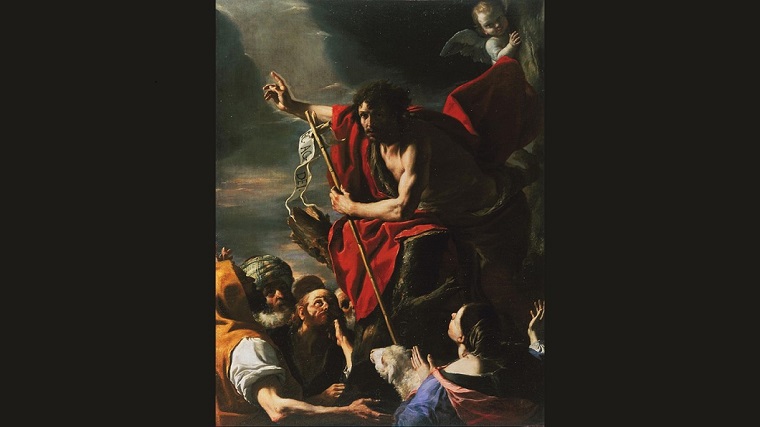
John the Baptist preached a baptism of repentance for the forgiveness of sins. He also taught of the greater one to come who would baptize with Holy Spirit and fire. What was this baptism of repentance for the forgiveness of sins and the baptism of the Holy Spirit and fire? Our search for the answer begins in the Gospel of Luke.
Call of the Prophet: Luke informs us that “the word of God came to John the son of Zechariah in the wilderness” (Lk. 3:2).[1] The “wilderness” was an arid region around the Jordan River and the Dead Sea. John’s calling occurs in the fifteenth year of Tiberius Caesar, when Pontius Pilate was governor of Judah, Herod (Antipas) the tetrarch of Galilee, Philip tetrarch of Ituraea and Trachonitis, and Lysanias the tetrarch of Albiene, which also coincided with high priesthood of Annas and Caiaphas (Lk. 3:1-2).[2]
The mention the rulers in power at the time the word of God came to John accords with the way Old Testament writers described the calling of prophets. Examples of this include Jeremiah (Jer. 1:1-3), Ezekiel (Ezek. 1:2-3), Haggai (Hag. 1:1), and Zechariah (Zech. 1:1, 8). Luke thus depicts John as being among the prophets.
The Law and the Prophets were proclaimed until John the Baptist (Lk. 16:16; Matt. 11:13). John’s ministry signifies the end of the Old Testament era of promise and the beginning of the New Testament era of fulfillment.[3]
Baptism of Repentance for Forgiveness: John proclaimed “a baptism of repentance for the forgiveness of sins” (Lk. 3:3). This particular rite served to prepare recipients for the arrival of the Messiah. It signified both the break from former sinful ways (repentance) and the washing away sin (forgiveness). Recipients were thus reconciling and reestablishing relationship with God.
The preaching and baptizing were part and parcel of John’s vocation as the herald announcing the arrival of the Messiah. His ministry fulfilled the prophecy spoken by Isaiah:
The voice of one crying in the wilderness:
‘Prepare the way of the Lord,
make his paths straight.
Every valley shall be filled,
and every mountain and hill shall be made low,
and the crooked shall become straight,
and the rough places shall become level ways,
and all flesh shall see the salvation of God’” (Lk. 3:4-6; cf. Isa. 40:3-5).[4]
John the Baptist introduces to the world to the Messiah whose advent was of epic significance. The salvation of God was witnessed with the coming of the Messiah, and through the Messiah all things are ultimately set to right — the mountains flattened, the crooked straightened, and the rough smoothed.
The Fruitless Tree: John the Baptist warned of the imminent perils coming upon the unrepentant. He cried out:[5]
“You brood of vipers! Who warned you to flee from the wrath to come? Bear fruits in keeping with repentance. And do not begin to say to yourselves, “We have Abraham as our father.” For I tell you, God is able from these stones to raise up children for Abraham. Even now the axe is laid to the root of the trees. Every tree therefore that does not bear good fruit is cut down and thrown into the fire” (Lk. 3.7-9).
It would be senseless for God to spare a vile brood from divine judgement if they were simply going to carry on in the same sinful activities afterwards. Fruits of repentances needed to come forth. Neither would there be any sense for God to spare certain folks on the basis of their pedigree, i.e., the Jewish listeners who prided themselves as the biological descendants of Abraham. God could simply produce children of Abraham from inanimate stones. The fruitless tree was about ready to be chopped down and thrown into the fire. The proper response was to receive the baptism of repentance for the forgiveness of sins in light of Messiah’s arrival.
The crowds then inquired on what they ought to do. John gives an earthy reply: “Whoever has two tunics is to share with him who has none, and whoever has food is to do likewise” (Lk. 3:11). They were to give from out of their abundance to help out those in need. They were to be just in their ways. Tax collectors were instructed, “Collect no more than you are authorized to do” (Lk. 3:13). Likewise, soldiers were told, “Do not extort money from anyone by threats or by false accusation, and be content with your wages” (Lk. 3:14).
John’s baptism of repentance for the forgiveness of sins pointed to something greater — the baptism of the Holy Spirit and fire.
Baptism of Holy Spirit and Fire: When people inquired wither whether the baptizer might be the Messiah (or Christ), John used the occasion to point to the greater one. He said, “I baptize you with water, but he who is mightier than I is coming, the strap of whose sandals I am not worthy to untie” (Lk. 3:16a). The Baptizer was preparing the way for the Christ but he was not the Christ.
John made it known to the crowds that the Christ “will baptize you with the Holy Spirit and fire” (Lk. 3:16a). Baptism of the Holy Spirit is connected to what the Old Testament prophets anticipated concerning the outpouring of the Spirit when thing in the world would be set to right (Isa. 44:1-5; Ezek. 36:22-32, 39:25-29).
John the Baptist further adds, “His winnowing fork is in his hand, to clear his threshing floor and to gather the wheat into his barn, but the chaff he will burn with unquenchable fire” (Lk. 3:17). The prophet anticipates “all the Spirit will do as Jesus forms his people” yet “pictures the Spirit’s coming to those who trust in Jesus, while excluding those who do not respond to him (1 Cor. 12:12-13).”[6] Put it another way: “The offer of the Spirit must be received. Those who respond are purged and taken in, while those who reject are tossed away like chaff.”[7]
What John foretold about the Messiah baptizing with the Holy Spirit and fire comes to realization (at least in part) on the first Pentecost after the resurrection and ascension of Christ. It was then that the Spirit came upon the followers of Jesus, tongues of fire manifested above their heads, and they began speaking in tongues (Acts 2:1-4).[8] On the other hand, there is more to the purifying and cleansing fire than what has been realized, and “it would appear from the context (both before and after; see verses 9 and 17) and from Joel’s Pentecost prophecy (Joel 2:30; cf. Acts 2:19), considered in its context (see Joel 2:31), that the ultimate fulfilment of the Baptist’s words awaits Christ’s glorious return to cleanse the earth with fire (2 Peter 3:7, 12; cf. Mal. 3:2; 2 Thess. 1:8).”[9]
The Holy Spirit is the divine agent at work in reconnecting people with the Lord. He is the Helper or Paraclete. The Spirit proceeds from the Father and dwells with the Christian (Jn. 14:16-17; 15:26). The Spirit brings to remembrance the teachings of the Son (Jn. 14:26). The Spirit illuminates people concerning sin, righteousness, and judgment (Jn. 16: 7-11). The Spirit speaks on behalf of the Son (Jn. 16:12-15). The Spirit works in reconnecting people to the Lord, which ultimately brings forth the fruits of righteousness, but continued disconnection from the Lord only perpetuates degeneration and leads to death (Jn. 15:1-6; Gal. 5:16-25).
Conclusion: Giving food and clothing to those in need and ceasing from mistreatment of others. Showing such virtues is doing the right thing. The spirit is willing but the flesh is weak. We fall short of doing the things we know ought to be done, and we do the very opposite, especially when it sates our own selfish carnal passions.
It takes more than our own human potential. No number of positive affirmations in thoughts and words will manifest real fruits of righteousness. The thing needed is the transformational power of the Holy Spirit to rejuvenate the soul for bearing fruits of righteousness.
John the Baptist heralds the arrival of Jesus of Nazareth, the Savior, Lord and Christ. It is through union with Christ that we can experience true supernatural transformation into truly virtuous people Christ baptizes with the Holy Spirit and fire.
The Spirit indwells the believer, and the believer is to be filled with the Spirit. Put it another way: “While the indwelling of the Spirit happens at conversion, the infilling of the Spirit happens continually (Ephesians 5:18). As such, we daily seek the Holy Spirit to empower us whether in our prayers to God or in our proclamations of the gospel. Indeed, whenever the gospel penetrates the human heart it is ‘not by might nor by power, but by my Spirit,” says the Lord Almighty’ (Zechariah 4:6).”[10]
— WGN
[1] All Scripture cited from The Holy Bible: English Standard Version (Wheaton, IL: Crossway Bibles, 2016).
[2] This makes the call of John the Baptist around AD 27-28. In the IVP Bible Background Commentary New Testament, Craig Keener points out “Luke thus shows that John began preaching somewhere between September of a.d. 27 and October of a.d. 28 (or, less likely, the following year). Tiberius reigned from a.d. 14 to 37; Herod Antipas, son of Herod the Great…was tetrarch (governor) of Galilee from 4 b.c. to a.d. 39; Pontius Pilate was in office from a.d. 26 to 36” (Craig S. Keener, The IVP Bible Background Commentary: New Testament [Downers Grove, IL: InterVarsity Press, 1993], Lk 3:1–2.) John indicates that Annas was the father-in-law of Caiaphas (Jn. 18:13). Moreover, Keener notes that “Annas was high priest from a.d. 6 to 15, when the Romans deposed him. According to Jewish law, the high priest was entitled to rule for life; thus some Jews no doubt considered the Roman deposition of Annas invalid, and he continued to command great respect” (Keener, The IVP Bible Background Commentary, Jn 18:13–14).
[3]William Henriksen writes, “What is the meaning of the statement that this has been going on since the days of John? Before that time God had revealed himself in the law and the prophets; that is, in what we now call the Old Testament. That revelation was preparatory. With John the Baptist the new dispensation, that of fulfilment, arrived, as is clear from the fact that John pointed to the Christ as being actually present (John 1:29, 36). With John, therefore, a new stage in the history of God’s kingdom had arrived (cf. Mark 1:1–4; Acts 1:22; 10:37), and the gospel of the reign of God in hearts and lives was being proclaimed by message and confirmatory signs” (William Hendriksen and Simon J. Kistemaker, Exposition of the Gospel According to Luke, vol. 11, New Testament Commentary [Grand Rapids: Baker Book House, 1953–2001], 774).
[4] Likewise, John’s own father, the priest Zechariah being filled with the Holy Spirit, prophesied: “And you, child, will be called the prophet of the Most High; | for you will go before the Lord to prepare his ways, | to give knowledge of salvation to his people | in the forgiveness of their sins, | because of the tender mercy of our God, | whereby the sunrise shall visit us from on high | to give light to those who sit in darkness and in the shadow of death, | to guide our feet into the way of peace” (Lk. 1:76-79).
[5] Luke indicates John was addressing the “crowds” (Lk. 3:7). Matthew, however, indicates those being addressed were the “Pharisees and Sadducees,” i.e., men affiliated with the two major sects of first century Judaism. Matthew informs us whom the prophet was specifically being addressed. Of course, if anyone else in the crowd was presuming their own connection to Abraham would spare them of divine wrath, then the same condemnation applied.
[6] Darrell L. Bock, The IVP New Testament Commentary Series: Luke, vol. 3, ed. Grant R. Osborne (Downers Grove, IL: InterVarsity Press, 1994), 74.
[7] Bock, 74.
[8] Scriptures indicate that every Christian has been born of (or baptized by) the Spirit (Jn. 3:5-6), that the Spirit is provided for individuals through faith in God’s promise (Gal. 3:5-7), and that the elect in Christ are sealed with the Spirit of promise (Eph. 1:13-14), but only some and not all Christians possess the gift of speaking in tongues (Rom. 12:6; 1 Cor. 12:8-11, 29-30).
[9] Hendriksen, 210.
[10] Hank Hanegraaff, Complete Bible Answer Book: Collector’s Edition Revised and Updated (Nashville, TN: Thomas Nelson, 2008, 2016), 44-45.


