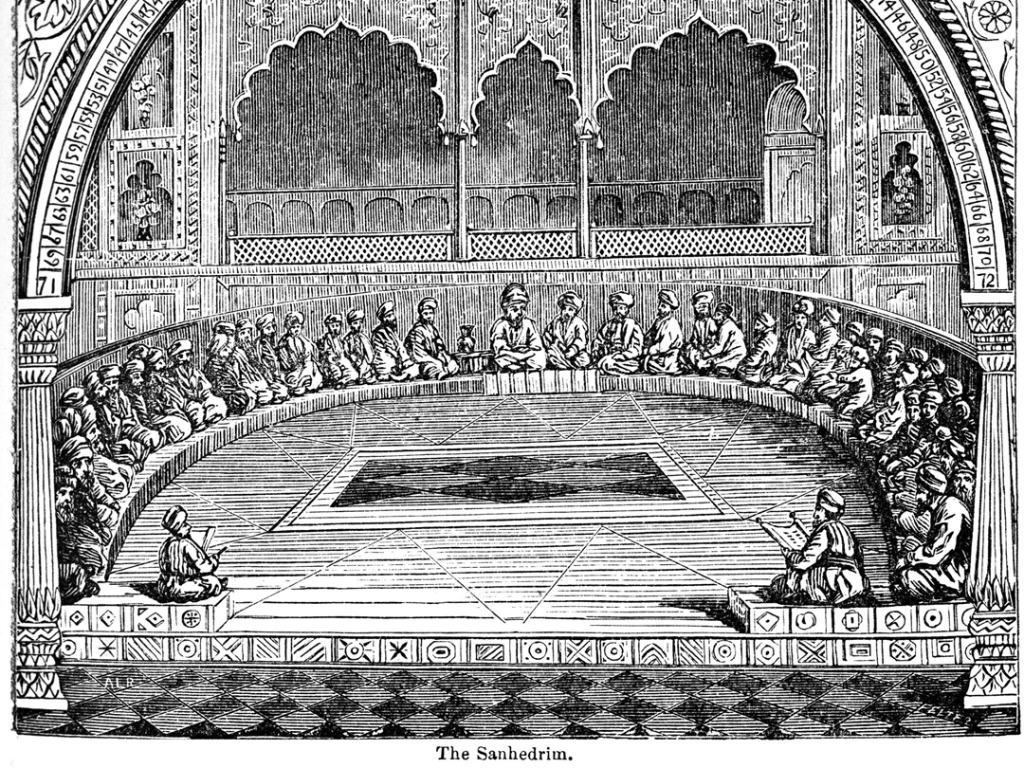
Acts 5:12–42 recounts a second occasion in which the apostles stood before the Sanhedrin and likely would have faced a death sentence had it not been for the intervention of Gamaliel, a Pharisee and respected member of the council. Through this account, Luke emphasizes that the apostles’ ministry in Jerusalem and beyond was truly the work of God. Because God stood behind their mission, no human opposition would ultimately stop them. The following will highlight several incidents that demonstrate God being behind the apostles’ works in Jerusalem, including miracles, an angelic rescue, Peter’s testimony of Christ resurrection, and Gamaliel’s intervention on the apostles’ behalf.
Miracles: Many signs and wonders were performed by the apostles when they gathered at Solomon’s Portico in Jerusalem (v. 12). Those hesitant to join Christ’s followers still held the apostles in “high esteem” (v. 13). [1] But multitudes of other men and women were continually being added to the Lord (v. 14). They came for healing and laid their sick upon cots and mats out on the streets in hopes that Peter’s “shadow might fall upon them” (v. 15). Crowds even came from towns surrounding Jerusalem for healing from sickness and unclean spirits (v. 16). God was indeed doing great and marvelous works through the apostles.
Angel of the Lord: The high priest and the Sadducees were provoked to jealousy over the success of the apostles, and they had them arrested (vv. 17-18). Yet after nightfall, an angel of the Lord opened the prison doors, let them out, and instructed: “Go and stand in the temple and speak to the people all the words of this Life” (vv. 19–20).At dawn, the apostles resumed teaching in the temple (v. 21a). God set the captives free!
When the entire assembly of the Sanhedrin convened, they sent officers to bring in the apostles, but the officers returned and reported, “We found the prison securely locked and the guards standing at the doors, but when we opened them we found no one inside.” This happening perplexed the captain of the temple and chief priests (vv. 21b–24). Reports soon came that the apostles were teaching people in the temple! The captain and officers went to being in the apostles again, yet they apprehended them without force because they were afraid the people would stone them (vv. 25–26).
Peter’s Testimonial: Standing once more before the council, the apostles were questioned about their defiance of the earlier command forbidding them to teach in the name of Jesus. The Sanhedrin accused them of filling Jerusalem with their teaching and bringing responsibility for Jesus’ blood upon them (vv. 27–28).
Speaking on behalf of the group, Peter declared: “We must obey God rather than men” (v. 29). For the apostles, the Word of the Lord held greater incumbency than the decree of the Sanhedrin. They chose dismiss the latter imperative and carryout the latter.
Peter then seized the moment to proclaim the wondrous works that God was accomplishing among them. He declared that the God of their fathers had raised Jesus, whom they had killed by hanging on a tree (v. 30). The Sanhedrin had condemned Jesus for blasphemy, and the same religious leaders manipulated Pilate into pronouncing Him guilty of sedition and sentencing Him to be crucified. Jesus died and was buried, but resurrected on the third day. Peter continued, saying that “God exalted Him at His right hand as Leader and Savior, to give repentance to Israel and forgiveness of sins” (v. 31). In ascended glory, Jesus is thus positioned to lead, save, and forgive those who repent, particularly the people of Israel. This truth is confirmed by two witnesses: the apostles and the Holy Spirit of God (v. 32). The apostles bore witness to the resurrected Lord and they had received the Holy Spirit, whom the ascended Jesus had asked the Father to send.
The message did not go over well. Enraged by this testimony, members of the Sanhedrin considered putting the apostles to death (v. 33).
Gamaliel’s Intervention: At this point, Gamaliel—a Pharisee and respected teacher of the law — stood and intervened. After ordering the apostles to be put outside (v. 34), he addressed the other members of the court: “Men of Israel, take care what you are about to do with these men” (v. 35). He reminded them of previous failed revolutionary movements, such as those led by Theudas and Judas the Galilean, both of which came to nothing (vv. 36–37).[2] Gamaliel advised them to leave the apostles alone: if their movement were of human origin, it would fail on its own; but “if it is of God, you will not be able to overthrow them. You might even be found opposing God!” (vv. 38–39a). The apostles of Jesus Christ were by no means an insurrectionist group, but the council member figures whatever they were doing, any work backed by God would be unstoppable. The council took the advice (v. 39b).
It is possible that Gamaliel had some awareness of the reports about the apostles’ teachings and signs and wonders at the Solomon’s Portico gatherings and senses the chief priests and Sadducees were jealous of the growing influence of the emerging sect of Christ followers. He was not committed to Christ per se, but still acknowledged a movement of God could not be stopped.
Given the signs and wonders, angelic jailbreak, and resurrection of Jesus served it stretches credulity to suppose the energy supplying the works of the apostles was human rather than divine in origin.
The apostles were then called back in, beaten, and once again “charged…not to speak in the name of Jesus” before being released (v. 40). Yet they departed “rejoicing that they had been counted worthy to suffer dishonor for the name” (v. 41). Here the apostles put into practice the very words Christ spoke: “Blessed are you when people hate you and when they exclude you and revile you and spurn your name as evil, on account of the Son of Man! Rejoice in that day, and leap for joy, for behold, your reward is great in heaven; for so their fathers did to the prophets” (Lk. 6:22-23). Undeterred, the apostles continued their mission daily, both in the temple and from house to house, never ceasing to teach and proclaim that the Christ is Jesus (v. 42).
Conclusion: Christians under the influence of the Holy Spirit become a positive influence in the world — they go about as the salt of the earth and the light of the world. Yet such witness inevitably creates friction with those driven by jealous ambitions for prestige, power, and influence. These earthly pursuits ultimately fade away, just as treasures on earth are destroyed by moth and rust. By contrast, through the Spirit, believers are able to lay up heavenly treasures that endure for eternity.
It is God who ultimately gave the apostles remarkable boldness. Refusing to be silenced, they remained grounded in their conviction that they must “obey God rather than men.” Even when confronted with legal threats and physical suffering, they did not pray for the removal of their trials. Instead, they rejoiced that they had been counted worthy to suffer dishonor for the name of Jesus.
Acts 5 ultimately demonstrates that human opposition cannot prevail against the work of God. As Gamaliel himself unintentionally recognized, if a movement is truly from God, no earthly power will be able to overthrow it.
— WGN
* Update 5/15/2026: The section on Gamaliel was amended for clarity.
[1] The Holy Bible: English Standard Version (Wheaton, IL: Crossway Bibles, 2025), Ac 5:12–42.
[2] Josephus mentions the execution of a self-proclaimed messiah named Theudas during the governorship of Fadus (Antiquities 20.5.1 §§97–98), who served around AD 44–46. In contrast, the tax revolt led by Judas the Galilean took place in AD 6. Yet Gamaliel, in his speech before the Sanhedrin, indicates that the rebellion of Judas came “after” that of Theudas. This raises a chronological puzzle: either Gamaliel’s ordering is mistaken and Luke repeats the mistake, or Josephus’s chronology is in error. Critics use this chronological discrepancy to argue that Luke misread Josephus’ Antiquities (composed c. AD 93–94), but such an assertion is precluded if one accepts a pre-AD 70 composition date for Acts of the Apostles (cf. John A.T. Robinson, Redating the New Testament [Eugene, OR: Wipf and Stock, 1976]). A compelling third possibility is that Gamaliel refers to an earlier revolt led by another man named Theudas, well-known to the Sanhedrin at the time. Darrell Bock observes, “Given the popularity of the name and the turmoil of the period leading to the census and Judas the Galilean, mentioned in verse 37, Gamaliel may well be referring to a Theudas who was earlier than the one Josephus mentions… This Theudas would have preceded the activity of Judas during the census period” (Darrell Bock, Baker Exegetical Commentary of the New Testament: Acts, Grand Rapids, MI: 2007, 250). William Larkin notes “Josephus reports many uprisings at Herod’s death (Jewish Antiquities 17:269). Theudas, a contracted form of names such as Theodorus, Theodotus and Theodosius, was a common name in antiquity, as inscription and papyri show” (William J. Larkin Jr, Acts: The IVP New Testament Commentary Series [Downers Grove, IL: InterVarsity Press, 1995] 97n.). Jerusalem and the surrounding regions of Judea and Galilee were prone to insurrection during the Roman occupation, continuing through the revolts of AD 70 and AD 135. Just as there were at least three different failed insurrections led by men named Judas, it is likely that multiple other revolts were led by men named Theudas (Eckhard J. Schnabel, Acts: Zondervan Exegetical Commentary on the New Testament, Grand Rapids, MI: 2012, 316).


