Stephen stood before the Sanhedrin accused of speaking blasphemous words against God and Moses. In response, he sought to demonstrate through the retelling of Israel’s sacred history that the followers of Christ stood in continuity with all the Israelites who honored and respected God and Moses invalidating the charges against him.
This post will examine Stephen treatment of Moses at three pivotal stages of his life — as an infant, a forty-year-old man, and an eighty-year-old shepherd called by God — which reveal how God raised up Moses to deliver the Israelites from Egypt and bring them back to the land promised to Abraham. Conversely, the sacred history tells of the perilous end to those who stood opposed to Moses, rejected God, and wandered off into idolatry. This segment of the retelling of Israel’s sacred history tacitly draws parallels between Moses and Christ, portraying both as God appointed deliverers rejected by wayward Israelites. It serves as a theological indictment against those who have rejected Jesus and stood opposes to the message of His followers.
Finally, this post will comment on the emptiness of life severed from God, the insufficiency of idolatry to fill that void, and Jesus Christ as the way of having reconciliation with God.
Moses in Infancy:
Stephen notes that as the time for God’s promise to bring Abraham’s descendants from Egypt back to the Promise Land drew near, “the people increased and multiplied in Egypt” (Acts 7:17).[1] However, a new Pharaoh arose who did not know Joseph, he dealt shrewdly them, and forced their parents to expose their infants so that they would not survive (Acts 7:18–19).[2] This fulfilled the Word of the Lord to Abraham about his descendants being enslaved and afflicted for four hundred years (Acts 7:6).
Now the newborn Moses was “beautiful in God’s sight,” and he was brought up for three months in his father’s home, but Pharoah ordered every male Hebrew born to be exposed. This state sanctioned infanticide forced Moses’ parents to expose him, which involved putting the infant inside a reed basket adrift on the Nile defenseless against the elements and predators. Yet in an ironic twist Pharaoh’s daughter fishes out the basket, finds the boy, adopts him, and raises him up as her own son. Moses was thus educated in “all the wisdom of the Egyptians” and grew up to be “mighty in words and deeds” (Acts 7:20–22).[3] In the faceoff between Pharoah and infant Moses, the child triumphed, and all the wisdom of the Egyptian were the spoils that went to the victor.
Joseph, Mary and the Christ Child similarly had to flee to Egypt to escape the Herod’s order to kill all male children two years old and under in the Bethlehem region (Matt. 2:1-23), but whereas the imposter king of Judea eventually died, Jesus rose from the dead to be enthroned forever as King of kings and Lord of lords (Phil. 2:5-11; 1 Tim. 6:13-16; Rev. 17:14; 19:16).
Moses at Forty:
When Moses entered middle adulthood, it came upon his heart to visit his Hebrew brethren — the children of Israel. Witnessing one of the Hebrews being mistreated by an Egyptian, Moses intervened and struck down the Egyptian. He supposed his brothers would realize “God was giving them salvation by his hand, but they did not understand” (Acts 7:23–25). Despite having royal status and being educated with all the wisdom of Egypt, Moses’ own kind rejected him as a judge who could deliver them.
The following day, Moses attempted to reconcile two quarreling Hebrews. Rather than accepting him as a mediator, the man who was in the wrong objected, saying, “Who made you a ruler and a judge over us?” The man knew the identity of the murderer of the Egyptian. Exposed and fearing for his life, Moses fled to the land of Midian. While in exile, he married and fathered two sons (Acts 7:26–29).
Note the typological correspondence between Moses and Christ: “As Moses was sent by God to Israel as ‘ruler and judge’ to save Israel, so God exalted Jesus as ‘Leader and Savior’ ([Acts] 5:31); and as Moses was pushed away by an Israelite brother, so Jesus was rejected by the Jewish people.”[4]
Moses at Eighty:
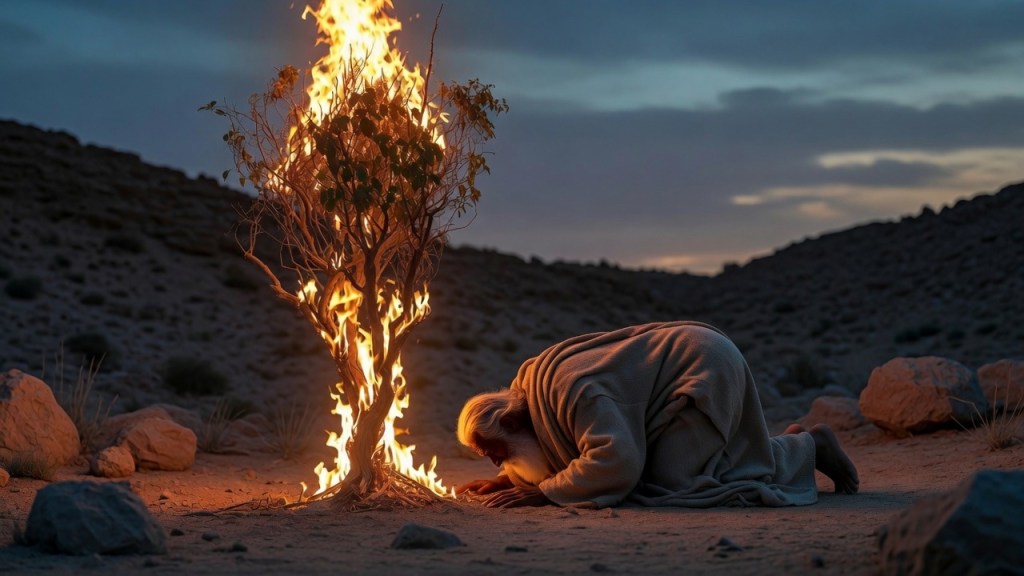
The Burning Bush: Forty years in exile passed when “an angel appeared to him in the wilderness of Mount Sinai, in a flame of fire in a bush.” Seeing such an amazing sight, Moses approached for a closer look (Acts 7:30-31). Then the Lord spoke, “I am the God of your fathers, the God of Abraham and of Isaac and of Jacob.” Moses then “trembled and did not dare to look” (Acts 7:32). He was witnessing the visible manifestation of the invisible God — a theophany.[5] On another occasion, Moses witnessed again a theophany while sheltered within the cleft of a rock (Exod. 33:18-22). No one can see God’s face in unveiled glory and live (Exod. 33:20); yet, Scripture tells of extraordinary occasion wherein God chose to visibly manifest to humans and they lived![6]
Moses was instructed by the Lord to remove his sandals for he was standing upon holy ground (Acts 7:33). It was not that the plot of ground that the man stood upon was different in nature that all the surrounding land, but “wherever God chooses to make himself known, there is holy ground.”[7]
Yahweh then said “I have surely seen the affliction of my people who are in Egypt, and have heard their groaning, and I have come down to deliver them.” The Lord then commissioned Moses, “I will send you to Egypt” (Acts 7: 34). God is thus sending Moses with the assignment to deliver Israel out of Egypt. The burning bush encounter thus begins the central salvation episode of Old Testament history.
Rejection: But the Israelites rejected Moses just like the one who said “Who made you a ruler and a judge?” (7:35a). A fourfold description of the one rejected is then presented. First, they rejected the Moses whom God appointed by the hand of the angel in the burning bush to be both the ruler and redeemer of the Israelites (Acts 7:35b).
Second, they rejected the Moses who worked divine signs and wonders in Egypt, at the Red Sea, and throughout the entire forty-year wilderness journey (Acts 7:36). God worked countless miracles through Moses, which included the manna that appeared on the ground until the day the people crossed over the Jordan into the Promise Land (Exod. 16:35; Josh. 5:12).
Just as Moses gave Israelites the bread from heaven called manna, God the Father gave the true bread from heaven who is Jesus Christ the Bread of Life (Jn. 6:32-33, 35-40, 41, 53-58).
Third, they rejected the Moses who predicted “God will raise up for you a prophet like me from your brothers” (Acts 7:37; cf. Deut. 18:15, 18; Acts 3:22). Many Jews and Samaritans in the first century expected such a prophet-deliverer to arise.[8] Crowds of people proclaimed Jesus to be this coming prophet (cf. Matt. 21:11; John 6:14).
By recalling of Moses’ prophecy about the coming prophet like himself (Acts 7:37; cf. Deut. 18:15-19), Stephen implicitly affirms that God fulfilled this promise in Christ Jesus of Nazareth. The Sanhedrin could hardly have missed the implication, for Peter already proclaimed to multitudes at Solomon’s Portico that Jesus was indeed the Prophet foretold by Moses (Acts 3:22-23).
Stephen’s appeal to this prophecy reinforces one of the central themes of his defense: just as Israel rejected Moses, God’s appointed deliverer, so too many of Stephen’s generation from Jerusalem to Galilee, including members of the Sanhedrin, stood opposed to Jesus Christ, the Prophet like Moses and the Righteous One sent by God. The followers of Christ were no greater than their Master, and they too suffered at the hands of the opposition.
Fourth, they rejected the Moses who was with the congregation in the wilderness, received God’s revelation through the angel at Mount Sinai, and passed on the “living oracles” to the people of Israel (Acts 7:38). Here Stephen affirms God spoke to Moses the Law that leads to everlasting life.
The followers of Christ also valued the written Word of God (1 Tim. 2:14-17; 2 Pet. 1:16-21). Luke even testifies that Cleopas and another disciple were on the way to Emmaus when they met the resurrected Lord, and “beginning with Moses and all the Prophets, he interpreted to them in all the Scriptures the things concerning himself” (Lk. 24:27).
The Golden Calf: The Israelite forefathers refused to follow Moses, they casted him away, and yearned in their hearts for Egypt (Acts 7:39). They told Aaron, “Make for us gods who will go before us” under the pretense of not knowing what became of Moses (Acts 7:40). They commissioned the fashioning of a golden calf, “offered a sacrifice to the idol,” and rejoiced in the “the works of their hands” (Acts 7:41). They exchanged the worship of the Creator for the worship of an idol they created. The consequence of their persistent rebellion was that God gave them over to the idolatrous worship of “the host of heaven” or celestial beings (Acts 7:42a; Rom. 1:18-32).
Stephen recalls God spoke through the prophet Amos, posing the rhetorical question: “Did you bring to me slain beast and sacrifices, during the forty years in the wilderness, O house of Israel?” The implied is no. Instead, they carried the shrine of “Moloch,” the star representing the god “Rephan,” and other “images” they crafted to worship. For this idolatry, God announced that they would be sent “into exile beyond Babylon” (Acts 7:42b–43; cf. Amos 5:25–27).[9]
The recaps of the golden calf, Moloch, and Rephan are significant. God used Moses to deliver them out of their Egyptian captivity but they rebelled, and made for themselves idols to worship, such as the golden calf, Moloch, and Rephan. Moreover, the idolatrous children of Abraham were eventually exiled from the promise land.[10]
Stephen’s retelling of Israel’s sacred history, particularly the chapters on Yahweh calling Moses to bring His people out of Egypt and take them back to dwell in the land promised to Abraham, shrewdly rebuts the accusation that the disciple spoke blasphemous words against Moses and God (cf. Acts 6:11). This respect and honor for God and the prophet Moses demonstrated the movement of Christ followers stood in continuity with the true heritage of Israel. But Stephen also gives implicit warning and indictment of covenant disloyalty upon those of his generation who like the Israelites that opposed God and His prophet Moses committed the most abominable error of remaining steadfast in opposition to Jesus Christ — the prophet like Moses who was sent by God.
Conclusion:
We all find ourselves in a world estranged from God. This estrangement leaves a void deep within our innermost being. It is like the gaping hole in a puzzle with a lost piece. The void leaves us incomplete. We were meant to be in union with God. But this is the result of our relationship with God being severed. Severance from God came as the result of Adam’s transgression, which left us all prone to sin and eventual death. This void is our severed relationship with God — the very relationship we were made to be in from the very beginning.
Idolatry becomes our ineffectual attempt to fill the void with false gods. Idols may not necessarily be fashioned from gold, wood, and stone, but things we come to adore and value in hopes that they could fill that emptiness. For example, many moderns turn to the worship of money, possessions, fame, influence, and superficial beauty. The idols of wealth, possessions, fame, influence, and appearances are earthly treasures that can be stolen or destroyed.
We can also still witness in the twenty-first century many worshipping idols (pagan icons; symbols; sacred vessels) and ancestors among Eastern Religions, occultists, and animists. Many other modern westerners even make conscious efforts to revive the worship of the ancient pagan gods and spirits of the Greeks, Egyptians, Babylonians, and Norse. Do the gods and ancestral spirits really concern themselves with living mortals? They demand so many rituals and rules to follow, but can we ever truly reach them? Are the differences between gods, humans, and everything else merely illusions — with reality being just one thing or perhaps no thing at all? If there is a god, whose god is the one true God? All religions make truth claims, but these claims contradict one another. They cannot all be true. They could all be false. Yet, perhaps one is the genuine article.
All idols are fashioned by human hands, they are inanimate objects with neither knowledge nor discernment, and impotent to save (Isa. 44:9-20). Pagan offerings are but sacrifices to demons and not God (1 Cor. 10:19-20). Idolatry can never calm the restlessness within.
What can fill the void? God sent Moses to deliver His people out of Egyptian captivity and bring them to the Promise Land according to what He said to Abraham. God became a man, Jesus Christ of Nazareth, He died, resurrected, ascended to glory, and promised to come again. He is the Prophet foretold by Moses. Whoever turns to Jesus, believes in Him, receives forgiveness of sin, everlasting life, and reunion with God. They can reestablish the relationship with God that was severed by the fall and resume the relationship united with God forever. This was God’s plan all along. On account of Adam’s transgression, all humanity is in bondage sin and death, But Christ death and resurrection provide the way for us to receive forgiveness and everlasting life so that we can resume the relationship God that was disrupted on account of the fall. This union with God grows deeper and deeper in intimacy for all eternity. This is what fills the void.
— WGN
Notes:
[1] All Scripture cited from The Holy Bible: English Standard Version (Wheaton, IL: Crossway Bibles, 2025), unless noted.
[2] The Torah indicates that Pharaoh initially asked the midwives Shiphrah and Puah to terminate the newborn males, but when they refused because they “feared God,” he commanded all his people to casts the newborn Hebrew males into the Nile (Exod. 1:15-22).
[3] It is also interesting to note that Pharaoh’s daughter even paid Jochebed, Moses’ biological mother, to nurse the child (Exod. 2:1-10; 6:20).
[4] Eckhard J. Schnabel, Acts, Expanded Digital Edition, Zondervan Exegetical Commentary on the New Testament (Grand Rapids, MI: Zondervan, 2012), 375.
[5] A theophany refers to a manifestation of God that is either audible (e.g., Gen. 3:8; Matt. 3:17) or visible, the latter of which can be manifested in various forms (e.g., Exod. 3:2-6; 19:18-20; Judg. 13) (James C. Moyer, “Theophany,” Evangelical Dictionary of Theology, ed. Walter A. Elwell [Grand Rapids: Baker Books, 1984], 1087).
[6].God manifested on Mount Sinai to Moses, Aaron, Nadab, Abihu, and seventy of Israel’s elders for the confirmation of the Mosaic Covenant (Exod. 24:9-10; cf. Deut. 5:22-27). Others who experienced theophanies were Abraham and Sarah (Gen. 18:1-33), Jacob (Gen. 32:22-31), Gideon (Judg. 6:22-23), and Manoah and his wife (Judg. 13:1-25), Elijah (1 Kings 19:9-18), and Ezekiel (1:4-28).
[7] William J. Larkin, The IVP New Testament Commentary Series: Acts, vol. 5, ed. Grant R. Osborne (Downers Grove, IL: InterVarsity Press, 1995)114.
[8] Craig S. Keener, The IVP Bible Background Commentary: New Testament (Downers Grove, IL: InterVarsity Press, 1993), Ac 7:37.
[9] Amos 5:26 in the Hebrew Masoretic Text (MT) names the gods “Sikkuth” and “Kiyyun,” but Stephen uses “Moloch” and “Rephan,” following the Septuagint (LXX), an ancient Greek translation of the Old Testament. Amos 5:26 of the MT and LXX name the place of exile “beyond Damascus.” Whereas Amos had in mind the Assyrian captivity of the northern kingdom of Israel, Stephen was thinking of the later historically more significant Babylonian captivity of the southern kingdom of Judah (I. Howard Marshall, “Acts,” in Commentary on the New Testament Use of the Old Testament [Grand Rapids, MI; Baker Academic, 2007], 565.). From the vantage point of Jerusalem, both Assyria and Babylon were located “beyond Damascus.” Stephen’s use of “beyond Babylon” makes no substantive alteration to Amos’ prophecy concerning the exile of Israel’s disobedient idolators.
[10] Amos’ prophecy telescopes the history of the Israelite nation from the Exodus to exile. Except for Joshua and Caleb, everyone twenty-years-old and upward of the exodus generation perished in the wilderness on account of their idolatry and rejection of Yahweh, which culminated in the refusal to enter the Promise Land after receiving the false report from the spies and the resolve to return to Egypt (Num. 13:1-14:38; Deut. 1:19-40). But idolatry and rebellion against the Lord continued after the conquest through the period of the judges, the establishment of the monarchy, the civil war that divided the kingdom, and the ultimate Assyrian exile of the northern kingdom of Israel and the Babylonian exile of the southern kingdom of Judah (2 Kings 17:6-23; 23:36-25:21; 2 Chron. 36:15-21; Jer. 52:1-24).


