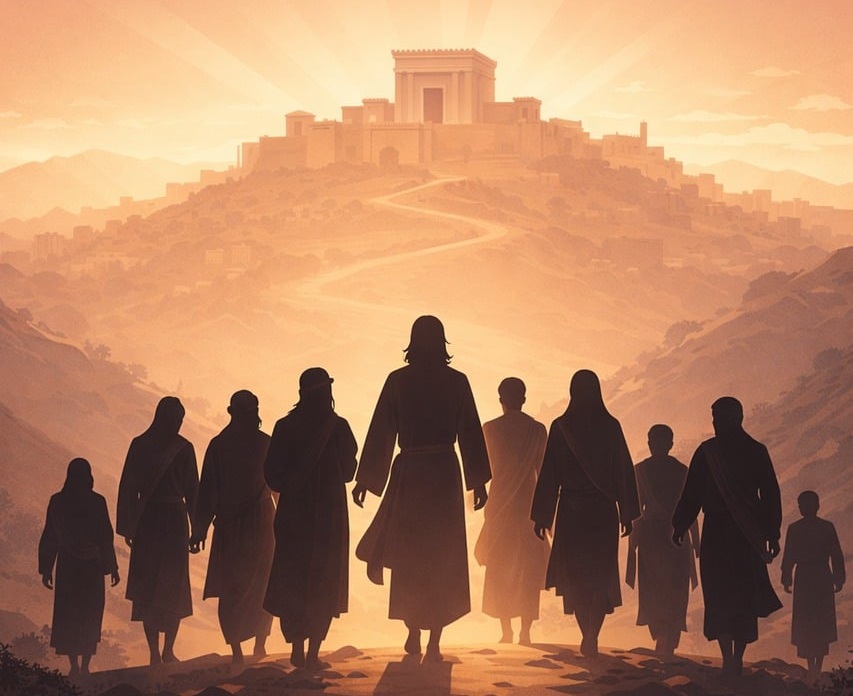
Stephen full of grace and power did many signs and wonders in Jerusalem. But men from the synagogue of the Freedmen and others conspired to have him arrested and face the Council. They sent false witnesses to testify to the Sanhedrin that “This man never ceases to speak words against this holy place and the law, for we have heard him say that this Jesus of Nazareth will destroy this place and will change the customs that Moses delivered to us” (Acts 6:13-14).[1] In response to the accusation, Stephen retells Israel’s sacred history and gives particular attention to the tabernacle and temple in the worship of God.
This post will first take a look closer at Israel’s worship with the portable tabernacle from the days of Moses. Next, we will address the reorientation of worship in the stationary temple at Jerusalem proposed by David and constructed by Solomon. Then we will consider worship of God who cannot be contained in the universe and the significance of Jesus’ prophecies about temple of His body and the Second Temple in Jerusalem.
The tabernacle: Stephen testified, “Our fathers had the tent of witness in the wilderness” (Acts 7:44a). The Lord “directed” Moses to make the tabernacle “according to the pattern that he had seen” (Acts 7:44b; cf. Exodus 25:1-9).[2] The tabernacle was basically a portable tent used as a sanctuary for Israel’s worship of Yahweh. They called it the “tent of meeting,” since that became the place where God met with Moses and His people. But they also referred to it as “tent of the testimony” or “tent of witness” for it housed the covenantal testimony — the stone tablets containing the commandments of God — deposited inside the Ark of the Covenant and kept within the Most Holy Place (Exodus 25-31, 35-40; Deuteronomy 10:1-5). The Levites were assigned to assemble, disassemble, transport, guard, and camp around the tabernacle (Numbers 1:50-54).
Stephen indicated, “Our fathers in turn brought [the tabernacle] in with Joshua when they dispossessed the nations that God drove out before our fathers” and it remained in use “until the days of David” (Acts 7:45). Israelite worship of Yahweh at the tabernacle was initiated by Moses in the wilderness, continued through the settlement under Joshua then the era of the judges, and — following a temporary disruption when the Philistines captured but returned the Ark — persisted into the monarchy until the completion of Solomon’s temple.
The temple: King David, who found favor with God, initially proposed “to find a dwelling place for the God of Jacob” (Acts 7:46).[3] But the Lord denied the request: “You shall not build a house to my name, because you have shed so much blood before me on the earth” and “for you are a man of war” (1 Chronicles 22:8; 28:3). On the other hand, Yahweh promised David: “I will raise up your offspring after you, who shall come from your body, and I will establish his kingdom. He shall build a house for my name” (2 Samuel 7:12b-13a; cf. 1 Chronicles 17:11b-12a). Yet, David still made preparations for building the temple and commissioned Solomon with the task (1 Chronicles 22:1-26:32). Solomon thus built the first temple in Jerusalem (Acts 7:47; cf. 1 Kings 6:1-37; 7:13-8:66; 2 Chronicles 2:1-7:22).
Still Solomon acknowledges that “the Most High does not dwell in houses made by hands” (Acts 7:48) and confesses, “Will God indeed dwell on the earth? Behold, heaven and the highest heaven cannot contain you; how much less this house that I have built!” (1 Kings 8:27; cf. 2 Chronicles 6:18).
Stephen follows up by reciting lines from the prophet Isaiah:
Heaven is my throne,
and the earth is my footstool.
What kind of house will you build for me, says the Lord,
or what is the place of my rest?
Did not my hand make all these things?
(Acts 7:49–50; cf. Isaiah 66:1–2a).
Mere humans could never construct with their hands a dwelling place capable of containing the fullness of God. Heaven is His throne and the Earth His footstool. He is the Creator of the universe. In other words, God is uncircumscribed and omnipresent—He cannot be confined to any manmade building. It is also impossible for finite humans to traverse the infinite expanse between Earth and Heaven in order to meet God. Rather, God comes down to dwell with His people (Exodus 25:8; 29:45-46). The temple would serve as a place where the house of Jacob could gather together for the worship of Yahweh. Moreover, the awesome and wonderous glory of the Lord filled both the tabernacle (Exod. 40:34-35) and the temple (1 Kings. 8:10; 2 Chronicles 5:13b-14; 7:1-3).
Stephen’s recounting of how Israel’s sacred space of worship transitioned from the portable tabernacle to the permanent temple subtly demonstrated that the customs associated with Moses could change when such changes accorded with the Lord’s purpose and plan.
All present in the court would have understood from Isaiah’s prophecy in context that Yahweh only looks upon worshippers who have humble and contrite spirits and tremble at His Word (Isaiah 66:2b). But God detested the sacrifices of the disobedient. “He who slaughters an ox is like one who kills a man; | he who sacrifices a lamb, like one who breaks a dog’s neck; | he who presents a grain offering, like one who offers pig’s blood; | he who makes a memorial offering of frankincense, like one who blesses an idol,” says the Lord (Isaiah 66:3). Simply put: “What God wants is humble obedience from his people rather than the building of an elaborate temple and the offering of sacrifices that are no better than the abominable practices of other people if unaccompanied by full obedience to him.”[4] It would thus be an abomination for sinful people to offer defiled sacrifices that desecrate the sacred place meant for the worship of the everywhere present God and Creator of all things.
The court would also have been fully aware that after sending numerous prophets to warn of impending judgment and call the people to repentance, God eventually brought about the destruction of Jerusalem and the temple at the hands of the Babylonians in 586 BC (2 Kings 25:8–9; 2 Chronicles 36:14–21). Yet even while in exile, the penitent could turn toward the Promised Land and pray to the Lord, confident that He would hear and forgive them (1 Kings 8:46–53; cf. 2 Chronicles 6:36–40).
Yahweh subsequently stirred the heart of Cyrus, king of Persia, to decree that the Jewish exiles return to Jerusalem and rebuild the house of God (2 Chronicles 36:22–23; Ezra 1:1–3; 5:13–17; 6:1–5). The Second Temple was completed in 516 BC during the ministries of prophets Haggai, Zechariah, and Ezra under the leadership of Zerubbabel. The Second Temple stood for centuries before undergoing an extensive renovation under Herod the Great, beginning around 19 BC. Jesus and His followers including Stephen ministered, taught, and prophesied at the Second Temple.
Even if something rang true about the accusation that Stephen had been preaching, “Jesus of Nazareth will destroy this place and will change the customs that Moses delivered to us” (Acts 6:14), how could he rightly be condemned if what he proclaimed came from the Lord? David and Solomon had established the temple, bringing a significant change to the Mosaic pattern of tabernacle worship, and the prophets themselves had foretold the desecration and destruction of Solomon’s temple. Thus, the mere prospect Stephen reiterating Jesus’ prediction about the destruction of the Second Temple and proposal of changes to the customs of Moses could not alone constitute blasphemy.
Jesus and the Temple: During the final week of His earthly ministry, Jesus looked over the city of Jerusalem from a distance and wept over it, prophesying: “For the days will come upon you, when your enemies will set up a barricade around you and surround you and hem you in on every side and tear you down to the ground, you and your children within you. And they will not leave one stone upon another in you, because you did not know the time of your visitation” (Luke 19:43-44).
Luke’s Gospel testifies that God had come to dwell among His people in Jesus of Nazareth the incarnation of the Son of God. He was born of the virgin Mary, He healed the sick, gave sight to the blind, enabled the lame to walk, and raised the dead. He was the long-awaited Christ of the Old Testament prophets. But Christ was rejected by His own people. By missing this divine visitation, they set their lives on a devastating trajectory that would bring about their personal ruin and the catastrophic destruction of their city.
Jesus next went into Jerusalem, entered the temple, drove out the merchants, and exclaimed, “It is written, ‘My house shall be a house of prayer,’ but you have made it a den of robbers” (Luke 19:45–46). Part of the Lord’s statement comes from Isaiah 56:7 wherein through the prophet Yahweh says that His temple is “a house of prayer for all people.” The temple was meant to be a place for both Israelites and Gentiles to gather for worship. On the other hand, the “den of robbers” comes from Jeremiah 7:11. God stood witness to temple worshippers who would steal, murder, commit adultery, swear falsely, make offerings to Baal, go after other gods they have never known, then enter Solomon’s temple declaring, “We are delivered,” only to go back doing the same abominations (Jeremiah 7:8-10).
Now, the merchants were in the temple selling goods needed for the sacrifices, including animals, wine, oil, salt, and doves. Moneychangers were also present, exchanging Roman and Greek coins for the half-shekel required for the temple tax. This currency exchange involved a surcharge, with a portion reportedly benefiting the high priest’s family.[5] The Lord regarded the first-century temple as having become excessively commercialized and sinful — a “den of robbers” — rather than a place devoted to worship and prayer.[6] Yet the hypocrisy extended beyond the temple’s corrupt commercial practices. It was rooted more fundamentally in the nation’s refusal to worship God and recognize the day of visitation.[7]
Later on in the same week, as the disciples were commenting on how the temple was adorned with “noble stones and offerings,” Jesus seized the moment to tell them that “the days will come when there will not be left here one stone upon another that will not be thrown down” (Luke 21:5–6; cf. Matthew 24:1–2; Mark 13:1–2).[8] The Lord thus predicted the fall of Jerusalem and the destruction of the Second Temple.
The Twelve Apostles, Stephen, and the other followers of Christ were not denigrating the temple simply by conveying Jesus’ prophecy on the destruction of the temple; rather, all those who rejected the Christ sent by God while continuing to offer sacrifices at the temple were the ones committing sacrilege in the very place designated for worship by the everywhere present God and Creator of the universe. Just as the Old Testament prophets spoke out against temple sacrilege so too Christ and His followers spoke out against the same in their day.
Jesus Christ also taught about the temple of His own body. After driving the merchants and money changers from the temple,[9] the religious leaders confronted Him, asking what sign He could offer to demonstrate His authority to do such things. Jesus replied, “Destroy this temple, and in three days I will raise it up” (John 2:18–19). John explains that Jesus “was speaking about the temple of his body” (John 2:21). After Jesus was raised from the dead, His disciples remembered what He had said, and they came to believe both “the Scripture and the word that Jesus had spoken” (John 2:22).
If this astonishing prediction concerning the temple of Jesus’ own body being raised in three days came to pass—and it did—then His warning concerning the coming desolation and destruction of the Second Temple, a message proclaimed by Stephen and other Christians, likewise should have been taken with the utmost seriousness. Jesus’ prediction concerning the destruction of the Second Temple was ultimately fulfilled when the Romans razed Jerusalem and its temple in AD 70.
Jesus also connected His suffering and vindication with the imagery of the rejected stone that became the cornerstone (Mark 12:1–11; cf. Matthew 21:33–44; Luke 20:9–18; Psalm 118:22). Peter and John made clear that the religious leaders, and specifically the Sanhedrin, were those who had rejected Jesus. Yet God raised Him from the dead, and there is no other name under heaven by which we must be saved (Acts 4:8–12).[10] The Epistle to the Hebrews likewise presents Jesus Christ as the superior High Priest according to the order of Melchizedek, who ministers in the superior heavenly sanctuary and mediates a new covenant through the once-for-all sacrifice of Himself, securing eternal redemption (Hebrews. 4:14–10:18).
The New Testament further develops this temple imagery by applying it to Christ’s people. Peter indicates that each Christian is a “living stone rejected by men but in the sight of God chosen and precious,” and that believers are “being built up as a spiritual house, to be a holy priesthood, to offer spiritual sacrifices acceptable to God through Jesus Christ” (1 Peter 2:4–5). Paul similarly reminds the Ephesians that they are “fellow citizens with the saints and members of the household of God,” having been “built on the foundation of the apostles and prophets, Christ Jesus himself being the cornerstone.” In Him, “the whole structure, being joined together, grows into a holy temple in the Lord,” and believers are “being built together into a dwelling place for God by the Spirit” (Ephesians 2:19–22). Elsewhere, Paul affirms even more directly: “We are the temple of the living God” (2 Corinthians 6:16).
The place associated with God’s worship has transitioned from a portable tabernacle carried from place to place, to a stationary temple in Jerusalem, and ultimately to the temple composed of the living stones of God’s people set upon the Cornerstone — Jesus Christ. Worship is reoriented around Christ. In this sense, Christ’s words to the Samaritan woman find their realization: “The hour is coming when neither on this mountain nor in Jerusalem will you worship the Father…but the hour is coming, and is now here, when the true worshipers will worship the Father in spirit and truth, for the Father is seeking such people to worship him. God is spirit, and those who worship him must worship in spirit and truth” (John 4:21–24).
Conclusion:
What Stephen says about the temple offers insights on the true worship of God. Heaven is God’s throne the Earth is His footstool. No manmade sanctuary can contain the fullness of God. But this infinite expanse between Earth and Heaven is also impossible for us to cross based upon our own strengths, virtues, and merits. In order for us to meet with God, God must first come down to us.
God came to dwell among us in the person of Jesus of Nazareth. He was born of the virgin Mary. He healed the sick, restored sight to the blind, enabled the lame walk, and raised the dead. He was the long-awaited Christ (Messiah) foretold by Moses and the prophets. He died upon the cross, was buried, and rose again on the third day. He was seen by the disciples and many others. He ascended to Heaven, sent the Holy Spirit from the Father, and promised to return.
The Son of God humbled Himself, setting aside heavenly glory, being born in human likeness, and taking the status of a servant. He humbled Himself further by becoming obedient to the point of death—even death on a cross. Therefore, God highly exalted Him and bestowed on Him the name above every name, so that at the name of Jesus every knee should bow—in heaven, on earth, and under the earth—and every tongue confess that Jesus Christ is Lord, to the glory of God the Father. Worship thus becomes reoriented around Christ, who is the King of kings and Lord of lords, worthy of all glory, honor, and praise.
Christ came to redeem humanity from its bondage to sin and death. He gave His own life to suffer the punishment on behalf of undeserving sinners so that they could be reconciled to God. Whosoever believes in Him shall not perish but have everlasting life. We are transferred out of the kingdom of darkness into His kingdom. In His kingdom we have belonging and purpose. We become adopted sons and daughters of the Father in Heaven. The walls that separate God and humanity and disunify humans are broken down by Christ. We experience the blessed hope of participating in the future resurrection to everlasting life. We are joined to the Father, through the Son, by the power of the Holy Spirit.
Salvation is the resumption of experiencing the life in the Trinity that was forged in Eden but disrupted on account of the fall but made new again through Jesus Christ, and it is life that never ends. Worship is what takes place as we go about our new life with the Triune God of the universe.
Unbelief invalidates true worship. Despite the maintaining of ceremonial cleanliness, the bountiful offerings made in the temple at the altar of the Lord, the pleasant aromas of roasting meat and incense, the singing of the choirs, the multitudes of pilgrims in attendance, and the awesome spectacle of the temple architecture, on account of rejecting the Christ sent by God, all those who disbelieved came short of experiencing the true worship of God. The true heart of worship begins with faith in Christ.
We too have to guard our hearts from the distractive allurement of false Christ inviting us into idolatry. Even if we attend the finest church with the most spectacular songs and sermons, without Christ truly present the worship is invalid. Unfortunately, there are so many false Christs and other rivals to the true Christ manifesting in alternative spiritualities, worldly interests, and satanic ideologies that grab at our affections, true worship can be tragically lost.
Worship of the everywhere present God is communal. The portable tabernacle and the stationary temple were meant to be a place for people to gather together in worship. Although God whose throne is Heaven and footstool the Earth cannot be contained in a manmade temple, God’s human creatures can only be in one place at a time. We thus gather at church to worship in prayer, praise, and proclamation of the Word of God. We gather to partake in the Lord Supper and witness the baptism of believers. We gather to be equipped and encouraged to carry on our assignment of sharing the good news of Jesus to the world. Coming together for embodied corporate worship is what Christians as they experience life in the Trinity.
— WGN
[1] All Scripture cited from The Holy Bible: English Standard Version (Wheaton, IL: Crossway Bibles, 2025) except noted.
[2] Yahweh also called and filled with the Spirit the artisan Bezalel to craft the tabernacle and all the furnishings particularly the ark of the covenant. The Lord also appointed and gifted Oholiab along with other craftsmen to assist in constructing the tabernacle (Exod. 31:1-11; 35:30-39:43).
[3] A notable textual variant among the ancient manuscript copies of the New Testament can be found in Acts 7:46. The majority of our ancient manuscripts read “the God of Jacob” (τῷ Θεῷ Ἰακώβ). This reading is followed in translations such as the English Standard Version, Christian Standard Version, New King James Version, and the King James Version. But a number of excellent earlier ancient manuscript copies read “the house of Jacob” (τῷ οἴκῳ Ἰακώβ). This reading is followed in translations such as the New Revised Standard Version and the New English Translation. For a listing of ancient manuscripts representing the two readings, see textual apparatus in Barbara Aland et al., eds., The Greek New Testament, Fifth Revised Edition [Stuttgart, Germany: Deutsche Bibelgesellschaft, 2014], 421). The Greek New Testament adopts with a relative degree of certainty the reading “house of Jacob.” Bruce Metzger prefers “house of Jacob” based on the external evidence, namely the combination of Alexandrian and Western witnesses (𝔓74 א* B D copsa al) and transcriptional probability, specifically there is no good reason why scribes should have altered “God of Jacob” to “house of Jacob,” and the temptation to assimilate it to the Septuagint translation of Psalm 132:5 [LXX 131:5] – wherein David yearns after “a tabernacle for the God of Jacob” (σκήνωμα τῷ θεῷ Ιακωβ) — would influence many to emend the text (Bruce Manning Metzger, A Textual Commentary on the Greek New Testament, Second Edition [London; New York: United Bible Societies, 1994], 308). The reading of “house of Jacob” is difficult but not impossible to figure as the context of Stephen’s speech in Act 7 directly references Solomon’s temple (2 Samuel 7:1-29; 1 Chronicles 17:1-27; 22:1-26:32).
[4] I. Howard Marshall, “Acts,” in Commentary on the New Testament Use of the Old Testament (Grand Rapids, MI; Nottingham, UK: Baker Academic; Apollos, 2007), 569.
[5] Darrell I. Bock, Luke: The IVP New Testament Commentary Series, vol. 3, ed. Grant R. Osborne (Downers Grove, IL: Inter-Varsity Press), 316-317
[6] Bock, Luke, 317; Notes: 19:45-48.
[7] Bock, Luke, 318.
[8] There is debate on whether Jesus’ apocalyptic prediction in Matthew 24:3-51, paralleled in Mark 13:36, and reiterated in portions of Luke 17:26-30, 34-36, and 21:5-23 find fulfillment in the fall of Jerusalem and destruction of the temple in AD 70 or the predictions have some still yet future fulfillment.
[9] For differences in timing between the Synoptic Gospels and the Gospel of John on Jesus chasing out the money changers and merchants, see post Just How Many Times Did Jesus Cleanse the Temple?
[10] For related reading, see my post “Why is Jesus Christ the Cornerstone? Peter’s Use of the Rejected Stone Becoming the Cornerstone Imagery in Acts 4:11-12”


