Who is Simon Magus? We are first introduced to Simon Magus in Acts 8:9-25. This passage is in fact the only New Testament mention of Simon. Most of the remaining information about Simon comes to us from subsequent church traditions conveyed by the early church fathers and later Christian writers. This post will look at the portrait of Simon Magus from Acts 8.
Simon Magus Encounters Philip the Evangelist
After Stephen’s martyrdom, Saul of Tarsus began persecuting Christians, and many believers fled Jerusalem. But the light of the fledgling church was not extinguished, instead “those who were scattered went about preaching the word” (Acts 8:4).[1] Philip, one of the seven chosen to oversee the daily distribution to the widows (Acts 6:5), went to the main city in the district of “Samaria”[2] and “proclaimed to them the Christ” (Acts 8:5–6).
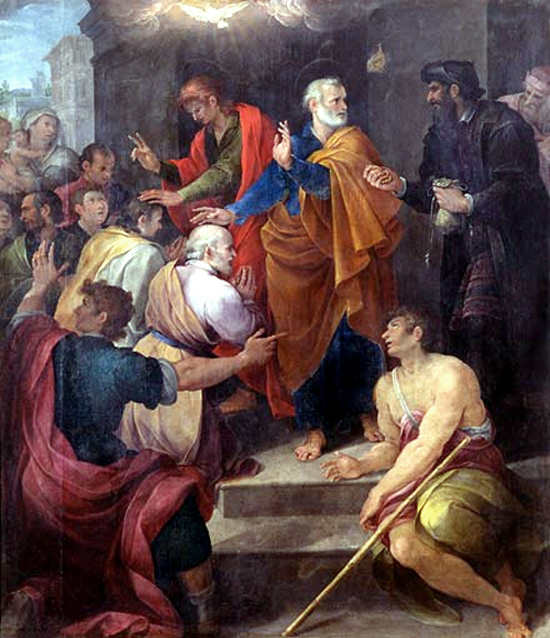
God work many miracles through Philip, which grabbed the attention of many Samaritans. Luke indicates “the crowds with one accord paid attention to what was being said by Philip, when they heard him and saw the signs that he did” (Acts 8:6). The evangelist exorcised “unclean spirits” from many and the demons came out “crying with a loud voice.” Moreover, the disciple healed those “who were paralyzed or lame” (Acts 8:7). Their afflictions were both spiritual and pathological. Such are the sufferings of life in this sinful and fallen world, which came as the result of Adam’s transgression. But Philip the evangelists brought the good news of Jesus Christ who came to set free the captives. This resulted in “much joy in that city” (Acts 8:8).
Now Simon the magician “practiced magic in the city and amazed the people of Samaria,” and boasted about himself as being “somebody great” (Acts 8:9). The Samaritans “all paid attention to him,” and the “least to the greatest” of them would say, “This man is the power of God that is called Great” (Acts 8:10). Simon “amazed them with his magic” for a long time (Acts 8:11).
On account of his dealings with magic, the man came to be known as Simon Magus. The name “Magus” comes from the Latin word magus meaning “magician,” “sorcerer,” or “practitioner of magic.”[3] The New Bible Dictionary indicates, “magic and sorcery attempt to influence people and events by supernatural or occult means.”[4] Using supernatural powers to manipulate circumstances and/or attain favorable outcomes involved various occult techniques such as incantations, spells, potions, astrology, divination, and necromancy. The Scriptures strongly condemned such practices (Deuteronomy 18:9-14; Leviticus 19:26, 31; Isaiah 47:13; 1 Chronicles 10:13; cf. 1 Samuel 28:3-20). Simon practiced magic among the Samaritans, though the particular occult techniques he used go unmentioned in the Acts of the Apostles.
Many Samaritans “believed Philip as he preached good news about the kingdom of God and the name of Jesus Christ, they were baptized, both men and women” (Acts 8:12). Simon Magus even “believed,” was “baptized,” and remained “amazed” having witnessed the “signs and great miracles performed” (Acts 8:13). This initial glimpse of Simon’s conversion appears genuine, yet the events that follow expose a troubling side to the man, which raise questions about the nature of his belief and understanding of the work of the Holy Spirit.
Simon Magus and Buying the Power to Confer the Holy Spirit
When news reached Jerusalem about Samaria receiving the word of God, the apostles sent Peter and John to “pray for them that they might receive the Holy Spirit” (Acts 8:14–15). Luke explains that the Holy Spirit “had not yet fallen on any of them” and that they “had only been baptized in the name of the Lord Jesus” (Acts 8:16). Peter and John “laid their hands on” the Samaritan converts, “and they received the Holy Spirit” (Acts 8:17). This affirmed Samaritan inclusion in the community of believers and provided apostolic confirmation of Philip’s ministry of evangelism and baptism.
Witnessing converts receiving the Holy Spirit through the laying on of hands of the apostles Peter and John prompted Simon to “offer them money” with the request: “Give me this power also, so that anyone on whom I lay my hands may receive the Holy Spirit” (Acts 8:19).
The ex-sorcerer misunderstood the true meaning of behind the appointment of the apostles, the practice of laying on of hands, and the receiving of the gift of the Holy Spirit. Simon sought to buy for himself “a priesthood subordinate to that of the apostles,” a practice “not uncommon in the ancient world, even in Israel,” but one that “reflects the typically idolatrous and pagan understanding of the way to acquire supernatural power that one would then control.”[5] The Shepherd of Hermes pointed out “the false prophet ‘accepts rewards for his prophecy, and if he does not receive them he does not prophesy,’” thus “If Simon is willing to pay money for the use of the Spirit, clearly he will later accept payment when he employs its power.”[6] But the request was rejected.
Peter replies with a fourfold rebuke. First, Simon is subjected to a severe pronouncement of judgment: “May your silver perish with you, because you thought you could obtain the gift of God with money!” (Acts 8:20).
The Holy Spirit is a gift (Acts 2:38; 10:45) and not a commodity that can be bought and sold for a profit. Neither could Simon purchase the authority given to the apostles. Jesus Christ appointed the apostles from among His followers who were present from the time of John the Baptist to the witnessing of the resurrection, and the selection of Matthias to replace Judas was neither purchased or acquired through personal ambition (Acts 1:21-26; cf. Luke 6:13-16).
Whereas there is a connection between the laying on of hands and the reception of the Holy Spirit in Acts 8, the apostles themselves were not manipulating the Spirit. The apostles were instruments through whom God accomplishes His purposes in the distribution of the Spirit.[7] Rather, the sending of the Holy Spirit is according to God’s will. Christ ascended to the Father, asked the Father to send the Spirit, and the Father sends the Spirit whom indwells believers (John 14:15-17, 26; 15:26; 16:7-15).
Second, Simon is condemned: “You have neither part nor lot in this matter, for your heart is not right before God” (Acts 8:21). The “lot in this matter” may be the apostolic ministry of laying on of hands which would be accompanied by the reception of the Spirit or perhaps salvation itself. Simon in mind and heart was not right with God.
Third, Simon is instructed to “Repent, therefore, of this wickedness of yours, and pray to the Lord that, if possible, the intent of your heart may be forgiven you” (Acts 8:22). Simon was not instantly damned; rather, he was called to get right with God by turning from his error and praying for forgiveness. When coming to the knowledge of having committed sin, the appropriate response is confession and receiving forgiveness (1 John 1:9).
Fourth, Simon is made fully aware of the seriousness of his error: “For I see that you are in the gall of bitterness and in the bond of iniquity” (Acts 8:23). The sinful condition of Simon’s heart is likened to gall or bile, which has a bitter taste, the kind of bitter taste associated with poison. The sinful condition is also likened to being bound or fettered in unrighteousness. The effect of sin is likened to an illness brought about by bitter poison or being shackled as divine lawbreaker.
On Simony: The Christian term “simony” is derivative of Simon Magus, which “denotes the purchase or sale of spiritual things.” The Council of Chalcedon (AD 451) “condemned ordination for money.” Other general councils in the West also condemned simony, specifically the Third Lateran Council (1179) and the Council of Trent (1545-1563). Gregory the Great (c. 540-604) and Thomas Aquinas (d. 1274) openly denounced simony.[8] Christians of all stripes are right to condemn simony in the form of charging mandatory fees for baptisms, prayers, or ministerial appointments. However, this would not necessarily preclude voluntary giving cheerfully to support ministries (1 Corinthians 9:7) nor salaries for ministers (1 Corinthians 9:14).
Did Simon Magus Repent?
Simon answered, “Pray for me to the Lord, that nothing of what you have said may come upon me” (Acts 8:24). This response of asking the apostles to pray on his response has been interpreted by New Testament scholars in disparate ways. For instance, Eckhard J. Schnabel indicates, “Simon’s reaction to Peter’s indictment indicates that he repented. His plea that Peter should pray for him is best understood as showing remorse. The fact that he does not pray himself may indicate that he has come to the realization that his former way of handling supernatural power is no longer adequate, perhaps afraid that what he might say to the Lord would again be manipulative, perhaps in terms of defensive magic against misfortune and calamity.”[9] On the other hand, William Larkin expresses skepticism, “It is uncertain whether Simon’s request for the apostles’ intercession is a sign of true repentance. Is he sensing the seriousness of the sin and asking the apostles to join in intercession? In humility does he feel so incapable of praying or so distrustful of his own prayers that he must ask for the intercession of others? Or do the content of his request — to be spared the consequences of his sin — and the very fact that he asks others to intercede indicate that here is remorse and not true repentance…?”[10] Mikeal C. Parsons likewise adopts a skeptical assessment, observing that “Luke leaves no real trace that this ‘idolater’ and ‘evil-doer,’ Simon, has repented or been forgiven.” Parsons cites Susan R. Garrett’s characterization of Simon as “a cornered criminal, frightened at the prospect of punishment although not obviously remorseful over his crimes.”[11]
The portrait of Simon Magus as one with a feigned profession of faith is increasingly pronounced in early Christian traditions conveyed in the writings of early church fathers, such as Justin Martyr, Irenaeus, and Hippolytus, as well as in noncanonical works such as the Clementina. Moreover, these post New Testament writings portray Simon Magus as an archrival to the apostles, a development that will be explored in the next post.
— WGN
[1] All Scripture cited from The Holy Bible: English Standard Version (Wheaton, IL: Crossway, 2025), unless noted.
[2] There is strong ancient manuscript witnesses indicating in Acts 8:5 that Philip went to tēn polin tēs Samareias [τὴν πόλιν τῆς Σαμαρείας], meaning “the city of Samaria.” But since the New Testament Samaria denotes a district as opposed to a city, the translation would be “the [main] city of Samaria” On the other hand, a vast majority of later manuscripts omit the article, indicating the apostle went to polin tēs Samareias, meaning “a city of Samaria.” Textual critic Bruce Metzger indicates The Committee had difficulty deciding which variant to place in the text, and” was of the opinion that the external evidence supporting the article (𝔓74 א A B 69 181 460* 1175 1898) was so strong that the word ought not be omitted from the text altogether. Yet because internal considerations favor the absence of the article, it was considered best to enclose it within square brackets” (Bruce Manning Metzger, United Bible Societies, A Textual Commentary on the Greek New Testament, Second Edition a Companion Volume to the United Bible Societies’ Greek New Testament 4th Rev. Ed. [London; New York: United Bible Societies, 1994], 311).
[3] Magus is derived from the Greek magos (μάγος).
[4] J.S. Wright, “Magic and Sorcery,” in New Bible Dictionary, ed. D. R. W. Wood et al. (Downers Grove, IL: InterVarsity Press, 1996), 713.
[5] William J. Larkin, Acts: The IVP New Testament Commentary Series, ed. Grant R. Osborne, et al. (Downers Grove, IL: InterVarsity Press, 1995), 129.
[6] Mikeal C. Parsons, Acts, Paideia Commentaries on The New Testament (Grand Rapids, MI: Baker Academic, 2008), 117.
[7] The laying on of hands — a gesture of blessing and affirmation — coincided with the filling of the Holy Spirit in Acts 8, but such never established the Spirit could only be conveyed upon the laying on of hands. Acts 10:44-48 indicates otherwise. No universal temporal sequence between baptism and receiving the Holy Spirit is being set by Luke.
[8] F.L. Cross and E.A. Livingston, eds, The Oxford Dictionary of the Christian Church, second edition (New York: Oxford University Press, 1958, 1974, 1983).1278. The Council of Chalcedon is recognized as the Fourth Ecumenical Council by Roman Catholics, Eastern Orthodox, and the majority of Protestant traditions (Lutheran, Reformed, Anglican, etc.). Whereas the Third Lateran Council and the Council of Trent are authoritative general councils of the Western (Latin/Roman Catholic) Church, and are recognized as Ecumenical within Roman Catholicism, but neither Eastern Orthodoxy nor Protestants regard them as Ecumenical councils in the undivided Church.
[9] Eckhard J. Schnabel, Acts: Zondervan Exegetical Commentary on the New Testament (Grand Rapids, MI: Zondervan, 2012), 415.
[10] Larkin, 130
[11] Parsons, 118.


