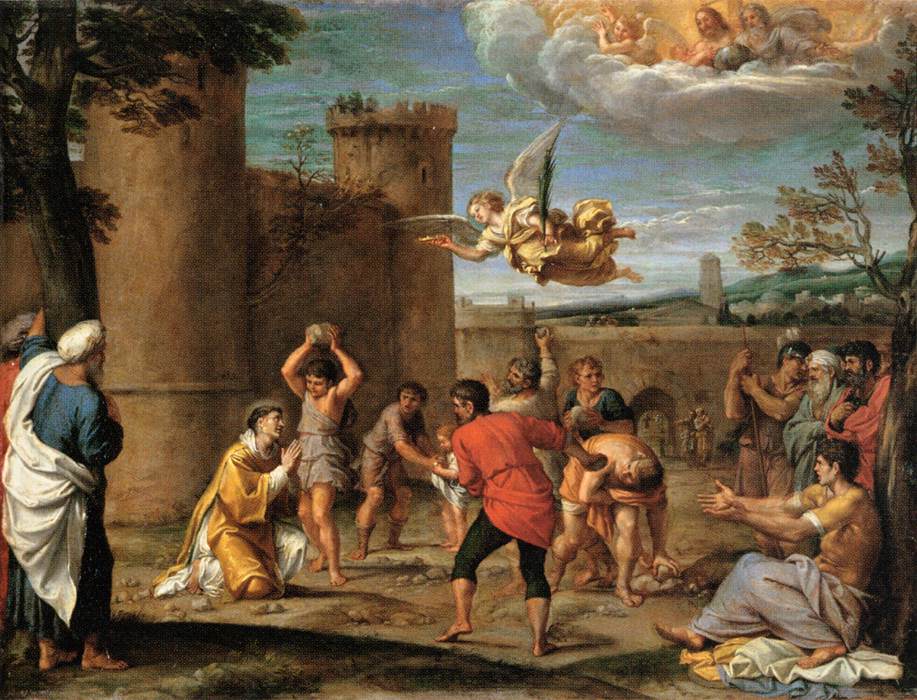
Stephen is remembered as the first named among the seven servants chosen to administer the daily distribution to the widows (Acts 6:5). Full of God’s grace and power, he performed great wonders and signs among the people. But certain opponents of Christ had him arrested. He stood trial before the Sanhedrin charged with speaking against God, Moses, and the temple (Acts 6:8-15).
While testifying in his own defenses,[1] Stephen openly indicts the Sanhedrin as those truly guilty of rejecting God and murdering the prophets. The judges became enraged, took the disciple outside the city, and stoned him to death. The disciple took his last breath praying that the Lord would not hold this sin against them. Stephen thus entered glory as the first Christian martyr (Acts 7:51-60). His martyrdom initiated the first great persecution of the church (Acts 8:1-3).
This post will take a deeper dive into Stephen’s indictment against the unbelieving Sanhedrin, the disciples dying prayer that the Lord would not hold the sin of his wrongful execution against the executioners, and the influence his martyrdom had on the expansion of the church to the ends of the earth.
Stephen’s Condemnation of the Unbelieving Sanhedrin:
Stephen pronounced in the Jewish high court this indictment explicitly against the Sanhedrin and implicitly to all those who stood opposed to Christ Jesus of Nazareth: “You stiff-necked people, uncircumcised in heart and ears, you always resist the Holy Spirit. As your fathers did, so do you. Which of the prophets did your fathers not persecute? And they killed those who announced beforehand the coming of the Righteous One, whom you have now betrayed and murdered, you who received the law as delivered by angels and did not keep it” (Acts 7:51-53).[2]
The indictment against the Sanhedrin is fourfold. First, they are called “stiff-necked people” To be “stiff-necked” is to be stubborn—a description Yahweh used of Israel’s forefathers when they turned to idolatry and worshiped the golden calf (Exod. 32:9; 33:3, 5).
Second, they are called “uncircumcised in heart and ears.” Circumcision was the sign of the covenant Yahweh made with Abraham. Circumcision of the heart, however, pointed to an inner transformation marked by reverence, love, and obedience to God—the reality that gave meaning to the outward physical sign (Deut. 10:16; 30:6). Uncircumcised hearts signified alienation from God and separation from his covenant. Stephen calls out those in the court who persisted in unbelief of being “disobedient to Israel’s covenant God who fulfills his promises in the coming of Jesus, the Righteous One. In contrast to Abraham, who was obedient to God’s revelation (vv. 2–8) and who received the covenant of circumcision (v. 8), the Jewish leaders have repudiated God’s new revelation” and that “they have failed to truly hear and accept the word of God, whose promise of the coming Redeemer and Prophet like Moses (cf. vv. 35, 37) has been fulfilled in Jesus (v. 52).”[3]
Third, they “always resist the Holy Spirit.” Despite witnessing—or receiving credible reports of—Jesus’ miraculous works, his resurrection on the third day, and his sending of the Holy Spirit to the Twelve Apostles and other followers, who were themselves empowered to perform signs and wonders, the members of the court remained steadfast in their unbelief.
Lastly, their lives exemplified the ways of their apostate Israelite forefathers — “As your fathers did, so do you.” Moreover, Stephen exclaims, “Which of the prophets did your fathers not persecute? And they killed those who announced beforehand the coming of the Righteous One, whom you have now betrayed and murdered, you who received the law as delivered by angels and did not keep it” (Acts 7:52–53).[4] Far from serving as faithful guardians of the Law, they had rejected and murdered the Christ foretold by Moses and the prophets. Moreover, they sought to censure the Lord’s followers from proclaiming the good news of Jesus, and they even ordered the apostles to be beaten. In doing so, they demonstrated their complete continuity with the ways of their stiff-necked, apostate forefathers.
Jesus Christ Stands Up for Stephen
The Sanhedrin grew enraged and ground their teeth as they listened to the disciple (Acts 7:54). Stephen being “full of the Holy Spirit” looked upward and beheld “the glory of God and Jesus standing at the right hand of God” (Acts 7:55). While still inside the courtroom, the Spirit opened up the disciple’s eyes to perceive invisible heavenly realities![5]
“Behold, I see the heavens opened, and the Son of Man standing at the right hand of God,” declared Stephen (Acts 7:56). This imagery recalls the exalted Son of Man from Daniel 7:13–14, to whom was given everlasting dominion, glory, and a kingdom that shall never pass away. Jesus repeatedly self-identified as the Son of Man. Even before the Sanhedrin, He testified that they would see the Son of Man seated at the right hand of God (Matthew 26:64; Mark 14:62; Luke 22:69). In response, the Sanhedrin charged Him with blasphemy and delivered Him up to be crucified, but Christ was vindicated through His resurrection and exaltation into glory. But the fact that Jesus is witnessed standing at the right hand of the Father is significant.
Jesus in carrying out His role as the Son of Man indicated that He would suffer many things, be rejected by the elders, chief priest, and scribes, and they would kill Him, but that He would resurrect on the third day (Luke. 9:22). His own suffering and death established the pattern for His followers who endure persecution and martyrdom. Moreover, the Son of Man will acknowledge and vindicate in God’s presence those who are not ashamed of Him but openly confess their allegiance before others (Luke 12:8). Thus, Jesus stands at God’s right hand as Stephen’s advocate, pleading his cause and welcoming the dying man into His presence. As Christ was raised from the dead so will His followers.[6]
The Martyrdom of Stephen
Stephen’s words only further enraged his opponents. Refusing to hear any more, the members of the Sanhedrin cried out, covered their ears, and rushed at him in unison (Acts 7:57). They dragged him outside the city and began stoning him (Acts 7:58a). According to the Mosaic Law, blasphemers were to be taken outside the camp for execution (Leviticus 24:14–16; Deuteronomy 13:6–11).
Although the Sanhedrin exercised judicial authority over Jewish civil and criminal matters, Roman rule restricted its authority to carry out capital sentences, which required the procurator’s approval. Stephen’s execution, however, bears the features of an illegal mob action.[7] No Roman procurator’s judgment is recorded.
The executioners laid their garments at the feet of a young man named Saul of Tarsus (Acts 7:58b). This is the first mention of the soon to be Apostle to the Gentiles.
As the casting of stones commenced, Stephen prayed, “Lord Jesus, receive my spirit,” then he kneeled and cried out, “Lord, do not hold this sin against them.” Having said this, he fell asleep (Acts 7:59–60). These prayers strikingly parallel the words of Jesus on the cross: “Father, forgive them, for they know not what they do,” and, “Father, into your hands I commit my spirit!” (Luke 23:34, 46). In his final moments, Stephen reflected the character of his crucified and risen Lord, praying that God would extend grace and mercy to those who so fiercely opposed the good news.
The First Persecution
Stephen’s execution marked the beginning of the first great persecution of the church in Jerusalem. Many believers were scattered throughout the regions of Judea and Samaria, while the apostles remained in Jerusalem (Acts 8:1b). The persecution thus became an occasion for the first Christians to carry the gospel outside of Jerusalem to the ends of the earth, as the Lord intended for them to be His “witnesses in Jerusalem and in all Judea and Samaria, and to the end of the earth” (Acts 1:8; cf. Matthew 28:19).
Devout Christian men later buried Stephen and mourned deeply for him (Acts 8:2). It would have been a great dishonor to leave the dead unburied in the ancient Mediterranean world, but risking life to bury the dead would be honorable and heroic, and while mourning a criminal was prohibited, “Stephen’s pious friends ignore the illegal ruling of the highest Jewish court to honor their friend.”[8]
Stephen’s martyrdom also introduces readers to Saul of Tarsus, who approved of the disciple’s execution, and began ravaging the church. He went from house to house, dragging off both men and women and committing them to prison (Acts 8:1a, 3). Yet, as Luke will later reveal, God extended grace even to Saul, transforming this fierce persecutor into the apostle to the Gentiles. In this way, God answered Stephen’s final prayer that his enemies might receive mercy rather than judgment.
While at the moment of the first martyrdom and persecution of the church it appeared as if the kingdom of darkness had scored a victory, the flame of the lamp lit by the risen Lord and Savior could not be easily extinguished. The twelve apostles still remained in Jerusalem and many other Christians continued on in regions throughout Judah and Samaria. There would even be more to the story of Saul of Tarsus, the enemy persecutor of God’s people, than anyone could tell when the first persecution initiated. God still could do wonders even within the midst of our darkest moments.
Conclusion
Stephen was a disciple who exemplified faith, grace, power, and fulness of the Holy Spirit Christ in life and death. He knew the Scriptures, and eloquently expressed Israel’s sacred history, highlighting primary examples of faithfulness to God from the lives of Abraham, Joseph, Moses, and Solomon and cautioning of the perils of certain patriarchs who stood opposed to God and His people and perished as idolators, worshippers of the golden calf, and other manmade gods.
Stephen models what it means to speak the truth in love, confronting his fellow countrymen who had lost their way with uncompromising honesty. Many in first-century Israel professed allegiance to the Law of Moses, yet when the long-awaited Prophet like Moses arrived, they rejected Him. They put the Son of God to death, but He rose again on the third day. Even then, many persisted in unbelief and opposed those who proclaimed the risen Christ. The disciple confronted his rivals neither out of spite nor vengeance, but to call them to repentance. Even as they stoned him, he prayed for their forgiveness (Acts 7:60).
Christians today should likewise speak boldly about touchy matters like sexual immorality, the sanctity of human life, and salvation through Christ alone, refusing to compromise biblical truth for the sake of political correctness or popular approval. Yet, as Stephen exemplified, our candor must be tempered by grace, our convictions expressed in love, and our witness sustained by a willingness to remain faithful whatever the cost.
Stephen also extended mercy to those who openly opposed Christ, praying that God would forgive his persecutors even as they stoned him to death. His example stands in stark contrast to a public square increasingly marked by incivility, contempt, and the acerbic vitriol of cancel culture. Christians, too, are often slandered and maligned for their convictions. Yet Christ calls His followers to turn the other cheek, love their enemies, and pray for those who persecute them (Matthew 5:39, 43–44; cf. Romans 12:20–21; 1 Peter 3:9). Rather than retaliating in kind, we are called to overcome evil with good, extending grace even to those who oppose us and entrusting ourselves to the righteous judgment of God.
The martyrdom of Stephen triggered a wave of persecution that scattered many Christians from Jerusalem, yet this very displacement helped open the way for the gospel to spread beyond the city and eventually to the ends of the earth. The familiar adage that “when one door closes, another opens” captures something of this providential turn, reminding us not to fixate on lost opportunities at the expense of recognizing new ones the Lord opens. One closed door is never the end; God can even use adversity to advance His plan and purpose. Bede the Venerable reminds Christians: “This is what the Lord himself commanded: ‘When they persecute you in one city, flee to another.’ It occurred according to the Lord’s will, ‘so that the occasion of tribulation might become the seedbed of the gospel’” (Commentary on the Acts of the Apostles 8.1). [9] What appeared to be a setback for the early church became an occasion for the gospel to take root in new places.
— WGN
[1] The disciple began his defense with a retelling of Israel’s sacred history, highlighting the lives of Abraham, Joseph, and Moses. He identifies Jesus as the prophet Moses foretold would come and explains the proper place of true worship in the tabernacle and temple. Throughout his testimony, the disciple points out Israel’s history of idolatry and rebellion, showing the tribunal that their forefathers repeatedly opposed God and resisted Moses (Acts 7:2–50)
[2] All Scripture cited from The Holy Bible: English Standard Version (Wheaton, IL: Crossway Bibles, 2025), unless noted.
[3] Eckhard J. Schnabel, Acts, Expanded Digital Edition, Zondervan Exegetical Commentary on the New Testament (Grand Rapids, MI: Zondervan, 2012), 387.
[4] Note that Jesus Christ prophesied similarly against the religious leaders: ”Woe to you, scribes and Pharisees, hypocrites! For you build the tombs of the prophets and decorate the monuments of the righteous, saying, ‘If we had lived in the days of our fathers, we would not have taken part with them in shedding the blood of the prophets.’ Thus you witness against yourselves that you are sons of those who murdered the prophets. Fill up, then, the measure of your fathers. You serpents, you brood of vipers, how are you to escape being sentenced to hell? Therefore I send you prophets and wise men and scribes, some of whom you will kill and crucify, and some you will flog in your synagogues and persecute from town to town, so that on you may come all the righteous blood shed on earth, from the blood of righteous Abel to the blood of Zechariah the son of Barachiah, whom you murdered between the sanctuary and the altar. Truly, I say to you, all these things will come upon this generation” (Matthew 23:29-36).
[5] This does not mean that heaven is a physical realm visible from a particular vantage point on earth. Heaven is an unseen reality. Rather, while still inside the courtroom, the Stephen’s eyes were enabled by God to view heaven as though it were in physical proximity above (Simon J. Kistemaker and William Hendriksen, Exposition of the Acts of the Apostles, vol. 17, New Testament Commentary [Grand Rapids: Baker Book House, 1953–2001], 279).
[6] I Howard Marshall, Acts: Tyndale New Testament Commentaries, vol. 5 (Grand Rapids, MI: William B. Eerdmans Publishing Company, 1996), 149.
[7] J. A. Thompson, “Sanhedrin,” in New Bible Dictionary, ed. D. R. W. Wood et al. (Downers Grove, IL: InterVarsity Press, 1996), 1060–61.
[8] Craig S. Keener, The IVP Bible Background Commentary: New Testament (Downers Grove, IL: InterVarsity Press, 1993), Ac 8:2.
[9] Francis Martin and Evan Smith, eds., Acts, Ancient Christian Commentary on Scripture (Downers Grove, IL: InterVarsity Press, 2006), 89.


